
Your Hyundai Elantra’s dashboard lights illuminate, the headlights work, and the radio may even play, yet the engine refuses to start. This can happen because the battery has enough power for small electrical components but cannot supply the current needed to turn the engine over. A faulty starter, loose battery connection, or starting system fault can produce similar symptoms.
The best approach is to identify what happens when you attempt to start the car. That simple distinction helps you narrow down the likely fault before spending money on replacement parts.
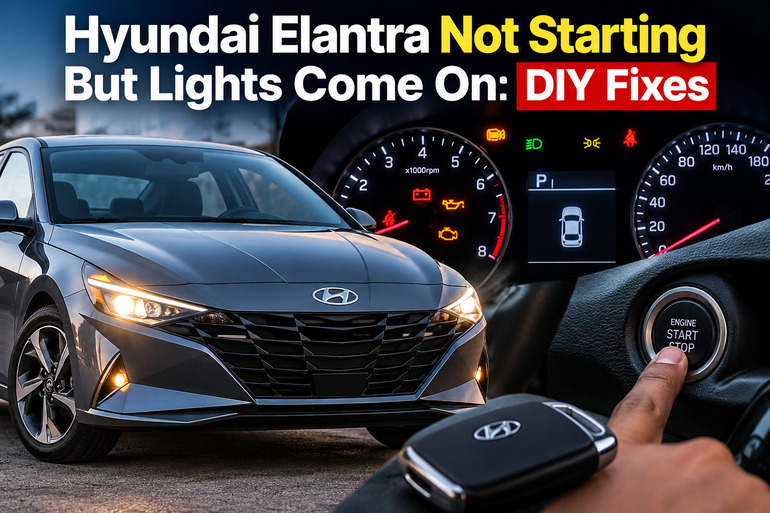
What It Means When Your Hyundai Elantra Has Power but Won’t Start
Your Hyundai Elantra uses its 12-volt battery to power electrical accessories and operate the starting system. When you turn the ignition key or press the Start button, the battery must supply a large amount of current to the starter motor. The starter then rotates the engine until combustion can begin.
Dashboard lights require much less power than the starter motor. Consequently, working lights don’t prove that your battery is healthy. A weak battery can illuminate the dashboard normally but lose voltage when you attempt to start the engine. Hyundai’s owner manual troubleshooting guidance advises checking battery connections and observing whether the interior light dims when the starter operates.
Pay attention to the sound your Elantra makes. Rapid clicking often points to inadequate battery power or a poor electrical connection. A single click can indicate a starter solenoid or motor problem, although the battery and cables can produce similar symptoms. Complete silence may indicate a starting circuit fault, a safety interlock, or a key recognition problem.
There is another important distinction. If the engine turns over at its normal speed but never starts running, the battery and starter may be functioning. The fault could instead involve fuel delivery, ignition, or an engine management component. Identifying which of these situations applies will help you choose an appropriate fix.
Hyundai Elantra Not Starting But Lights Come On: Likely Causes
Several faults can leave your Elantra’s electrical accessories working while the engine remains off. The following are five common possibilities, along with clues that can help you distinguish between them.
1. A Weak or Discharged Battery
A weak battery is one of the first things to investigate. Although your dashboard lights, interior lights, and radio may continue working, the battery might lack the current required to operate the starter motor.
Batteries lose capacity as they age. Leaving the headlights on, keeping accessories running with the engine off, or repeatedly taking short trips can contribute to a low charge. An alternator that fails to recharge the battery properly can also leave the car unable to start after the vehicle has been driven.
The symptoms vary with the remaining charge. You might hear several rapid clicks, notice the dashboard lights dim significantly, or hear the engine turn over slowly. Sometimes there is no obvious warning before the battery fails.
A battery can also become internally damaged and fail to deliver sufficient power even after charging. A battery test under load is more informative than checking whether the headlights come on.
2. Loose or Corroded Battery Connections
Your Elantra’s battery must have clean, secure connections to deliver electrical power. If a terminal is loose or covered in corrosion, resistance increases and the starter may not receive sufficient current.
Corrosion often appears as a white, bluish, or greenish deposit around a battery terminal. A loose connection may also cause intermittent electrical problems, flickering lights, or clicking when you attempt to start the vehicle. However, corrosion isn’t always visible, and a cable can develop internal damage that is difficult to recognize from the outside.
The battery’s ground connection also matters. The negative cable connects the battery to the vehicle’s electrical system and engine ground. A damaged or loose ground connection can prevent the starter from operating even when the battery itself is adequately charged.
These connection problems can resemble a failed starter motor. Replacing the starter without checking the battery cables and ground connections may therefore waste money.
3. A Faulty Starter Motor, Solenoid, or Starting Relay
The starter motor rotates the engine during startup. A solenoid, which acts as an electrical switch and moves the starter’s drive mechanism into position, helps connect the motor to the battery’s power supply.
When a starter motor wears out, it may stop working intermittently before failing completely. You may hear one solid click when you turn the key, but the engine doesn’t turn over. In other cases, the starter makes no sound because it isn’t receiving the necessary electrical signal.
A faulty starter relay or ignition switch can create similar symptoms. The relay controls power to the starter circuit, while the ignition switch or Start button initiates the starting request. A problem with wiring or an electrical connection can also interrupt this process.
A grinding sound during startup deserves particular attention. It may indicate that the starter gear isn’t engaging properly with the engine’s flywheel. Stop attempting to start the vehicle if grinding continues, because repeated attempts could cause additional damage.
4. A Gear Selector, Brake Switch, or Clutch Safety Interlock Problem
Your Elantra has safety features that prevent the engine from starting under certain conditions. On an automatic transmission model, the system generally requires the gear selector to be in Park or Neutral. A transmission range sensor or related switch can prevent the starting system from recognizing that the selector is in the correct position.
A manual transmission model may use a clutch safety switch that requires the clutch pedal to be fully depressed before the engine can start. If the switch fails or the pedal isn’t pressed far enough, the starter may not operate.
Some Elantra models with a push-button ignition also require the brake pedal to be recognized as depressed. A faulty brake light switch, a related fuse problem, or a key recognition fault can prevent a normal start. Certain smart-key models may display a warning such as a key detection message or a request to check the brake switch fuse.
These faults don’t necessarily mean the battery is dead. The dashboard can remain fully illuminated because electrical power is available even though the vehicle’s safety system has not authorized the starting process.
5. A Key Recognition, Fuel Delivery, or Ignition Fault
Modern Hyundai Elantra models may use an immobilizer or smart-key system to help prevent unauthorized starting. If the vehicle can’t recognize the key, the engine may refuse to start. A weak key-fob battery, an interfering electronic device, or a fault in the recognition system can contribute to this problem.
The symptoms depend on the model. A dashboard warning may report that the key isn’t detected, while an immobilizer indicator may flash. A conventional key may also have a damaged transponder that the vehicle can no longer recognize correctly.
Fuel delivery and ignition faults are another possibility when the engine turns over normally but won’t run. The fuel pump, its electrical supply, an ignition coil, or a crankshaft position sensor may prevent the engine from starting. In this situation, working lights are expected because the electrical system can still power accessories while the engine remains unable to run.
These faults usually require further testing. Replacing a key fob, fuel pump, or ignition component without confirming the cause can become an expensive exercise in guesswork.
Hyundai Elantra Not Starting But Lights Come On: How to Fix
Start with the checks that are simple and safe before moving on to more involved repairs. The following steps can help you identify a likely cause and determine whether the car can be restarted without professional assistance.
1. Identify Whether the Engine Cranks
Begin by sitting in the driver’s seat with the parking brake applied and the transmission in Park, where applicable. Turn the ignition key or press the Start button according to your owner’s manual.
Listen carefully to what happens.
-
Rapid clicking: The battery may be weak, or an electrical connection may have excessive resistance.
-
One click: A starter solenoid, starter motor, battery, or cable fault is possible.
-
Complete silence: Investigate the starting controls, key recognition, safety interlocks, and starting circuit.
-
Slow engine cranking: The battery may be discharged, or the cables or starter may have a problem.
-
Normal cranking without the engine starting: Investigate fuel delivery, ignition, or engine management rather than assuming the starter is faulty.
Avoid repeatedly holding the key in the start position or pressing the Start button over and over. Continuous cranking can overheat the starter and place additional strain on the battery. If the engine doesn’t start after a few brief attempts, pause and investigate.
This first check helps you choose the next step rather than replacing parts based on symptoms alone.
2. Check the Gear Selector, Pedals, and Key Fob
A starting problem can sometimes be resolved by correcting the conditions required for the engine to start.
For an automatic Elantra, confirm that the gear selector is fully in Park. Apply the brake pedal and make another start attempt. If the car remains unresponsive, apply the parking brake firmly and try starting in Neutral, provided your owner’s manual permits this procedure for your model. Do not attempt this with the vehicle in motion.
For a manual transmission, depress the clutch pedal fully before attempting to start the engine. Remove any floor mat or object that could prevent the pedal from reaching its normal travel.
If you have a push-button model and the dashboard displays a key recognition warning, move the key fob away from other electronic devices and try again. If available, use your spare programmed key to determine whether the original fob is responsible. Some Hyundai models provide an emergency procedure for starting when the smart-key battery is weak. Follow the procedure specified in your model’s owner’s manual.
If the warning persists or the engine still doesn’t respond, the problem may involve a switch, sensor, fuse, or immobilizer that needs testing.
3. Inspect the Battery and Its Connections
Switch off the ignition and all electrical accessories before opening the hood. Keep your hands away from moving components, and do not touch exposed electrical connections unnecessarily.
Look at the battery for loose terminals, heavy corrosion, damaged cables, or a cracked or swollen case. If the battery is swollen, leaking, unusually hot, or gives off a strong sulfur-like odor, do not attempt a jump-start. Seek professional assistance.
The battery terminals should be secure, and the cables should not be visibly frayed or damaged. Avoid touching both battery terminals with a metal tool or allowing a tool to bridge a terminal and the vehicle body.
If the connections appear sound but the car still won’t start, have the battery tested. A multimeter can provide an initial voltage reading, but a battery may show reasonable resting voltage and still fail under the heavy load required for starting.
Cleaning or tightening battery connections may help when corrosion or looseness is responsible. However, disconnecting battery terminals incorrectly can create electrical risks, reset vehicle settings, or cause other complications. Follow the exact battery service procedure for your Elantra, or have a technician carry out the work if you aren’t familiar with it.
4. Try a Jump-Start When the Battery Is Weak
If the battery appears discharged and shows no signs of physical damage, a jump-start may get the engine running. You will need an appropriate booster pack or a compatible donor vehicle and suitable jumper cables.
Before connecting anything, consult the owner’s manual for your specific Elantra year and powertrain. The correct jump-start terminals, cable sequence, and precautions can vary by model. Use only a compatible 12-volt starting source and follow the manufacturer’s instructions exactly.
Keep the vehicles from touching each other, turn off unnecessary electrical accessories, and keep cable clamps away from one another. Never reverse the positive and negative connections. Avoid flames and sparks near a battery, and stay clear of belts, fans, and other moving components.
Do not jump-start a battery that is frozen, cracked, swollen, or leaking. If you are uncertain about the connection points or procedure, roadside assistance is the safer choice.
If your Elantra starts after a jump, the underlying problem may be a discharged or failing battery, a charging system fault, or an electrical drain. Have the battery and charging system tested rather than assuming the problem has been solved permanently. If the car does not start after a correctly performed jump-start, stop and arrange further diagnosis.
5. Check the Fuel Level and Relevant Warning Messages
If the engine cranks at a normal speed but doesn’t start, verify that the fuel tank contains enough fuel. A faulty fuel gauge can be misleading, so consider whether the vehicle has been driven for a substantial distance since the last refueling.
Look for messages on the instrument cluster. A key-not-detected warning, brake-switch message, immobilizer indicator, or other startup warning may direct you toward a specific system. Consult the relevant section of your owner’s manual before attempting any reset or fuse replacement.
You can also check the fuse box for a fuse identified in the manual as belonging to the starting, ignition, or fuel system. Only perform a visual inspection if you can safely identify the correct fuse. Replace a blown fuse only with one of the specified type and amperage. If the replacement blows again, there may be an electrical fault that needs professional diagnosis.
Avoid tapping the starter repeatedly, bypassing safety switches, or replacing the fuel pump because you suspect it has failed. These approaches can cause damage or mask the underlying fault. If the engine cranks normally but still refuses to fire, a technician can test fuel pressure, ignition operation, sensor signals, and fault codes to narrow down the cause.
Final Solution: Contact a Qualified Automotive Technician
Professional diagnosis is appropriate when the basic checks don’t resolve the problem, the fault returns after a jump-start, or the symptoms point to a failed starter or an electrical control system. A technician can perform a battery load test, check voltage drop across the cables, verify the starter signal, and scan the vehicle’s control modules for stored fault codes.
Seek assistance immediately if you smell burning insulation, see smoke, hear persistent grinding, or discover a damaged battery. Do not continue trying to start the vehicle under these conditions.
An accurate diagnosis also helps prevent unnecessary parts replacement. For example, a starter that appears faulty may actually be receiving insufficient current from a weak battery or damaged ground connection. Testing the relevant components before replacing them is the most reliable way to identify the repair your Elantra needs.
Wrap-Up
A Hyundai Elantra that has working lights but won’t start may have a weak battery, poor battery connections, a faulty starter, an interlock problem, or a fault involving key recognition, fuel delivery, or ignition. The most useful first step is to determine whether the engine stays silent, clicks, cranks slowly, or turns over normally without starting.
Start with the checks that match those symptoms, and use your model’s owner’s manual for vehicle-specific procedures. A successful jump-start or corrected gear position may resolve a simple starting problem. Persistent faults require proper testing before parts are replaced. Taking that approach can save money and reduce the risk of damaging the vehicle while troubleshooting.