
Your Kia refusing to shift into Park can be frustrating, especially when you’re ready to turn off the engine and leave the vehicle. Sometimes, the gear lever won’t move into position. Other times, it moves normally, but the dashboard still shows Drive, Reverse, or Neutral.
Either situation deserves attention because your vehicle may roll unexpectedly if Park isn’t properly engaged. Fortunately, several possible causes are relatively straightforward to identify, and understanding the symptoms can help you determine the safest solution.
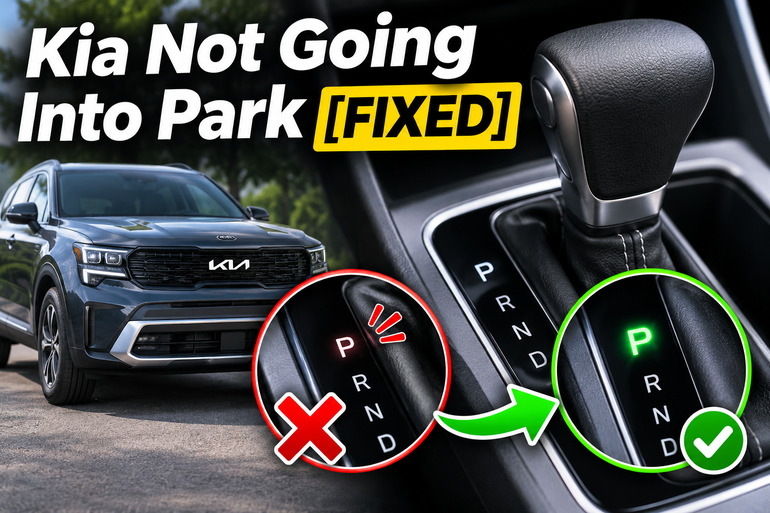
Why Your Kia Won’t Go Into Park
Your Kia’s Park position is designed to prevent the vehicle from rolling when it’s stationary. In conventional automatic transmissions, selecting Park engages a locking mechanism called a parking pawl. This small metal component holds part of the transmission in place, helping prevent the drive wheels from turning.
However, the way Park operates depends on your Kia’s model, year, and transmission design. Some vehicles, including certain older Kia Optima, Forte, and Sorento models, use a traditional gear lever connected to the transmission through a shift cable. Others use electronic gear selectors that send commands to the transmission through an electronic control system.
When something interferes with either system, you may notice several symptoms.
- The gear lever won’t reach Park. It may feel unusually stiff, stop before reaching the P position, or move without engaging the transmission correctly.
- The dashboard doesn’t recognize Park. Your shifter may appear to be in Park, but the instrument cluster continues displaying another gear.
- The engine won’t shut off normally. Certain Kia models require the transmission to recognize Park before completing their normal shutdown sequence.
- A transmission warning appears. Messages such as “Check P button” or “PARK malfunction” may indicate an electronic shifting problem.
- The vehicle moves despite Park being selected. This can indicate a serious problem with the parking mechanism or another drivetrain component.
Occasionally, the issue comes from something as simple as an object obstructing the gear selector. However, damaged shift cables, electronic faults, and internal transmission problems can produce similar symptoms.
If your Kia won’t engage Park, apply the parking brake while keeping your foot firmly on the brake pedal. Don’t force the gear selector or leave the vehicle unsecured. A Kia that cannot reliably hold Park needs attention before normal use continues.
Kia Not Going Into Park [FIXED]: Common Causes
Several mechanical and electrical problems can prevent a Kia from shifting into Park. The following causes are worth considering, although the symptoms and checks needed to confirm them depend on your vehicle’s transmission design.
1. Damaged or Misadjusted Shift Cable
On Kia models with a mechanical gear selector, a shift cable connects the lever inside the cabin to the transmission. When you move the lever, the cable transfers that movement to the transmission’s gear selection mechanism.
Over time, the cable, its attachment points, or its adjustment can develop problems. A damaged cable or loose connection may prevent the transmission from reaching Park even when you move the gear lever as far as it will go.
One clue is unusual movement at the shifter. You might notice that the lever feels loose, doesn’t line up with the gear markings, or requires an unexpected amount of effort. In some cases, the lever reaches P, but the dashboard continues displaying Reverse or Neutral.
A cable can also detach from its connection point, leaving the transmission in a different gear from the one indicated by the lever’s physical position.
This isn’t simply a theoretical problem. Kia previously recalled certain 2006 through 2008 Optima vehicles because a shift cable could detach, allowing the gear lever to move into Park while the transmission remained in its previous gear. The recall was identified as NHTSA campaign 11V153000.
Therefore, if your Kia has a traditional gear lever and its movement suddenly feels different, the shift cable and its connections deserve professional inspection.
2. Faulty Gear Shifter Assembly
Sometimes, the problem originates inside the gear selector itself rather than at the transmission.
Traditional gear shifters contain moving components that guide the lever between positions. Depending on the design, these may include a release button, locking mechanism, springs, and internal guides. Damage or wear can interfere with smooth movement.
For instance, a worn selector mechanism may prevent the lever from moving completely into Park. A damaged release button can also make normal shifting difficult, although the exact symptoms depend on how that particular shifter works.
Electronic Kia shifters can develop different problems. A faulty Park button, jammed rotary selector, or damaged internal electrical component may prevent the system from recognizing your request to engage Park.
You might notice that the button doesn’t respond, feels stuck, or produces a dashboard warning. Kia specifically identifies messages such as “Rotary shifter stuck” and “Shift button held down” in some owner manuals.
These symptoms are useful because they point toward a possible selector problem. However, they don’t confirm whether the fault is inside the shifter or elsewhere in the electronic system.
3. Electrical or Transmission Control Problems
Many newer Kia vehicles use electronic shifting systems that depend on sensors, control modules, and electrical signals to select gears.
Instead of physically moving the transmission mechanism through a conventional cable, the electronic selector communicates your request to the vehicle’s control system. The system then manages the appropriate gear selection hardware.
If the selector signal isn’t received correctly, an electrical connection fails, or the control system detects an unsafe operating condition, Park may not engage as expected.
A faulty transmission position sensor or related control component can also affect how the vehicle recognizes the selected gear. Depending on the design, this may cause a disagreement between the requested gear and the position shown on the dashboard.
Warning messages provide particularly useful clues. For example, Kia’s documentation associates a “PARK malfunction” message with a problem engaging Park and recommends immediate dealer inspection.
If your Kia displays such a warning, avoid treating it as an ordinary temporary glitch. Proper diagnosis may require a scan tool capable of communicating with the transmission and electronic shifter modules.
4. Weak or Discharged 12-Volt Battery
A weak 12-volt battery can cause shifting problems in Kia vehicles that rely on electronic gear selection.
Although the battery is commonly associated with starting the engine, it also supplies electrical power to important vehicle control systems. Electronic shifters and their related components need an adequate power supply to function correctly.
When the battery becomes severely discharged, the electronic gear selector may stop responding. You could also notice dim dashboard lights, difficulty starting the vehicle, or several electrical warnings appearing together.
Kia’s owner documentation for certain shift dial models specifically states that the transmission cannot be shifted when the 12-volt battery is discharged.
However, a battery problem shouldn’t automatically be blamed whenever Park stops working. If your lights, starting system, and other electrical functions operate normally, the shifter or transmission may require a closer examination.
5. Damaged Parking Mechanism or Transmission Components
The transmission’s internal parking mechanism can sometimes be responsible for a Kia that won’t engage or hold Park.
In a conventional automatic transmission, a parking pawl engages a matching mechanical component to lock the transmission’s output. If the pawl, its operating mechanism, or related parts are damaged, Park may fail to engage properly.
Damage can occur through mechanical failure or excessive stress, including attempts to engage Park while a vehicle is moving. That’s why Kia instructs drivers to bring the vehicle to a complete stop before selecting Park.
Depending on the failure, you may notice grinding, an inability to engage Park, or a vehicle that doesn’t remain stationary even though the selector indicates P.
However, unexpected movement doesn’t always mean the parking pawl itself has failed.
For example, Kia recalled certain 2020 through 2024 Telluride vehicles under NHTSA campaign 24V214 because a driveshaft connection could become damaged, potentially allowing the vehicle to roll while in Park. The repair involves the electronic parking brake software and replacement of damaged components when necessary.
This distinction matters because different faults require different repairs. Internal transmission work and safety-related drivetrain repairs should always be handled by qualified technicians.
Kia Not Going Into Park [FIXED]: DIY Fixes
The safest approach is to begin with simple checks that don’t require disassembling the shifter or transmission. Some problems can be resolved by correcting a shifting condition or removing an obstruction, while others require professional repairs.
1. Stop Completely and Follow the Correct Shifting Procedure
Before assuming something has failed, make sure you’re using the correct procedure for your Kia’s transmission.
Start by stopping on a level surface whenever possible. Keep your foot firmly on the brake pedal, apply the parking brake, and check that your vehicle is completely stationary.
Next, follow the appropriate procedure for your shifter.
- Traditional gear lever: Press the brake pedal, operate the selector release button where required, and move the lever gently toward Park.
- Rotary electronic shifter: With the vehicle stopped and the brake pedal depressed, press the P button according to your owner’s manual.
- Electronic shift lever: Follow the model’s instructions for operating its release or unlock button and selecting Park.
Avoid pulling, twisting, or forcing the shifter if it resists normal movement.
Some electronic Kia models won’t accept a Park command while the vehicle is moving. Kia also uses dashboard messages such as “Shifting conditions not met” and “Press brake pedal to change gear” to explain why a requested shift hasn’t been accepted.
If correcting the operating conditions resolves the issue, verify that the instrument cluster displays P before completing your normal parking procedure.
However, if the shifter continues refusing Park, stop repeated attempts and move on to the other checks.
2. Look for Objects Obstructing the Gear Selector
Small objects around the center console can sometimes interfere with a Kia’s gear selector.
Coins, crumbs, loose accessories, and other debris may settle around the shifter. On certain electronic models, objects pressing against the Park button or restricting the rotary selector can prevent normal operation.
First, secure the vehicle and switch off the engine if it can be shut down safely. Then examine the visible area around the shifter.
Check for anything resting against the gear lever, blocking a selector button, or restricting the rotary dial. Remove loose objects by hand where they are easy to reach.
If there’s ordinary surface dirt, gently clean the surrounding area with a soft, dry cloth. Avoid forcing sharp tools into narrow openings or pouring cleaning liquids into the assembly.
After clearing the obstruction, try selecting Park again using the correct procedure.
Kia’s instructions for certain models specifically recommend checking for objects around the shifter when a rotary selector becomes stuck. If the warning remains, dealer inspection is recommended.
If your shifter still feels stiff, loose, or mechanically damaged, avoid taking the console apart. The problem may involve internal parts that require replacement or adjustment.
3. Check the Brake Pedal and Dashboard Warnings
Your Kia’s brake pedal signal can provide clues about certain electronic shifting problems.
Many Kia transmission systems monitor brake pedal input before allowing particular gear changes. If the system doesn’t recognize the brake being pressed, it may reject the requested shift and display a warning.
Begin by checking whether your brake lights illuminate when you press the pedal. You can ask someone to observe them or look for their reflection on a nearby surface.
If the brake lights don’t operate, a brake light switch, fuse, wiring fault, or lighting issue could be involved.
However, a failed brake switch usually affects shifting out of Park on traditional automatic transmissions. It isn’t a typical explanation for a mechanical gear lever refusing to move into Park.
Therefore, don’t replace the brake switch simply because your Kia won’t select Park.
Pay closer attention to the exact dashboard warning. A message requesting brake pedal input may point to an operating condition or brake signal issue, while “Check P button” or “PARK malfunction” suggests a different problem.
If the vehicle reports a parking system malfunction, stop using it normally and arrange qualified inspection. A warning that disappears after restarting doesn’t necessarily mean the underlying fault has been repaired.
4. Check the 12-Volt Battery Condition
If your Kia uses an electronic shifter and several electrical functions are acting strangely, checking the 12-volt battery is a sensible next step.
Begin with simple observations. Notice whether the dashboard illuminates normally, whether the vehicle starts as expected, and whether its electrical systems seem unusually weak.
If the battery appears discharged, follow your vehicle’s owner’s manual for the appropriate battery assistance procedure.
For certain Kia models, approved jump-starting can restore the electrical power needed for the gear selector to operate. However, the correct connection points and procedures vary, especially between gasoline, hybrid, and electric vehicles.
Don’t attempt a jump-start unless you can follow the manufacturer’s instructions safely. A damaged, leaking, swollen, or frozen battery requires professional attention.
If you have access to a suitable 12-volt battery tester, the battery’s condition can also be assessed without dismantling the vehicle. A technician can perform a more complete test when necessary.
Once adequate power has been restored, check whether the shifter responds normally and the dashboard confirms Park.
If the battery repeatedly loses charge, the cause may involve an aging battery, charging system fault, or unwanted electrical drain. Correcting that problem is necessary to prevent further trouble.
5. Check for Kia Recalls and Model-Specific Repairs
Before paying for repairs, check whether Kia has issued a safety recall affecting your vehicle’s transmission, shifter, or parking system.
This is especially worthwhile if the gear lever reaches Park but the vehicle doesn’t stay securely parked.
In the United States, you can check for open safety recalls through the NHTSA vehicle recall lookup at www.nhtsa.gov/recalls.
To perform the check, locate your vehicle identification number, or VIN. It’s typically visible near the lower corner of the windshield on the driver’s side and also appears on your vehicle registration.
Enter the VIN and review any outstanding recalls.
Pay attention to campaigns involving transmission shifting, gear selector components, parking mechanisms, and unintended vehicle movement.
For instance, the Telluride driveshaft recall mentioned earlier addresses a specific condition that can cause vehicle movement despite Park being selected. However, that recall doesn’t apply to every Telluride, and other Kia models may have entirely different faults.
If your vehicle has an applicable recall, contact an authorized Kia dealership to arrange the specified repair. Safety recall repairs are generally performed without charge.
Even when no recall appears, ask the service department whether any applicable service information exists for your model and symptoms.
A recall lookup is useful for identifying covered repairs, but a clear result doesn’t establish that your transmission is functioning correctly.
6. Contact a Qualified Kia Technician
If the previous checks don’t resolve the problem, a qualified Kia technician should inspect the vehicle.
Professional diagnosis is particularly important when the gear selector moves without engaging Park, the dashboard shows inconsistent gear positions, or an electronic parking system warning remains active.
A technician can examine the mechanical shift linkage where fitted, check the selector assembly, and evaluate transmission position signals.
For electronically controlled systems, the technician may also scan the relevant control modules for diagnostic trouble codes and test the electronic Park mechanism.
Depending on the results, the repair might involve adjusting or replacing a shift cable, repairing a damaged shifter, correcting an electrical fault, or replacing a failed transmission component.
If the vehicle cannot reliably engage or hold Park, arrange professional recovery rather than driving it to a workshop. Tell the towing company that the transmission may not secure the vehicle, because the correct loading and towing procedure depends on your Kia’s drivetrain.
While arranging assistance, keep the vehicle secured in a safe location. Use the parking brake, avoid slopes wherever possible, and don’t leave a vehicle unattended if there’s any indication that it may move.
Wrap-Up
A Kia that won’t go into Park needs careful attention because the fault can affect how safely the vehicle remains stationary. The symptoms often provide useful clues, particularly whether the gear lever is physically stuck, the dashboard fails to recognize Park, or the vehicle moves after Park has been selected.
Start with the correct shifting procedure and simple checks for obstructions or electrical problems. If those don’t help, professional diagnosis is the safest choice. Addressing the problem promptly can help you avoid unnecessary repairs while restoring confidence in your Kia’s parking system.