
A “Check electric vehicle system” message on your Kia can appear alongside warning chimes, reduced power, or trouble getting the vehicle ready to drive. Although the message doesn’t identify the failed part, it deserves prompt attention.
The right repair depends on your model, its year, and the faults stored in its computers. Understanding those differences helps you avoid unnecessary parts replacement, recognize warning signs, and get the correct diagnosis without attempting unsafe electrical work.
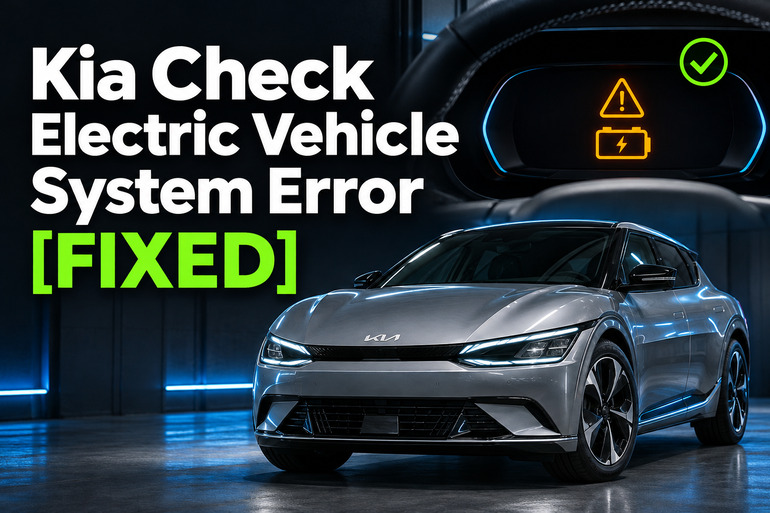
What the Kia Electric Vehicle System Warning Means
Kia describes this message as a warning that something is wrong with the electric vehicle control system. Its owner manuals instruct you to park safely and arrange towing to an authorized Kia dealer. Even if your car still moves normally, continued driving isn’t an appropriate way to test whether the problem will disappear.
The message alone doesn’t prove that the large drive battery has failed. Kia has documented several faults that can trigger it, including charging control problems, coolant leaks affecting electrical components, and a software issue that can damage a starting circuit component. Your vehicle’s model and diagnostic results determine which explanation applies.
Other dashboard messages provide useful context. On affected EV6 vehicles with a charging unit fault, Kia lists warning chimes, a charging system warning, a turtle shaped power reduction indicator, and a message telling you to stop and check the power supply. These symptoms can develop as the smaller 12 volt battery loses charge.
However, a low battery or cold weather power limitation is a separate condition. Kia explains that low charge, very high or low battery temperature, or high motor temperature can limit output. Don’t assume those normal protective limits explain an electric vehicle system warning appearing at the same time.
Kia Check Electric Vehicle System Error [FIXED]: Common Causes
Several documented faults can produce this warning, and they don’t apply equally to every Kia EV. The following causes are useful starting points for diagnosis rather than a ranking of what has failed on your vehicle.
1. A Faulty Integrated Charging Control Unit
The Integrated Charging Control Unit, usually called the ICCU, handles charging functions for the drive battery and the auxiliary 12 volt battery. On certain 2022 through 2024 EV6 vehicles, Kia documented damage associated with brief voltage spikes and repeated temperature changes. A damaged unit may stop charging the smaller battery.
As that battery discharges, available drive power can fall. This explains why a vehicle can have energy remaining in its drive battery yet still develop a serious electrical problem. In the affected EV6 recall population, continued operation despite the warnings can eventually lead to a complete loss of drive power.
Charging behavior can also help identify the affected system. Kia bulletin ELE298 describes certain 2023 Niro EV vehicles that charge poorly, or fail to charge, on Level 1 and Level 2 equipment while DC charging still works. Some display this warning. That pattern supports further charging system diagnosis, but the bulletin requires specific fault checks before replacement.
2. A Power Control Software Issue
Certain 2025 EV6 vehicles have a separate issue involving the Power Net Domain Controller, or PDC. Kia’s service campaign SC343 addresses software that can allow damage to a component called the precharge resistor if the vehicle is shut down abnormally, such as while the selector is in Neutral.
Kia identifies the electric vehicle system warning, a service warning light, and failure to enter READY mode as possible results. The campaign covers certain vehicles built from December 17, 2024, through June 24, 2025. Consequently, a 2025 EV6 that won’t become ready to drive needs its own diagnosis rather than an assumed repair based on an older EV6.
3. Coolant Leaking Inside the Power Control Unit
On certain 2020 Niro EV vehicles, improper sealing can let coolant leak inside the Electric Power Control Unit, or EPCU. The fluid can reach its circuit board and cause the vehicle to stop providing drive power. Kia addressed this defect through recall SC258, also listed as NHTSA recall 22V899.
Because the leak is internal, the absence of a puddle beneath the car doesn’t rule it out. You also can’t confirm this fault by looking at the dashboard message alone. An affected vehicle needs the inspection described in the recall.
This is particularly important if your warning appears while driving. Kia’s recall notice directs affected owners to pull over safely, switch the vehicle off, and arrange towing. Adding coolant or repeatedly restarting the vehicle cannot repair the faulty internal seal.
4. A Damaged Coolant Valve or Corroded Connector
Kia service campaign SC373 covers a different coolant related problem on certain 2024 through 2026 EV6 vehicles. The three way coolant valve may become damaged and leak. Corrosion can also develop in its electrical connector.
Possible clues include weaker heating or air conditioning performance, the electric vehicle system warning, or a coolant refill message. Kia’s campaign calls for valve replacement and inspection of the connector, with connector replacement when needed. Those symptoms make the valve worth checking on an eligible vehicle, but they don’t establish the diagnosis on their own.
Kia Check Electric Vehicle System Error [FIXED]: DIY Fixes
The safe work you can do yourself centers on recording symptoms and checking information that helps identify the correct repair. The documented component faults above require qualified service, so arranging assistance should begin as soon as the warning appears.
1. Park Safely and Record the Warning
If the message appears while you’re driving, concentrate on reaching a safe stopping place. Once parked, select Park, apply the parking brake, and switch the vehicle off. Follow the instructions in your model’s owner manual and arrange towing rather than driving to see whether the warning returns.
When it’s safe, photograph every dashboard message before the display goes dark. Include the battery percentage and any service, charging, or power reduction lights. This gives the service department a clearer picture than a general description that the car showed an error.
Record whether the problem began during driving, immediately after charging, or when you tried to start. Also note any loss of acceleration, interrupted charging, or change in cabin heating. These observations help the technician choose relevant checks without requiring you to reproduce the fault.
2. Identify the Exact Model and Check Recall Status
Find your vehicle identification number, or VIN, on your registration or near the lower driver side corner of the windshield. Enter it into the NHTSA recall lookup, then ask a Kia dealer to check its current campaign and repair history.
Ask about service campaigns as well as safety recalls. NHTSA explains that its VIN results don’t show manufacturer customer service campaigns or recalls already completed. Therefore, a result showing no unrepaired recalls doesn’t establish that every relevant update has been performed or that your vehicle has no fault.
3. Preserve Charging Information Without Forcing Another Test
If the warning appeared during charging, save any charger error message or app notification. Note whether you were using a household outlet, a Level 2 station, or a DC fast charger. Include whether charging stopped immediately or continued for a while before the warning appeared.
Previous charging behavior can be valuable. For example, Kia’s Niro EV bulletin distinguishes poor AC charging from normal DC charging on certain affected vehicles. Share that history if you already have it, but don’t drive to another charger simply to test the difference while the system warning is active.
Keep your observations specific. “Charging stopped at 46 percent on a Level 2 station” gives the technician useful information. “The battery is bad” assumes a diagnosis that the available evidence may not support. Don’t repeatedly reconnect equipment to force a charging session after the vehicle has reported a system fault.
4. Check Coolant Information Without Opening the System
If a coolant refill message appears, locate the relevant reservoir using your owner manual. With the vehicle switched off and cooled, look through the reservoir wall if it is accessible. Note the level relative to its markings and photograph any visible leakage without reaching into electrical areas.
Kia warns that driving with insufficient coolant can damage electrical equipment. However, a low reading doesn’t reveal where the fluid went. Likewise, a normal visible level cannot exclude the internal leak described in the Niro EV recall. Leave caps, hoses, electrical connectors, and covered components alone, and report your observations to the repair shop.
5. Arrange the Repair That Matches the Confirmed Fault
For eligible EV6 vehicles, recall SC327 addresses ICCU inspection, replacement when necessary, and software updates. It replaced the earlier SC302 recall. Vehicles repaired under that earlier recall still needed the newer remedy, so an old invoice showing an ICCU update isn’t enough to establish completion. The recall repair is free for affected vehicles.
Other models need different work. SC343 provides a PDC software update for eligible 2025 EV6 vehicles, while SC373 calls for coolant valve replacement and connector inspection on eligible EV6 vehicles. Ask the dealer to confirm applicability using your VIN and explain how its findings connect to your symptoms.
After service, request an invoice identifying the diagnosed fault, completed campaign, installed parts, and verification performed. If hardware has already failed, ask whether the proposed update also addresses that damage. The goal is a repair supported by diagnostic results, followed by confirmation that the affected functions work correctly.
6. Contact a Qualified Kia EV Technician
Professional diagnosis is necessary when this warning appears, even if it later disappears. An authorized Kia dealer is the appropriate contact for recall and campaign work. Give the service adviser your photographs, charging history, VIN, and any earlier repair records before the appointment.
Ask for the stored diagnostic trouble codes and a plain explanation of the test results. Depending on the symptoms, relevant checks may include the 12 volt battery, its charging supply, charging control components, or coolant related faults. Kia’s Niro EV diagnostic procedure specifically includes checking the auxiliary battery, connections, and fuse under certain conditions. Those are technician checks rather than instructions to open the system yourself.
If the warning returns after repair, contact the shop again and explain exactly when it returned. Don’t treat battery disconnection, code clearing, or a successful restart as proof that the underlying fault is repaired. A useful follow up compares the new symptoms and stored faults with the original diagnosis.
Wrapping Up
A Kia electric vehicle system warning needs a diagnosis that matches your vehicle. Similar dashboard messages can come from different faults, so replacing a battery or requesting a familiar software update without supporting checks can leave the real problem unresolved.
Your next step is to park safely, save the warning details, and arrange qualified inspection. With your VIN, symptom history, and campaign records available, the service department can focus on the relevant checks and explain the repair your Kia actually needs before you return to normal driving.