
A Kia Venga speedometer that drops to zero while you’re moving can make it hard to judge your speed, especially as traffic slows or a speed limit changes. The needle might jump back to life a moment later, or it might stay put for the rest of the trip.
What happens elsewhere on the dashboard can help narrow down the fault. A blank mileage display, a steady ABS light, and a lone stuck needle each point to different checks.
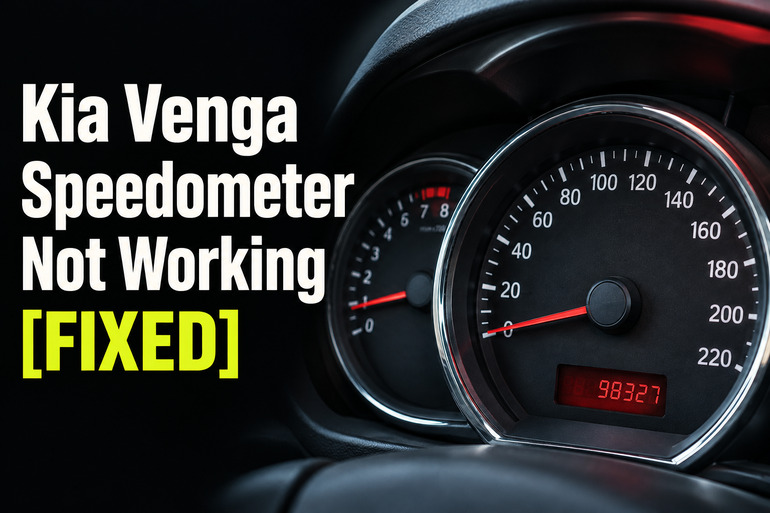
What a Failed Speedometer Means on a Kia Venga
The speedometer sits in the instrument cluster, the panel that also houses the fuel gauge, warning lights, and mileage display.[^kia-manual] It needs electrical power and a signal that represents how fast the car is moving. A fault in either can leave the needle at zero. The tachometer, which shows how fast the engine is turning, can still respond when the speedometer has lost its signal.
The mileage display gives you a second clue. The odometer records total distance, while the trip meter measures distance since you last reset it. If the trip meter stopped counting at the same time as the needle, a shared speed signal or cluster fault is worth checking. A display that still shows a number tells you only that the screen is on. The useful detail is whether that number continued to rise during the trip.
If the speedometer fails while you’re driving, pull over when it’s safe and arrange help before continuing. A steady amber ABS light means the system that helps prevent wheel lock during hard braking may be unavailable.[^kia-brakes] If the red brake warning stays on with the parking brake released, especially alongside the ABS light, or the brake pedal feels unusually soft, stop safely and arrange a tow. Kia warns that regular braking can also be affected when both warning lights stay on.
Kia Venga Speedometer Not Working [FIXED]: Common Causes
Start with the way the fault appeared and which other instruments were affected. That can help you tell a problem at the gauge from one further back in the circuit.
1. Loss of Power to the Instrument Cluster
A blown cluster fuse can cut power to several instruments at once. If the mileage screen went blank and the fuel gauge or other indicators stopped responding at the same time as the speedometer, check the cluster’s power supply first. Meanwhile, the radio or interior lamps may still work because they can draw power through separate circuits.
A fuse opens when too much current flows through it. A loose power or ground connection can also interrupt the cluster supply, even when the fuse itself is intact. If the whole panel flickers or restarts over bumps, tell the technician. That pattern makes a loose connection worth checking before replacing the cluster.
2. A Fault in the Vehicle Speed Sensor Circuit
Some Venga versions have a separate vehicle speed sensor.[^sensor] On a version that uses one for the speed reading, the sensor sends an electrical signal that changes as the car moves. If the signal drops out, the speedometer can fall to zero and the trip meter may stop adding distance.
The sensor can fail, but it also needs a sound circuit. A loose plug, corrosion at a terminal, or a broken wire can interrupt the same signal. A fault that begins after gearbox work is worth reporting to the shop, since a connector or section of wiring may have been disturbed during the job.
The name on a parts listing can be misleading. For example, Venga fuse charts list transmission input and output speed sensors alongside a speed sensor on certain versions.[^kia-fuses] An automatic transmission’s speed sensor code needs to be traced to its own circuit before anyone concludes that it explains the dead needle.
3. Missing or Erratic Wheel Speed Data
A wheel speed sensor reads a rotating ring at the wheel. The ABS control unit uses those readings to track how fast each wheel is turning. If your Venga’s speed reading depends on data from the ABS system, a fault affecting that data can also interfere with the dashboard reading. The wiring diagram for your version shows whether the systems share that signal.
The most useful clue is an ABS light that first appeared around the same time as the speedometer fault. A damaged wire, a faulty sensor, or a damaged ring can all distort a wheel’s reading.[^wheel-sensors] If the trouble began soon after a wheel bearing or hub replacement, tell the shop which side was worked on. On designs with a magnetic ring built into the bearing seal, the ring and its position relative to the sensor matter.
4. A Loose Connector or Damaged Wire
A needle that cuts out on rough pavement and recovers on a smoother stretch can point to an intermittent connection. Wires can chafe where they rub against a bracket or nearby part. A plug that hasn’t locked in place can lose contact when the car vibrates. Whether the whole panel flickers or only the speedometer drops out helps narrow down which circuit to check.
Corrosion can cause trouble too. Moisture inside a connector can weaken contact between its terminals. If the fault seems to happen after rain, note how long it lasts and whether other instruments are affected. The timing gives a technician somewhere to start checking, even when everything is working again by the time the car reaches the shop.
5. A Fault Inside the Speedometer or Cluster
If the needle stays at zero while the trip meter continues counting and the other gauges work normally, the fault may be inside the cluster. The needle has a small drive mechanism. That mechanism or the circuitry controlling it can fail while the rest of the panel still works.
A needle that sticks at one point on the dial and then jumps ahead can also draw attention to the gauge itself. A jumping needle can come from an erratic input, though, so the movement alone is a poor reason to order a cluster.
A technician can check what speed information reaches the cluster and, if the diagnostic tool supports it, command the gauge to move. If the cluster receives a steady speed signal but the needle fails to respond, testing can focus on the gauge and its circuitry.
Kia Venga Speedometer Not Working [FIXED]: DIY Fixes
You can do the first checks with the Venga parked and the parking brake applied. If they don’t reveal the problem, the details you collect can help a shop choose the right electrical tests.
1. Check Which Parts of the Dashboard Still Work
With the car parked, turn the ignition on and look at the instrument panel. Check whether the mileage screen comes on and which warning lights appear during the normal startup check. If the panel is readable in daylight but too dark with the headlights on, try the instrument illumination control if your Venga has one.
Use what you noticed before parking to fill in the rest. For instance, if you already know the trip meter kept counting while the needle stayed down, write that down. Zero is the expected speed reading while parked. There’s no need to take another trip just to see if the fault returns.
2. Check the Cluster Fuse and Replace It if Blown
Find the interior fuse panel using your owner’s manual, then use the label inside the cover to identify the instrument cluster fuse. Some Venga diagrams show a fuse marked CLUSTER rated at 10 amps. Use the label and rating for your own car, since fuse layouts vary.
With the ignition and accessories switched off, use the plastic fuse puller to draw the fuse straight out. Hold it up to the light and look for a break in the metal strip. If it’s blown, fit a new fuse of the same type and amperage and put the cover back on.
Turn the ignition on and see whether the display and indicators return. If the replacement blows again, stop there. Another fuse will leave the underlying electrical fault in place, and using one with a higher rating can let the wiring overheat. If the original fuse is intact and the panel stays blank, a technician can test the power and ground at the cluster.
3. Look for Visible Damage After Recent Work
If the fault started soon after service, pull out the invoice and see what was touched. A wheel bearing job gives the shop a specific corner to check. Work around the gearbox gives it a reason to check the nearby speed sensor wiring on a version equipped with that sensor.
With the engine off, use a flashlight to check any related wiring you can see from above or from beside the parked car. Look for a cable hanging from a clip, a cut in the outer covering, or a plug that’s visibly out of place. Leave any wiring you can’t readily see for the shop to inspect on a lift.
Take a photo of any damage you find so the technician can locate it quickly. If you can’t see anything obvious, the date and type of service are still worth sharing. A wire can break inside its insulation and look normal from the outside.
4. Save Any Fault Codes Before Clearing Them
If you already have a compatible scan tool, plug it in with the ignition off, then follow the tool’s instructions to read stored codes while parked. Save the exact code and the name of the system that reported it. Scan tools vary in the modules and data they can read.[^scan-tool] If your tool can access the Kia ABS system, check it as well as the engine system. A basic engine code reader may miss faults stored in the ABS module.
Leave the codes stored so the technician can check them alongside any recorded details about when the fault occurred. A code that names a sensor circuit gives the shop a place to test. The repair could be at the plug, the wiring, or the sensor itself.
5. Have the Shop Compare the Speed Readings
Ask the shop to verify where your Venga gets its vehicle speed signal before ordering parts. With a compatible scan tool and the right wiring diagram, a technician can use live data, the readings the car reports as it runs, to find where the speed information drops out. The comparison depends on which readings your car makes available.
For instance, if one wheel reports zero while the others show similar speeds as the car rolls straight, the technician can focus on that wheel’s sensor, wiring, and ring. If the speed information reaches the cluster and the needle still sits at zero, testing can move to the gauge itself.
Once the fault is repaired, ask the shop to confirm that the needle moves smoothly, the trip meter advances, and any related warning lights stay off after their startup check. If your needle used to fail only after the car warmed up, mention that before the verification drive so the shop knows when to look for the fault.
6. Contact a Kia Technician or Auto Electrician
Book a diagnosis if the speedometer stays dead, the fault comes back, or several gauges misbehave together. A Kia technician or an auto electrician with a scan tool that can read the Venga’s ABS and instrument systems can check for a shared electrical fault. If there’s a persistent red brake warning or a change in braking, arrange a tow for a brake inspection.
Give the shop your model year, engine, and transmission type, along with any photos or codes you saved. If the shop confirms that the cluster is faulty, ask whether yours can be repaired. If it needs replacement, ask how the shop will document the mileage and match the replacement cluster to your car.
Wrapping Up
An intermittent speedometer fault can be easy to put off once the needle starts moving again. Write down the details while they’re fresh, especially how long the fault lasted and what the rest of the panel was doing. If the problem disappears by the time you reach the shop, those observations give the technician something specific to check.
If you find a blown fuse and the replacement holds, have the speed reading confirmed before returning to normal use. If the needle drops again, pass along your notes so the shop can pick up where your checks left off.