
A Kia Sportage power liftgate that suddenly stops working can make loading groceries, luggage, or other cargo unnecessarily difficult. Sometimes, the liftgate won’t respond to the key fob or dashboard button. Other times, it opens halfway, makes a beeping sound, or refuses to close completely.
Fortunately, several common issues can be resolved without expensive repairs. However, the right solution depends on what’s preventing the liftgate from operating. Understanding the possible causes can help you identify the problem and avoid unnecessary repairs.
Understanding Why Your Kia Sportage Power Liftgate Isn’t Working
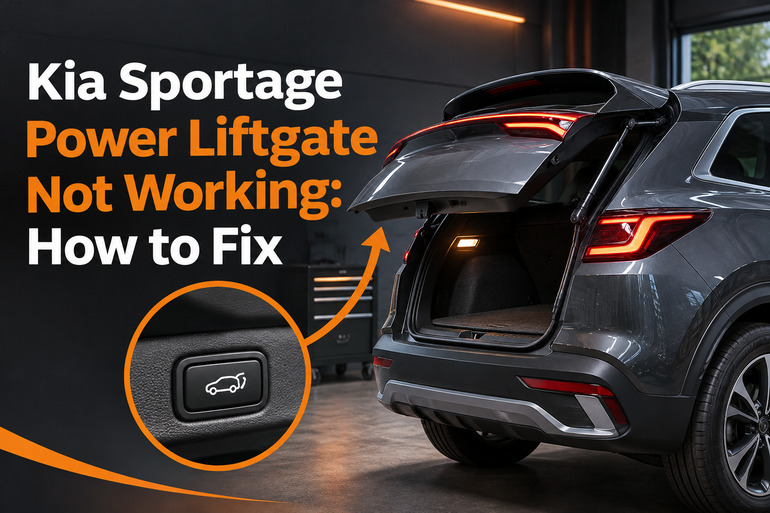
The Kia Sportage power liftgate uses an electric system to open and close the rear cargo door automatically. On equipped models, you can operate it using the smart key, an interior control, or a button near the liftgate. The system uses powered mechanisms and electronic controls to move the liftgate while monitoring its operation.
When you press an opening or closing button, the system checks whether the required operating conditions are satisfied. If everything is functioning correctly, the liftgate moves automatically. However, an electrical problem, mechanical resistance, or safety restriction can interrupt this process.
The symptoms often provide useful clues. For example, a liftgate that doesn’t respond to any button may have a power supply or control problem. If it starts moving but suddenly reverses, the system may be detecting resistance. A liftgate that opens only partway could also have a previously saved opening height.
It’s also important to understand that not every failure indicates a broken motor. The liftgate has built-in safety features that can prevent operation under certain conditions. Kia’s owner’s manuals describe restrictions involving vehicle speed, repeated operation, and detected obstructions. Therefore, checking these conditions before replacing components can save time and money.
Kia Sportage Power Liftgate Not Working: Common Causes
Several electrical, mechanical, and operating conditions can prevent your Kia Sportage power liftgate from working correctly. The following five causes are worth investigating because they produce different symptoms and require different solutions.
1. Incorrect Vehicle Settings or Operating Conditions
Your Kia Sportage has operating restrictions that help prevent the power liftgate from moving when it’s unsafe. For example, on recent models, the liftgate normally requires the transmission to be in Park when the vehicle is running. It also won’t open automatically above approximately 2 mph (3 km/h).
This means your liftgate may refuse to respond even when its electrical and mechanical components are working correctly. If the problem occurs only while the vehicle is running or after you’ve changed the vehicle settings, check these conditions before suspecting a component failure.
Some Sportage models also allow you to enable or disable the power liftgate through the instrument cluster or infotainment system. An incorrect setting can make the feature appear defective. Similarly, a low opening height setting can cause the liftgate to stop earlier than expected.
2. Weak Vehicle Battery or Blown Fuse
The power liftgate relies on the vehicle’s 12-volt electrical system. If the battery is weak, the system may not receive sufficient power to operate reliably, particularly when the engine is off.
You might notice that the liftgate moves slowly, struggles to complete its travel, or works intermittently. Other electrical symptoms, such as slow engine cranking or dim lights, can strengthen the suspicion of a battery problem. However, those symptoms alone don’t confirm that the battery is responsible.
A blown fuse can also interrupt the electrical supply. The Sportage uses several circuits associated with liftgate operation, and their names and ratings vary by model year. Kia’s 2025 Sportage manual, for example, identifies liftgate related fuses in the passenger compartment and engine compartment fuse panels.
Battery disconnection can introduce a separate issue. Even after electrical power is restored, the liftgate may require a reset before operating normally. Kia specifically identifies battery replacement, battery recharging, and related fuse replacement as situations that can require liftgate initialization.
3. Faulty Smart Key or Liftgate Control Button
The smart key sends a command to the vehicle’s electronic system whenever you use its liftgate button. If the key battery is weak or the remote is damaged, that command may not reach the vehicle reliably.
A useful clue is whether the liftgate operates using another control. For instance, if the exterior liftgate button works normally but the smart key doesn’t, the problem may involve the key rather than the liftgate motor.
Control buttons can also develop faults from wear, moisture, or damaged electrical connections. If one button consistently fails while the others work, that particular control or its circuit deserves attention. However, testing the buttons individually is necessary before deciding which component is defective.
4. Obstructions, Mechanical Resistance, or Motor Overheating
Your Kia Sportage power liftgate has an automatic reversal feature that responds to resistance during opening or closing. If something interferes with the liftgate, it may stop or reverse direction to reduce the risk of injury or damage.
Common sources of resistance include cargo pressing against the rear door, objects caught near the closing area, or ice around the liftgate seals. Heavy accessories or accumulated snow can also place extra strain on the powered mechanism.
Another possibility is overheating from repeated operation. Kia warns that operating the power liftgate more than five times continuously can strain its mechanism. On certain Sportage models, the system responds with three chimes and temporarily prevents further operation. Allowing the system to cool for over a minute may restore normal movement.
These conditions can produce similar symptoms, but they aren’t identical. A liftgate that repeatedly reverses at the same position suggests resistance or a mechanical issue, while one that stops after several consecutive cycles may simply need a cooling period.
5. Damaged Liftgate Motor, Powered Struts, or Electrical Components
The power liftgate depends on a motorized mechanism to raise and lower the rear door. Over time, a powered strut, motor assembly, or related component can develop faults that prevent smooth movement.
A failing mechanism may produce grinding, clicking, or unusual straining noises. You might also notice uneven movement, intermittent operation, or a liftgate that stops at nearly the same position during repeated attempts. These symptoms can indicate mechanical trouble, although they don’t identify the exact failed part.
Electrical faults can produce similar behavior. Damaged wiring, poor connections, a defective latch switch, or a malfunctioning liftgate control module may interrupt operation. Identifying these problems typically requires electrical testing and an appropriate diagnostic tool, so component replacement should follow a confirmed diagnosis.
Kia Sportage Power Liftgate Not Working: DIY Fixes
The best approach is to start with simple checks that don’t require removing parts or working on electrical components. Once you’ve ruled out operating restrictions and minor issues, you can investigate the power supply or reset the liftgate using Kia’s recommended procedure.
1. Check the Transmission Position and Liftgate Settings
Start by parking your Kia Sportage on level ground. Apply the parking brake, shift the transmission into Park, and make sure the vehicle is completely stationary. Then try operating the liftgate using its normal controls.
Next, check whether the power liftgate feature is enabled. Depending on the Sportage model year and equipment, you may find the option under User Settings or Setup → Vehicle → Door → Power Liftgate. Look for the relevant activation setting and ensure it’s switched on. The exact menu names can differ between versions.
If your liftgate opens but stops too low, check the opening height setting. Select Full Open instead of Level 1, Level 2, or a saved custom height. Then operate the liftgate again. If it now opens completely, the earlier stopping point was probably caused by the selected height rather than a mechanical failure.
2. Test the Smart Key and Liftgate Buttons
Testing the different controls can help you determine whether the problem involves a particular button or the entire liftgate system. With the vehicle parked and the liftgate’s path clear, try opening it using the smart key, dashboard control, and exterior liftgate button, where equipped.
For the smart key, press and hold the liftgate button for approximately one second on models that use this operation. If the remote doesn’t work, try a spare key if you have one. You should also check whether the remote can lock and unlock the vehicle normally.
If the key appears unreliable, replace its battery according to your owner’s manual. The 2024 Sportage manual specifies a CR2032 battery. Remove the mechanical key, carefully open the remote housing, install the correct replacement battery with the proper polarity, and reassemble it. Keep loose button batteries away from children because swallowing them can cause severe injuries.
For models equipped with Smart Liftgate with Auto Open, check that the separate hands-free feature is enabled. Kia specifies that the doors must be closed and locked for at least 15 seconds before activation. You must then stand in the detection area with the smart key for more than three seconds. If normal button operation works but automatic opening doesn’t, concentrate on this feature and its settings.
3. Remove Obstructions and Check the Liftgate Area
Inspect the visible areas around the liftgate before operating it again. Pay particular attention to the rubber seals, latch opening, cargo compartment, and the edges where the liftgate meets the vehicle body.
Remove loose objects that might interfere with closing, and make sure luggage isn’t pressing against the rear door. If ice or snow has accumulated around the liftgate, clear it carefully without using sharp tools or applying excessive force. Also, check that no heavy accessory is attached to the liftgate.
Once the area is clear, try operating the liftgate again. Watch whether it moves smoothly or stops at a particular point. If it continues reversing or produces grinding sounds, stop testing. Don’t force the liftgate or place your hands near moving hinges, struts, or latch components.
4. Allow the Power Liftgate Motor to Cool Down
If your Sportage liftgate stopped working after several consecutive opening and closing cycles, the system may have temporarily disabled operation to protect its motor.
Stop pressing the liftgate buttons and allow the mechanism to cool for more than one minute, as described in Kia’s guidance for affected models. Then try a single opening or closing command. Avoid repeatedly pressing the controls while the system is unresponsive.
If the liftgate resumes normal operation, overheating may explain the temporary problem. However, if it continues stopping after only one normal cycle, the mechanism could be encountering excessive resistance or developing a fault. Repeated overheating under ordinary use deserves professional inspection.
5. Check the Vehicle Battery and Liftgate Fuse
If none of the liftgate controls responds, investigate the vehicle’s electrical supply. First, look for signs of a weak 12-volt battery, especially if the problem appeared after the vehicle was parked for an extended period.
If other electrical systems are also behaving unusually, have the 12-volt battery and charging system tested. A technician can determine whether the battery needs charging, replacement, or further investigation. Hybrid models may have different battery arrangements, so follow the instructions specific to your vehicle.
You can also check the relevant fuse if you’re comfortable performing basic vehicle maintenance. Consult the fuse diagram in your owner’s manual and the labels on the fuse panel covers. With the vehicle switched off, inspect only accessible, user-serviceable fuses using the manufacturer’s procedure. Replace a confirmed blown fuse with one of the exact same rating. Never bypass a fuse or install a higher-rated replacement.
If the fuse blows again, stop there. Repeated fuse failure suggests an underlying electrical problem that needs diagnosis. Don’t dismantle high-current fuse assemblies or attempt wiring repairs yourself.
6. Reset the Kia Sportage Power Liftgate
If the power liftgate stopped working after a battery was disconnected, recharged, or replaced, a reset may restore normal operation. The same applies after certain related fuse replacements.
For the 2024 Kia Sportage, Kia provides the following reset procedure. Use it only when the liftgate can be accessed and moved safely.
- Park the vehicle securely and shift the transmission into Park. The vehicle can be switched off or running, but it must remain stationary.
- With the liftgate accessible, press the inner liftgate open/close button and the exterior liftgate open/close button simultaneously until you hear a chime.
- Slowly close the liftgate manually as directed by Kia. Avoid excessive force and keep everyone clear of the moving door.
- Press the exterior liftgate open/close button. The liftgate should begin opening automatically with a chime.
- Allow the liftgate to reach its fully open position without interruption. The reset is incomplete if it stops before reaching that position.
These steps follow Kia’s published reset instructions for the 2024 Sportage. Other model years may use slightly different procedures, so confirm the instructions in your specific owner’s manual.
After completing the reset, test the liftgate with its normal controls. It should open and close smoothly without unexpected stops or warning sounds. If the procedure cannot be completed, don’t repeatedly force the mechanism or disconnect electrical components in an attempt to reset it.
Also, keep in mind that resetting the liftgate won’t repair a damaged motor, defective switch, or broken mechanical component. If the problem persists, further diagnosis is necessary.
7. Contact a Qualified Kia Technician
If the liftgate remains unresponsive after these checks, have an authorized Kia dealer or qualified automotive technician inspect the system. Professional attention is especially important if the liftgate drops unexpectedly, cannot stay securely open, produces loud mechanical noises, or won’t latch completely.
A technician can test the electrical supply, switches, wiring, control module, latch assembly, and powered liftgate mechanisms. Diagnostic equipment can also help identify stored faults, allowing the repair to focus on the actual problem.
Avoid replacing expensive components based only on symptoms. A faulty switch and a damaged liftgate motor can sometimes produce similar behavior, but their repairs are very different.
If the vehicle is still covered by an applicable Kia warranty, check whether the required repair qualifies for coverage. If the liftgate cannot close and latch securely, don’t drive the vehicle until the problem has been resolved.
Wrap-Up
A Kia Sportage power liftgate that stops working doesn’t always require a major repair. Sometimes, correcting a vehicle setting, replacing a weak key battery, removing an obstruction, or resetting the system is enough to restore normal operation.
However, persistent electrical faults, unusual mechanical noises, and unexpected liftgate movement deserve closer attention. The safest approach is to identify the symptoms, perform the basic checks that apply to your model, and avoid forcing the mechanism. If the problem continues, a qualified Kia technician can identify the faulty component and recommend the appropriate repair.