
An EPB warning on your Kia Niro can leave you unsure whether the parking brake is stuck, unable to engage, or reporting another problem. The next step depends on the warning and how the brakes behave.
Some situations allow a few simple checks from the driver’s seat. Others need professional attention before you move the car. Understanding that difference helps you avoid unnecessary parts replacement while protecting the braking system from damage caused by forcing the vehicle to move.
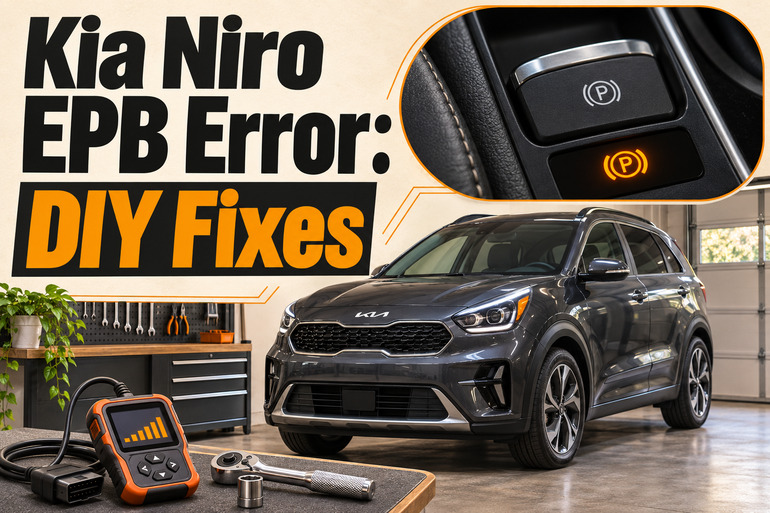
What a Kia Niro EPB Error Means
EPB stands for electronic parking brake. Instead of applying the parking brake with a hand lever or foot pedal, you operate a switch that controls an electric mechanism. A brief motor sound or click during operation can be normal. Likewise, the EPB indicator briefly illuminating during startup is a system check, rather than proof of a fault.
A warning that remains illuminated needs closer attention. However, distinguish the EPB malfunction indicator from the parking brake applied indicator. One reports a possible system problem, while the other can simply show that the brake is engaged. Photograph the display while safely parked so you can identify the exact symbol and message.
Auto Hold also needs a separate explanation. It keeps the vehicle stopped temporarily after you release the brake pedal. Although it works with the braking system, its indicator and operating conditions differ from those of the parking brake. An Auto Hold message therefore needs to be read alongside any EPB warning.
Stop driving if the brake won’t release, you notice smoke or a burning smell, or the brake pedal behaves abnormally. A brake warning that remains on after releasing the parking brake also requires immediate attention. Don’t assume every brake warning concerns only the parking brake.
Kia Niro EPB Error: Common Causes
Several conditions can explain an EPB warning or a parking brake that appears unresponsive. The following possibilities help narrow the problem, but none should be treated as a confirmed diagnosis without supporting checks.
1. Insufficient Auxiliary Battery Power
The electronic parking brake needs electrical power to operate. Kia warns that insufficient battery charge can prevent the EPB from applying or releasing. If the problem appears alongside difficulty powering up the vehicle, the auxiliary electrical supply deserves attention before anyone condemns the parking brake mechanism.
The useful clue is the combination of symptoms. Record whether the dashboard powers up normally, whether the vehicle reaches its normal ready state, and whether other electrical warnings appear. These observations help a technician decide which tests to perform.
Battery arrangements differ across the Niro range. For example, Kia documented an integrated lithium auxiliary battery and a battery reset button on the 2017 Niro hybrid. That arrangement should never be assumed to apply to every Niro hybrid, plug in hybrid, or EV.
2. Abnormal EPB Switch Operation
Kia identifies abnormal operation of the EPB switch as one reason the warning may appear. Its owner guidance includes switching the vehicle off and restarting after a few minutes, followed by professional inspection if the warning remains. This supports trying a normal restart in appropriate circumstances, rather than immediately replacing parts.
Pay attention to what happens when you operate the switch. A response that changes between attempts is useful information, but it doesn’t establish whether the switch itself is defective. Avoid pulling harder, repeatedly pressing it, or removing console trim to investigate. A warning light alone cannot identify the failed component.
3. Automatic Release Conditions Haven’t Been Met
A parking brake that stays applied doesn’t always have a mechanical fault. Depending on the model, automatic release can depend on the vehicle’s operating state, gear selection, seat belt use, and whether the driver’s door, hood, and tailgate are closed. Kia’s instructions vary between versions, so your own manual matters.
This possibility is especially relevant when the problem occurs during departure and the display asks you to complete an action. Read that message before trying again. A prompt to press the brake pedal gives you a different starting point from an EPB malfunction indicator that stays on continuously.
However, meeting the release conditions doesn’t explain away a persistent malfunction warning. If the parking brake still won’t release through the normal manual procedure, stop the checks. Don’t press the accelerator harder to overcome the resistance.
4. A Related Stability Control Fault
The electronic parking brake warning can appear alongside an electronic stability control warning. Kia explains that an ESC fault can illuminate the EPB indicator without establishing that the parking brake itself has failed. This is why replacing a parking brake component based only on the dashboard lights can miss the actual problem.
Record every warning that appears, including messages that disappear after restarting. Also note whether they appeared together or in sequence. Those details give the repair shop a better starting point than a description such as “the parking brake light came on.” Avoid treating an online report from another owner as a diagnosis for your vehicle.
Kia Niro EPB Error: DIY Fixes
Begin with checks that clarify the warning and confirm that you’re using the normal controls correctly. Continue only while the vehicle remains securely stopped and there are no signs of a serious braking problem.
1. Identify the Warning Before Changing Anything
Park somewhere safe and level if you can do so without forcing the vehicle to move. Keep your foot on the brake, select Park, and read the complete message. Use the warning light section of the owner’s manual for your exact year and powertrain to identify what you’re seeing.
Take a clear photograph and make a short note of the circumstances. Useful details include whether the warning appeared at startup, after parking, during an attempted release, or while driving. Don’t erase fault information or disconnect the battery before recording these details. A clear record remains useful even if the warning disappears later.
2. Try the Normal Manual Release Procedure
If the vehicle is securely stationary and the brakes otherwise feel normal, check the manual release instructions. Kia’s 2026 Niro EV guide specifies having the vehicle in the ON position, depressing the brake pedal, and pushing the EPB switch down. The parking brake indicator should go out. Confirm the procedure in your own manual before using it.
Before attempting release, fasten your seat belt and make sure the driver’s door, hood, and tailgate are properly closed. Keep your foot firmly on the brake throughout the check. Perform it from the driver’s seat, with nobody standing where the vehicle could move.
If the indicator stays on or the brake remains applied, don’t use acceleration as a test. Likewise, a sound from the mechanism doesn’t by itself confirm successful release. Stop if the displayed result and the vehicle’s behavior don’t agree.
3. Restart the Vehicle Once
For an isolated warning with no abnormal brake behavior, a normal shutdown and restart may be appropriate. Secure the vehicle in Park and confirm that it cannot move before switching it off. If you can’t establish that it’s safely secured, arrange assistance instead.
Kia’s guidance for abnormal EPB switch operation says to turn the vehicle off and restart after a few minutes. This is a normal vehicle restart, rather than a battery disconnection or a repair procedure. Don’t improvise a sequence involving fuses, wiring, or repeated switch operation.
After restarting, check whether the warning remains and whether the parking brake responds normally. A cleared warning is useful information, but it doesn’t prove that a recurring problem is repaired. If the fault returns, record the circumstances and arrange diagnosis instead of continuing to restart the car each time.
4. Follow the Correct Auxiliary Battery Guidance
If the vehicle also has trouble powering up, consult its emergency starting instructions. Identify the exact model first. Advice for an older Niro hybrid may be unsuitable for a Niro EV, and a generic battery replacement video may show equipment your vehicle doesn’t have.
On models equipped with a 12V BATT RESET button, use it only for the purpose and circumstances described in the owner’s manual. Kia’s technical guidance describes this button as reconnecting the protected auxiliary battery supply. It isn’t a dedicated EPB fault reset.
If the correct procedure isn’t clear, ask roadside assistance to handle the power problem. Don’t open battery enclosures, touch orange cables, or attempt work on the high voltage system. Once power is restored, the parking brake still needs to operate normally. Persistent EPB warnings require separate attention.
5. Check Auto Hold Messages Separately
With the vehicle stationary and your foot firmly on the brake, read any Auto Hold message before changing its setting. If the display instructs you to press the brake pedal, keep it depressed. Kia warns that a failed changeover from Auto Hold to EPB can mean the expected holding function isn’t available.
Where your manual permits, switch Auto Hold off while maintaining pressure on the brake pedal. Then assess the parking brake using its own normal controls. This helps you describe which function is giving trouble. It doesn’t repair an EPB fault or establish that the vehicle is safe to drive.
6. Contact a Qualified Kia Technician
Arrange professional diagnosis if the warning stays on, returns after restarting, or accompanies other brake system warnings. Tell the shop your Niro’s model year and whether it’s a hybrid, plug in hybrid, or EV. Share the photographs and notes from your checks, including any recent difficulty powering up.
Ask for diagnosis before authorizing component replacement. A practical request is to have the relevant brake system fault information checked and the suspected cause confirmed. If the problem is intermittent, explain how often it happens and what you were doing immediately beforehand. Avoid requesting a particular repair solely because another owner reported success with it.
If the EPB won’t release normally, Kia directs owners to have the vehicle transported on a flatbed for inspection. Tell the recovery operator that the parking brake may be stuck so they can plan the loading method. Don’t attempt to dismantle or electrically bypass the brake to get the car moving.
Wrapping Up
An EPB warning becomes easier to assess when you separate the exact message from the way the brake behaves. Clear observations can help you recognize an unmet operating condition, identify a possible power issue, or explain a recurring fault accurately to a repair shop.
Keep your next step proportional to the symptoms. A safe check from the driver’s seat may be enough to clarify normal operation. However, a brake that won’t release or any change in braking performance needs qualified attention before you continue driving.