
A check engine light paired with code P0101 can leave you wondering whether your Kia needs a new sensor or a simple intake repair. You might also notice hesitation, uneven idling, or weaker acceleration, although the engine can sometimes feel normal.
The useful starting point is understanding what the code actually reports. P0101 flags an airflow performance problem, but the correct repair depends on your Kia’s engine, its intake system, and the other information stored alongside the code.
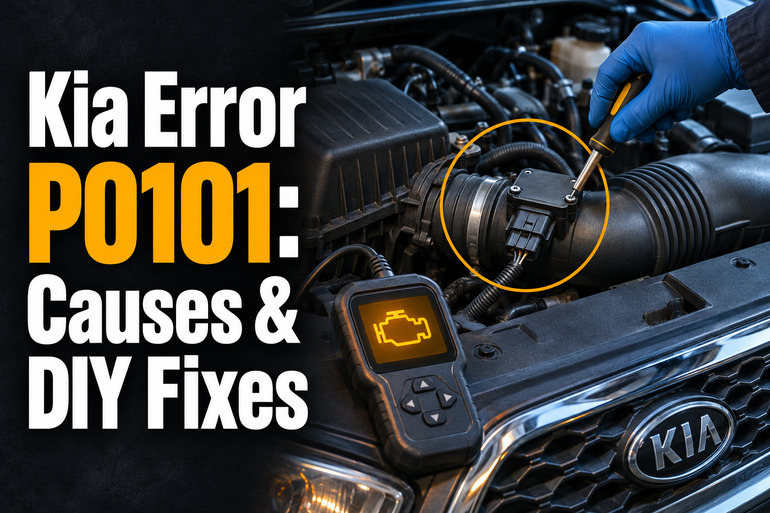
What P0101 Means on a Kia
P0101 means “Mass or Volume Air Flow Circuit Range/Performance.” On an engine equipped with a mass airflow sensor, commonly called a MAF sensor, the engine computer compares the sensor’s reading with the airflow it expects under current operating conditions. A large enough difference can trigger the code. That comparison helps explain why P0101 alone doesn’t prove the sensor has failed.
Where fitted, the MAF sensor measures air entering through the intake. The computer uses that information to help control fuel delivery. However, Kia engines don’t all use the same arrangement, and some don’t have a separate MAF sensor. Confirm your model year and engine before following instructions that tell you to locate, clean, or replace one.
An airflow measurement problem can cause rough idling, hesitation, stalling, or poor starting. You may notice the engine stumbling when you press the accelerator or the idle speed changing while you’re stopped. These symptoms overlap with other engine faults, so they’re useful clues rather than confirmation of one failed part.
Pay attention to how the vehicle behaves before attempting any checks. If the check engine light flashes while the engine is running, or the vehicle shakes badly, repeatedly stalls, or loses substantial power, stop somewhere safe and arrange assistance. A flashing light can indicate a serious misfire that threatens the catalytic converter. A steady light still needs prompt diagnosis.
Kia Error P0101: Common Causes
Several faults can interfere with airflow or make its reported value seem incorrect. The possibilities below provide a useful starting point, but their relevance depends on the equipment fitted to your Kia.
1. Air Leaking Through the Intake
On an engine with a MAF sensor, air should pass through the sensor before reaching the engine. A leak farther along the intake can let additional air enter without being measured, upsetting the relationship between measured airflow and actual engine operation.
Possible trouble spots include a split intake tube, a loose connection, or a damaged seal. Rubber tubing can develop cracks around its bends and folds, where the damage may be difficult to see from above. A problem that begins shortly after intake work makes disturbed connections worth checking.
However, the location matters. A loose airbox cover and a leak after the airflow sensor don’t affect the system in exactly the same way. Finding a gap is useful evidence, but the complete intake still needs to be checked before blaming the sensor. DENSO specifically includes intake leaks and damaged sensor seals among its installation checks.
2. A Contaminated or Damaged MAF Sensor
Where your Kia uses a MAF sensor, dirt or damage can change its readings without stopping its operation completely. The sensor may continue sending information that looks believable but doesn’t accurately reflect the air entering the engine.
Delphi identifies contamination, damaged measuring elements, and changes in sensor accuracy as possible failure causes. Consequently, a sensor can look intact while performing poorly. Equally, rough running doesn’t establish that it needs replacement. The reading must be assessed alongside the intake condition and the vehicle’s other diagnostic information.
3. A Restricted Filter or Disturbed Intake Duct
A clogged engine air filter or disturbed intake duct can affect airflow through the system. Kia’s service information for the 2005 Sorento lists a clogged air cleaner, a disconnected duct, and disturbed airflow as conditions to investigate when airflow readings are abnormal. That guidance supports checking the air supply before condemning a sensor.
The timing can offer a useful clue. If the warning appeared after an air filter replacement, check the filter fit and housing assembly first. If maintenance has been neglected, inspect for heavy contamination or damage. Still, a dirty filter doesn’t automatically explain P0101, and replacing it won’t correct an unrelated wiring or software problem.
4. Poor Electrical Connections or Damaged Wiring
The airflow sensor depends on sound electrical connections. A poor contact can interfere with its power supply or signal, leaving the engine computer with information it can’t use reliably. Delphi includes connector fit, electrical feeds, grounds, and wiring in its diagnostic checks.
A warning that appears after engine compartment work makes a disturbed connector worth considering. Visible damage near the plug, a broken locking tab, or wiring rubbing against another part also deserves attention. These observations identify an area for investigation without proving which circuit has failed.
Electrical testing must follow the correct diagram for the engine. Kia has used different airflow sensor designs, including sensors with voltage signals and others with frequency signals. A test value copied from another model can lead to the wrong diagnosis, even when the connector looks similar.
5. Throttle Deposits or Engine Computer Software
Some Kia applications have a documented repair path involving throttle cleaning and software. Kia bulletin FUE047 covers certain 2019 and 2020 Forte models with the Nu 2.0L MPI Atkinson engine. It addresses P0101, P0106, and P0068, individually or in combination, through an engine computer update and electronic throttle cleaning.
This makes the exact vehicle details especially useful. If your Forte falls within that group, checking bulletin applicability should come before buying an airflow sensor. However, matching the model year alone isn’t sufficient. The engine and installed software must also match the bulletin’s requirements, and an intake fault can still require separate attention.
Kia Error P0101: DIY Fixes
Begin with checks that preserve diagnostic information and reveal obvious intake problems. Then use the findings to decide whether a simple correction is reasonable or whether the vehicle needs testing with professional equipment.
1. Record the Codes and Confirm Your Engine
Connect an OBD II reader according to its instructions, with the vehicle parked securely. Record every stored and pending code before clearing anything. If the reader provides freeze frame information, save that too. Freeze frame data captures operating conditions when a fault was recorded and can help a technician understand when it occurred.
Write down your Kia’s model year, engine size, and recent service history. Also note whether the problem occurs during a cold start, at idle, or during acceleration. A photograph of the scanner screen is useful because it preserves the exact code rather than relying on a shortened description.
Avoid disconnecting the battery as an initial attempt to remove the warning. Resetting the computer can erase helpful information and reset emissions readiness monitors. It also leaves the original fault unresolved. Your first goal is a clear record of the problem, followed by a check of the components your particular engine actually uses.
2. Check the Engine Air Filter and Housing
With the engine off and cool, find the engine air cleaner using your owner’s manual. Open the housing as instructed and inspect the filter for damage, heavy dirt buildup, or an incorrect fit. Keep loose debris away from the opening that leads into the engine.
Replace a damaged or heavily contaminated filter with the correct specified part. Seat it evenly, then close the housing with its tabs, clips, or fasteners fully engaged. Kia’s filter guidance stresses preventing dirt from entering the intake and checking that the cover is firmly installed. Don’t run the engine with the filter removed.
Before closing the hood, check anything disturbed during the job. The housing should sit properly, and nearby tubing should remain connected. If the original fault began immediately after filter service, correcting a visible assembly mistake is a sensible first repair. However, an apparently clean filter doesn’t rule out another airflow problem.
3. Inspect Accessible Intake Tubing
Follow the large intake tube from the air cleaner along its accessible route. Use a flashlight to look around bends, underneath visible folds, and near connections. Keep the engine off, and avoid pulling hard on aging rubber. Look for an obvious split, a tube sitting crooked on its fitting, or a clamp that has moved away from its intended position.
If a connection is clearly displaced and the model’s instructions make correction straightforward, reseat it and secure it as specified. Don’t keep tightening a clamp against cracked rubber or damaged plastic. Arrange proper replacement for damaged parts. If no fault is visible, a workshop can check for hidden leaks rather than relying on guesswork or spraying chemicals around a running engine. DENSO recommends checking the entire intake for leaks during airflow sensor work.
4. Look for an Obviously Disturbed Connector
If your engine has an accessible MAF sensor, visually check its connector with the ignition off. Look for a plug that appears partly detached, a broken latch, or damaged wire insulation. Refer to the correct component diagram first so you don’t confuse it with another intake sensor. If an intact plug is plainly loose, reconnect it only as the service instructions allow.
Limit this check to what you can safely see and access. Don’t insert tools into terminals, pierce wires, or attempt repairs to exposed wiring. Photograph damage for the technician. A secure connection is part of diagnosis, but it doesn’t establish that the sensor’s signal is correct. Delphi recommends checking both connector contact and the wider circuit before replacing the sensor.
5. Confirm a Sensor Fault Before Cleaning or Replacement
Treat sensor cleaning cautiously. DENSO warns that cleaning a contaminated MAF sensor may offer only a temporary improvement and can damage its delicate parts. Unless the instructions for your exact sensor permit cleaning, avoid treating a spray cleaner as the standard solution to P0101.
When the intake checks don’t reveal a cause, the next useful step is evaluating sensor data against the correct vehicle specifications. Professional testing may include live readings and circuit checks. Delphi describes using diagnostic equipment, wiring information, and guided procedures to establish whether the sensor reports correctly. There’s no single reading that should be applied to every Kia engine.
If testing confirms a failed sensor, replacement may be manageable where access is simple and the service procedure is clear. Match the part to the engine and follow its installation instructions. Otherwise, let the shop complete the repair. Replacing a sensor solely because its name appears in a code description can leave you with the same warning and an unnecessary expense.
6. Contact a Qualified Kia Technician
Arrange professional diagnosis if P0101 returns, the simple checks reveal nothing, or the car runs poorly. Seek help immediately for severe symptoms rather than completing every DIY check first. Bring the code record, freeze frame information, and notes about recent repairs so the technician has useful evidence from the start.
For a potentially affected 2019 or 2020 Forte, ask about FUE047. The technician should confirm the engine and software identification before applying the bulletin. Its procedure includes electronic throttle service and computer programming, both of which require the correct equipment and instructions. It isn’t a universal update for every Kia displaying P0101.
After repair, ask how the result was verified. A cleared warning light alone doesn’t demonstrate that the problem is resolved. The engine should operate correctly, and the relevant diagnostic checks should support the repair. EPA guidance explains that scan tools help technicians verify repairs, while the vehicle’s own monitoring can turn the warning off once the fault no longer occurs.
Wrapping Up
P0101 gives you a starting point for diagnosis, but your Kia’s engine design determines what that starting point means. Identifying the vehicle correctly and preserving its diagnostic information can prevent wasted effort, especially when a generic scanner description seems to point straight to one component.
Begin with accessible checks that match your experience and the owner’s manual. If nothing clearly explains the fault, bring your findings to a qualified technician. Clear observations make the next decision easier and help keep the repair focused on the actual problem.