
Seeing “ECU hardware error” on a scan report can make an expensive repair seem unavoidable. However, that description alone doesn’t tell you which control unit has a problem or whether it needs replacement. Your Kia’s exact fault code, symptoms, and model all matter.
The first step is to identify the system reporting the error. From there, you can separate a power supply issue, damaged connection, software problem, or internal failure and choose the right repair without replacing parts on a guess.
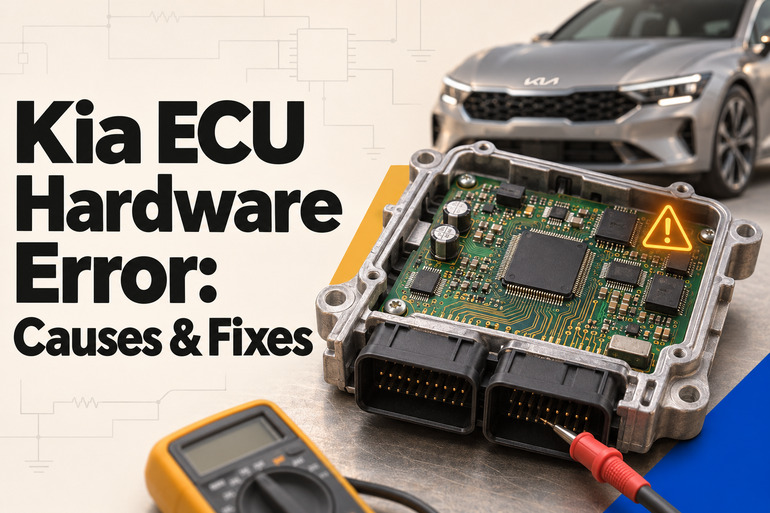
What a Kia ECU Hardware Error Means
ECU stands for electronic control unit. Although people often use the term for the engine computer, your Kia has other electronic controllers. Steering and braking systems also use them. Therefore, an ECU hardware error doesn’t automatically mean that your engine computer has failed.
Kia’s own service information shows why this distinction matters. Its steering bulletin CHA084 lists C1705 and C2413 as ECU hardware errors. Meanwhile, its Sportage recall documentation identifies C1604 as an ECU hardware error within the hydraulic electronic control unit, or HECU, associated with braking. The reporting system is essential to interpreting the code.
Your symptoms help establish the urgency. An engine control fault may involve a check engine light, while a steering or brake control fault may bring different warning lights and changes in assistance. Record what actually happens rather than assuming that every symptom comes from the same failed part.
If steering suddenly becomes difficult, braking feels abnormal, or the vehicle stalls repeatedly, stop somewhere safe and arrange qualified assistance. Kia warns that simultaneous ABS and brake warning lights can indicate problems affecting braking. Don’t continue driving to see whether a reset clears a safety concern.
Kia ECU Hardware Error: Common Causes
Several faults can lead to a control unit complaint or produce symptoms that resemble one. These possibilities need different checks, so the wording on a scanner should be treated as a starting point.
1. An Internal Control Unit Failure
A genuine internal fault remains one possibility. The controller may detect a problem within its own electronics and store a code identifying that condition. Depending on the system, it may also limit or disable assistance.
For certain Kia steering systems, the manufacturer’s diagnostic process includes checking connections and determining whether the fault returns before recommending ECU replacement. That sequence matters because replacing a controller before completing the checks can leave the underlying problem unresolved.
A fault that returns after the required checks gives the technician stronger evidence than a single stored description. Ask which tests support the replacement recommendation and whether they match your Kia’s exact model and steering system.
2. A Battery or Power Supply Problem
A low battery can create electronic symptoms that deserve attention before you approve a major repair. Kia’s steering guidance specifically separates battery voltage problems from certain internal controller faults. However, that doesn’t mean low voltage explains every hardware error.
Slow cranking or a recent discharged battery gives the technician useful context. Report whether the warning appeared before or after that event. A battery test can establish whether a supply problem needs correction, while the module’s diagnostic procedure determines whether it explains the stored code.
3. Poor Connections or Damaged Wiring
A loose connection, corroded terminal, or damaged wire can interfere with the electrical path a controller relies on. As a result, the symptoms may appear intermittently rather than remaining present every time you start the vehicle.
Kia’s steering repair guidance calls for checking connectors for poor contact, corrosion, damage, and deformation. It also distinguishes communication faults from other controller complaints. An intermittent warning therefore calls for careful diagnosis, especially if it began after nearby repair work. It doesn’t justify replacing the ECU solely because the scanner mentions it.
4. Moisture and Corrosion
Water damage is a documented concern on specific Kia vehicles. For example, recall SC138 covered certain 2008 and 2009 Sportage models whose HECU connector sealing could allow corrosion. Kia explained that moisture contaminated with road salt could reach the circuit board and cause electrical shorts.
That campaign included C1604 among the codes used in its repair procedure. However, this is a specific example with defined vehicle eligibility. It doesn’t establish that every Kia with C1604 has the same moisture problem.
A later campaign, SC253, addressed certain vehicles previously recalled under SC138 and included further HECU inspection and fuse replacement. If your Sportage falls within those model years, ask a dealer to check its campaign history. Previous recall work doesn’t establish that every later campaign has also been completed.
5. Software That Requires an Approved Update
Some controller complaints have a software remedy. A useful example is Kia service action SA377, which addressed P0606 on certain 2020 Soul 1.6T vehicles through an engine ECU logic update.
P0606 is an engine controller processor code, so it shouldn’t be treated as interchangeable with steering or braking hardware codes. This example shows why the technician should check applicable service information before condemning a controller. An update only belongs in the repair plan when Kia specifies it for the vehicle, installed software, and fault involved.
Kia ECU Hardware Error: DIY Fixes
The most useful checks begin with identifying the fault and gathering evidence. Some steps are safe to handle yourself, while electrical repairs, programming, and work on steering or braking controls belong with a qualified technician.
1. Save the Complete Scan Report
Before anyone clears the warning, photograph or save the diagnostic report. Record the full code, any suffix shown after it, the reporting module, and whether the scanner describes it as current or historical.
Also note the vehicle’s model year, engine, mileage, and symptoms. Include recent events such as a discharged battery, collision repair, or water entering the vehicle. These details help the shop choose the correct diagnostic procedure rather than relying on a generic code description.
Ask for a scan that covers the relevant systems. Kia’s steering bulletins instruct technicians to check other systems because related codes may appear in brake, ABS, or stability control menus. If your scanner cannot access those systems, its report may be incomplete.
2. Check the Battery’s Visible Condition
With the vehicle switched off, look at an accessible conventional 12 volt battery without disturbing its connections. Visible corrosion, a damaged case, or an unsecured battery deserves attention. Kia calls for keeping the battery securely mounted and its connections clean and tight.
Have a qualified shop test the battery and inspect any suspect connections. Keep sparks and flames away, and don’t handle a leaking or damaged battery. Battery designs differ across Kia models, so use your owner’s manual rather than assuming a conventional battery procedure applies to a hybrid or electric vehicle.
3. Review Fuse Information Without Bypassing Protection
Your owner’s manual and fuse panel label can help identify which circuits serve the affected system. Start by recording the relevant fuse names and noting whether other equipment has stopped working. That information can help the technician trace a power supply problem.
Follow the exact manual if it permits an owner to check or replace an accessible fuse. Kia requires the correct rating and warns against using wire, foil, or a higher capacity fuse. Leave bolted fuses, terminals, and related repairs to the dealer or a qualified technician.
If a replacement fuse blows again, stop replacing it. The circuit needs diagnosis. Also, don’t copy fuse changes described in an online recall document. Campaign repairs can specify different parts for particular vehicles, and those instructions require confirmation against the vehicle identification number, or VIN.
4. Check Recalls and Applicable Service Programs
Use your VIN to check for open safety recalls through NHTSA’s recall lookup. Then ask a Kia dealer to check for applicable service actions, warranty extensions, and technical bulletins. Keep the fault report available so the service adviser can compare the complaint with the relevant guidance.
Coverage depends on the vehicle and program terms. For example, Kia bulletin CHA114 describes an MDPS warranty extension for certain Optima and Sorento vehicles. It also distinguishes repairs for different steering designs. Ask the dealer to confirm eligibility and the current repair procedure before authorizing paid work.
5. Use Updates and Resets Only When Diagnosis Supports Them
Avoid treating battery disconnection or repeated code clearing as a repair. First preserve the report and establish what the code means for your vehicle. If a technician clears it during diagnosis, ask what conditions must be checked afterward to confirm the result.
When an approved software update applies, have a shop with the correct equipment perform it. Kia’s SA377 instructions require the proper software, a suitable power supply, and an uninterrupted programming process. Incorrect programming can leave the controller inoperative.
After the work, request confirmation that the update completed and the relevant fault checks passed. A warning disappearing immediately after code clearing doesn’t establish that the cause has been corrected. The repair needs verification under the conditions specified for that fault.
6. Contact a Qualified Kia Technician
Arrange professional diagnosis when the code remains active, returns after an attempted repair, or accompanies steering, braking, or engine operation problems. Seek help immediately when the vehicle cannot be controlled safely. You don’t need to complete every basic check before arranging a tow.
Choose a Kia dealer or an independent shop with suitable Kia diagnostic access. Ask for a written estimate that names the affected module and explains the evidence for repair or replacement. Useful questions concern the checks completed, the applicable service procedure, and any programming or calibration included in the price.
The correct repair may involve an individual component rather than an entire assembly. Kia’s steering guidance provides different repair paths for different faults and system designs. Before approving replacement, confirm that the proposed part matches the diagnosed failure and that the estimate includes the required checks afterward.
Wrapping Up
A Kia ECU hardware error needs a clear diagnosis before it needs a replacement part. The most useful information is the complete fault code, the module reporting it, and the symptoms you can describe. Those details help separate a documented internal failure from a supply, connection, or software issue.
Start by saving the scan report and checking your vehicle’s recall status. Then arrange the level of help your symptoms require. When steering or braking changes, prioritize safe transport and qualified inspection. A careful diagnosis gives you a sound basis for approving the repair.