
A Kia key that won’t turn in the ignition can leave you unable to start your car, even when the key slides into the ignition normally. Sometimes, the steering wheel feels unusually stiff, too. In other cases, the key gets stuck halfway through turning or refuses to move at all.
Fortunately, several causes are relatively simple to address. However, a worn ignition cylinder or damaged locking mechanism may require professional attention. Understanding what’s preventing the key from turning will help you find the right solution without causing further damage.
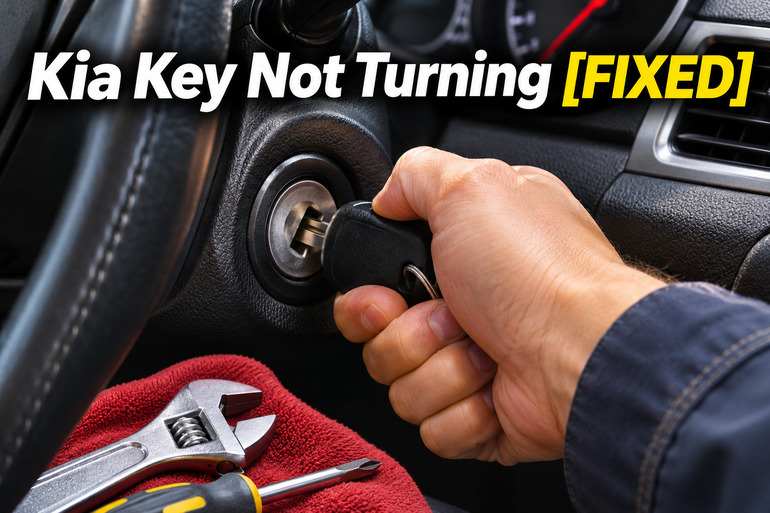
Why Your Kia Key Won’t Turn in the Ignition
When your Kia key refuses to turn, something is usually preventing the ignition lock cylinder from rotating. The cylinder is the part of the ignition assembly that accepts your key. Inside it are small locking components that must line up correctly before the key can turn. If the key is damaged, these components are worn, or another locking mechanism is engaged, the ignition may remain stuck.
On Kia vehicles equipped with a traditional ignition, the key normally moves through four positions: LOCK, ACC, ON, and START. The LOCK position allows you to remove the key, while ACC powers certain electrical accessories. Turning the key to ON activates the vehicle’s electrical systems, and START operates the starter motor. Kia’s owner’s manuals explain that steering lock pressure can sometimes prevent movement from LOCK to ACC.
The symptoms can help narrow down the problem. For instance, a key that won’t turn alongside a locked steering wheel often suggests pressure on the steering lock. If the key feels loose, sticks during insertion, or occasionally requires several attempts, wear inside the ignition cylinder becomes more likely. Meanwhile, difficulty returning the key to LOCK may be related to the transmission’s parking interlock.
It’s worth addressing these symptoms early, especially when the key has become increasingly difficult to turn. Repeatedly forcing a sticking ignition can damage its internal components or break the key inside the cylinder. Also, keep in mind that Kia models with push button starting systems have different starting mechanisms, so their troubleshooting procedures aren’t always the same.
Kia Key Not Turning [FIXED]: Common Causes
Several mechanical problems can prevent your Kia key from turning, although some are considerably more common than others. Identifying the circumstances surrounding the fault will help you determine which component deserves attention first.
1. Steering Wheel Lock Under Pressure
One of the first things to suspect when your Kia key won’t turn is the steering wheel lock. Many Kia vehicles with conventional ignition systems have an anti theft mechanism that prevents the steering wheel from rotating freely after the ignition is switched off.
This mechanism can engage when the steering wheel moves after you remove the key. If the wheel is left pressing firmly against the locking mechanism, the resulting tension may make it difficult to rotate the ignition cylinder. Parking with the wheels turned sharply or against a curb can sometimes contribute to this situation.
You’ll usually notice that the steering wheel moves slightly in one direction but feels completely blocked in the other. The key may enter the ignition without resistance, yet it won’t turn toward ACC. This combination strongly suggests that the steering lock needs to be released rather than that the key itself has failed.
Fortunately, the condition often doesn’t require replacement parts. Kia specifically recommends turning the steering wheel left and right while turning the ignition key to release the tension. The movement must be gentle because forcing either component can cause damage.
2. Worn, Bent, or Damaged Ignition Key
Your Kia’s ignition key must have the correct shape and grooves to operate the locking components inside the ignition cylinder. Over time, repeated insertion, removal, and everyday handling can wear down its edges.
As the key wears, the internal locking components may no longer line up correctly. Consequently, you might find yourself inserting the key several times before the ignition turns. A slightly bent key can produce similar symptoms because its shape prevents proper alignment inside the cylinder.
Damage can also develop when a key is dropped, twisted, or used to open objects. In some cases, a replacement key may be cut incorrectly, making it difficult or impossible to turn the ignition even though it looks similar to the original.
An important clue is whether another properly cut key works normally. If your spare turns the ignition smoothly while the original sticks, the original key is probably responsible. However, if both keys behave the same way, the ignition cylinder or another locking component deserves closer inspection.
3. Worn or Obstructed Ignition Lock Cylinder
The ignition lock cylinder contains small moving parts that recognize the shape of your key. With repeated use, these components can wear, become damaged, or stop moving freely.
Dust, dirt, and other foreign material can also interfere with the mechanism. If debris prevents the key from entering completely, the internal parts may fail to align, leaving the cylinder unable to rotate. Depending on the condition of the mechanism, you may feel resistance while inserting or removing the key.
A worn cylinder often produces symptoms that gradually become more noticeable. Initially, the ignition might occasionally stick before turning. Later, you may need several attempts to operate it, and eventually the key may stop turning altogether.
You should pay particular attention if the key becomes difficult to remove or feels as though it catches inside the cylinder. These symptoms can indicate internal wear rather than ordinary steering lock pressure. NAPA’s automotive guidance also identifies damaged keys, cylinder wear, and obstructions as possible causes of an ignition key refusing to turn.
4. Gear Selector or Ignition Interlock Problems
Some Kia vehicles with automatic transmissions use an ignition key interlock system. This system helps prevent the key from being removed unless the transmission is in Park.
If the gear selector hasn’t fully engaged the Park position, the interlock may prevent the ignition from returning completely to LOCK. As a result, you might find that the key turns partway but won’t return to the position needed for removal.
A related fault can develop when the mechanism responsible for recognizing the Park position becomes worn, misadjusted, or damaged. Depending on the model, the problem may involve the selector assembly, an interlock cable, or another part of the mechanism.
However, there’s an important distinction. A parking interlock fault is generally more relevant when the key won’t return to LOCK or come out of the ignition. It isn’t usually the first explanation for a key that won’t turn from LOCK toward START. Kia confirms that the ignition key interlock on equipped models prevents key removal unless the vehicle is in Park.
5. Faulty Steering Lock or Ignition Assembly
Sometimes, the problem goes beyond ordinary steering wheel pressure or key wear. Internal damage to the steering lock mechanism or ignition assembly can prevent the key from rotating even when everything appears to be positioned correctly.
The steering lock contains mechanical parts that engage and release as the ignition changes position. If these parts become damaged or jammed, turning the steering wheel may no longer release the lock. Similarly, a mechanical fault within the ignition assembly can prevent the cylinder from moving normally.
You may suspect this problem when the steering wheel remains locked despite careful attempts to release it, or when a known good key consistently refuses to turn. Grinding, catching, or unusually stiff movement can provide further clues. Because these components are located around the steering column and close to safety equipment, diagnosis and repairs are best handled by a qualified automotive technician.
Kia Key Not Turning [FIXED]: DIY Fixes
Start with the simplest checks before considering replacement parts. The following methods can help resolve common ignition problems while reducing the risk of damaging your Kia’s key or locking mechanism.
1. Release the Steering Wheel Lock
If your steering wheel feels locked and your ignition key won’t turn, relieving pressure on the steering lock should be your first step. This method is particularly useful when the problem appears suddenly after parking.
Make sure the vehicle is stationary, apply the parking brake, and place the transmission in Park if it’s an automatic. Then follow these steps.
- Insert your Kia key fully into the ignition.
- Hold the steering wheel and gently move it left and right to identify which direction allows a little movement.
- Apply steady, moderate pressure in that direction while gently turning the ignition key toward ACC.
- Once the steering lock releases, check whether the key turns normally.
You may feel the steering wheel release suddenly as the ignition moves out of LOCK. That generally indicates that pressure on the steering lock was responsible.
Avoid pulling aggressively on the wheel or twisting the key with excessive force. If the mechanism doesn’t release after a few careful attempts, stop and consider another cause. Continuing to force the assembly can turn a relatively simple problem into a more expensive repair.
2. Try Your Spare Kia Key
A spare key offers one of the easiest ways to determine whether the original key is causing the problem. However, you’ll need a spare that’s properly cut for your vehicle.
Remove the original key and examine its metal blade under good lighting. Look for obvious bends, damaged grooves, cracks, or unusual wear. Then insert the spare key completely and try turning the ignition gently.
If the spare operates normally, the original key is likely worn or damaged. You can then arrange for a replacement through an automotive locksmith or Kia dealer. Whenever possible, have the replacement cut from the correct key specifications rather than copying a heavily worn blade.
Don’t attempt to straighten a badly bent key with pliers. Bending it repeatedly can weaken the metal, increasing the chance of it breaking inside the ignition.
Also, many Kia keys contain an electronic transponder used by the vehicle’s immobilizer. A replacement may require proper programming before it can start the engine, even if its metal blade turns the ignition correctly.
3. Check the Gear Selector and Park Position
If your Kia key turns but won’t return to LOCK, check whether the transmission is fully in Park. This applies particularly to automatic models equipped with an ignition key interlock.
With the vehicle stationary, keep your foot on the brake and apply the parking brake. If the selector isn’t fully in Park, move it into P using the normal procedure. If necessary and safe, move the selector out of Park and back into Park to ensure that it engages properly.
Afterward, try turning the ignition toward LOCK without applying excessive force. If the key now moves normally and can be removed, the selector may not have been fully engaged previously.
If the problem keeps returning even when the selector is correctly positioned, there may be an issue with the Park position detection or interlock mechanism. A technician can inspect the system and determine whether adjustment or replacement is necessary.
Don’t attempt to bypass the ignition interlock or dismantle the gear selector assembly. These mechanisms help prevent unintended vehicle movement, and incorrect repairs can create safety risks.
4. Check the Ignition Opening for Obstructions
If your key won’t enter the ignition completely or feels unusually rough during insertion, inspect the key and visible ignition opening for contamination.
Start by removing the key and checking its metal surface for dirt or sticky residue. You can wipe the blade with a clean, dry cloth. Next, use a flashlight to examine the ignition opening without inserting anything into it.
If you notice a foreign object, broken piece of metal, or an obstruction that prevents the key from entering, avoid attempting to push it farther inside. A locksmith can remove trapped material using suitable equipment.
You should also avoid spraying household oil, WD-40, or an unidentified lubricant directly into the ignition. Some products can leave residue or attract dirt, and the correct treatment depends on the lock design.
After cleaning the key, insert it gently and check whether it reaches its normal depth. If it still sticks, there’s no reason to keep forcing it. Internal damage or accumulated contamination may require professional lock servicing.
5. Confirm the Correct Ignition Operation for Your Kia
Different Kia models don’t always use identical ignition mechanisms. Understanding how your particular system operates can prevent unnecessary troubleshooting and help you recognize when the problem involves another component.
On some older Kia models, turning the ignition from ACC back to LOCK requires pressing the key inward while rotating it. If your key won’t return fully to LOCK, consult your owner’s manual to see whether this procedure applies. Don’t force the key inward unless the manufacturer specifies that action for your model.
If your Kia has a push button starting system instead of a conventional ignition, the situation is different. A weak smart key battery, an undetected key, or a steering lock warning may prevent normal starting. Some Kia models display a message instructing the driver to press the START button while turning the steering wheel when the electronic steering lock doesn’t release.
It’s also useful to distinguish between a key that physically refuses to rotate and one that turns normally but won’t start the engine. If the key reaches START and the engine doesn’t crank, the issue may involve the battery, starting circuit, transmission starting conditions, or immobilizer.
A weak car battery or dead remote battery is generally not the reason a conventional metal ignition key physically refuses to turn. Keeping these symptoms separate helps you avoid replacing unrelated components.
6. Contact a Professional Automotive Technician
If your Kia key still won’t turn after checking the steering lock, key condition, and relevant transmission position, professional diagnosis is the safest next step.
A qualified automotive locksmith can examine the key and ignition cylinder, check for internal wear, and determine whether the cylinder can be repaired or needs replacement. An automotive technician or Kia dealer can investigate steering lock faults, damaged ignition assemblies, and problems involving the transmission interlock.
Seek professional assistance promptly if the key breaks inside the ignition, the cylinder feels severely jammed, or the steering lock won’t release. If the steering mechanism behaves abnormally while driving, stop safely and don’t continue driving until the issue has been assessed.
Before authorizing replacement parts, ask the technician to establish which component is actually defective. Replacing an ignition cylinder won’t solve every steering lock or interlock problem.
Also, if a new ignition lock or key is required, confirm that it will work with your vehicle’s immobilizer system. Depending on the Kia model and repair, key cutting, cylinder matching, or electronic programming may be necessary.
Wrap-Up
A Kia key that won’t turn can result from something as simple as pressure on the steering wheel lock or something more serious, such as internal ignition cylinder damage. The key is to pay attention to when the problem occurs, how the ignition feels, and whether a spare key works.
Start with the safe checks that match your symptoms, and avoid forcing a stubborn ignition. If the problem continues or returns frequently, have the affected mechanism inspected. Addressing the fault early can help prevent a broken key, a damaged ignition assembly, or another unexpected starting problem.