
A Kia Carnival that clicks, cranks without firing, or stays silent can leave you unsure where to begin. Although these symptoms all prevent you from getting moving, they can point to different problems, so replacing the battery or starter without checking the clues can waste money.
Your first step is to notice exactly what happens when you try to start it. From there, a few safe checks can help you decide whether you need a simple correction or professional diagnosis.
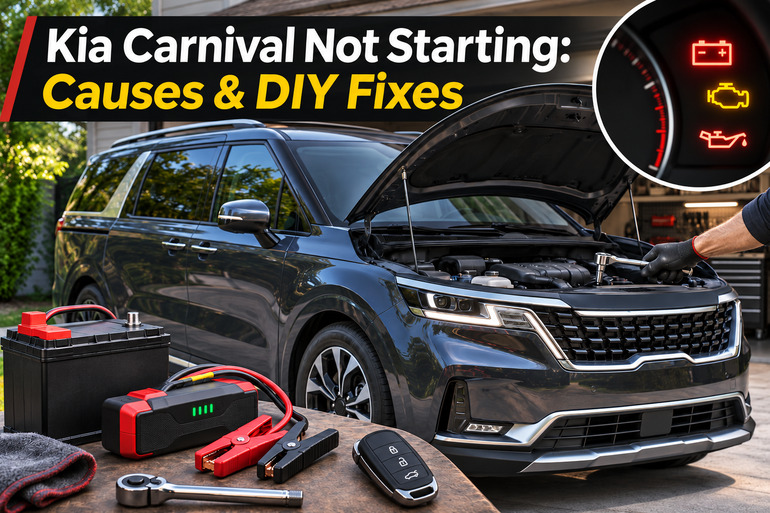
What It Means When Your Kia Carnival Won’t Start
Cranking means the engine is turning during a starting attempt. On a conventional gasoline Carnival, slow cranking or no cranking directs attention toward the battery, electrical connections, starter, and starting controls. If the engine turns at its usual speed but never runs, the investigation shifts toward fuel delivery and other systems needed for combustion. Kia separates these symptoms in its troubleshooting guidance.
A working radio or illuminated dashboard doesn’t establish that the starting system has enough power. Poor connections can restrict the current available to the starter, while a battery may need testing under load before its condition becomes clear. Treat electrical activity as a clue rather than proof that the battery is healthy.
The Carnival Hybrid needs a different interpretation. Its gasoline engine doesn’t have to run continuously after startup. A steady READY indicator means the hybrid system is ready for driving, even when the engine is quiet. Dashboard illumination without READY, however, shouldn’t be mistaken for successful startup.
Because starting procedures differ between model years and powertrains, use your vehicle’s own manual for specific instructions. Stop troubleshooting if you notice smoke, leaking fuel, or battery damage. A hybrid system warning also deserves prompt attention, particularly if READY flashes or the display tells you to stop safely.
Kia Carnival Not Starting: Common Causes
Several faults can produce similar starting symptoms, so one sound or warning rarely identifies the failed part. The following possibilities give you a useful starting point without treating any of them as a confirmed diagnosis.
1. A Discharged Battery or Poor Battery Connections
Slow engine rotation, clicking, or lights that dim sharply during a starting attempt can indicate inadequate electrical power. A discharged battery is one possibility, but dirty or corroded connections can also restrict current and make the starter turn slowly.
Consider what happened before the failure. Leaving the Carnival in accessory mode can discharge the vehicle battery. Kia also warns that external electrical equipment, including some dash cameras, can contribute to battery discharge while parked.
A successful jump start supports investigating the battery and its charging supply, but it doesn’t establish why the battery lost charge. If the problem returns, testing is more useful than repeatedly boosting the vehicle or buying another battery without a diagnosis.
2. A Smart Key That Isn’t Being Recognized
A “Key not detected” message points you toward key recognition. The fob might not be inside the vehicle, its battery may be depleted, or the vehicle may be having difficulty reading it. Kia provides a backup starting method for supported models when the smart key battery is weak.
The immobilizer, which is the security system that checks the key, must recognize an authorized key before allowing the engine to start. A damaged or unrecognized key therefore needs a different solution from an empty fuel tank. If a spare authorized key works, that gives the technician useful information about the original key.
3. The Starting Conditions Aren’t Being Met
Your Carnival needs the correct inputs before it will start. On models with push button starting, these include a recognized key, an acceptable gear position, and brake pedal input. Pressing the start button without pressing the brake can switch on accessories instead of starting the engine.
Read the display before assuming a component has failed. A request to press the brake or select Park may explain the interruption directly. However, if the message remains after you have followed it, the vehicle may not be recognizing the input correctly.
There is an important model distinction here. Some conventional Carnival manuals allow starting in Park or Neutral, but the U.S. 2025 Carnival Hybrid manual specifically requires Park and states that it cannot start in Neutral. Avoid applying a generic Neutral starting tip to every Carnival.
4. A Starter or Starting Circuit Fault
On a conventional gasoline Carnival, the starter turns the engine so it can begin running. If the battery is properly tested and the engine still won’t turn, the starter or its electrical supply becomes a stronger suspect. Wiring resistance and control circuit problems can prevent operation even when the battery itself is healthy.
A click alone doesn’t prove that the starter needs replacement. Diagnosis must distinguish an internal starter problem from inadequate power, poor connections, or a missing control signal. This explanation concerns the conventional starting system, so it shouldn’t be applied directly to the hybrid powertrain.
5. Fuel Delivery or Engine Control Problems
When the engine turns normally but doesn’t run, checking the fuel level is a sensible first step. If fuel is available, the engine may still lack the delivery or ignition conditions it needs. A fuel pump fault is one possibility, but pump wiring and electrical connections can also cause a starting failure.
Engine control sensors are another possibility. For example, Delphi identifies starting difficulty and stalling among the symptoms associated with crankshaft sensor problems. Those symptoms aren’t enough to condemn the sensor, though. Testing its signal and related wiring is necessary before deciding which part, if any, needs replacement.
Kia Carnival Not Starting: DIY Fixes
Begin with the checks that match your symptoms and stop if a warning indicates an unsafe condition. The aim is to correct simple problems and gather useful evidence before moving to repairs that require equipment or training.
1. Confirm the Starting Procedure and Record the Symptoms
Set the parking brake, confirm that the display shows Park, and bring the authorized key inside. For a push button model, hold the brake pedal down and press the start button normally, without pressing the accelerator. On the Carnival Hybrid, check for READY rather than waiting only for engine noise.
During that attempt, note whether you hear silence, clicking, slow cranking, or normal cranking without ignition. Photograph any warning message while the vehicle is stationary. Record whether the problem began after parking, refueling, battery work, or an earlier stall. These observations give a repair shop a clearer starting point than “it won’t start.”
If a brake prompt remains despite firm pedal pressure, check whether the brake lights illuminate using a reflection or help from another person. Missing brake lights need attention before driving. Kia notes that a blown stop lamp fuse can interfere with normal starting on certain models, but don’t bypass the starting controls or assume the fuse is the only possible fault.
2. Try the Authorized Spare Key or Backup Fob Method
If the display reports a key detection problem, try your spare authorized fob if one is available. For supported models, Kia also instructs owners to press the start button directly with the fob while holding the brake pedal down. Its 2026 Carnival guide specifies positioning the fob with the lock button facing the start button. Follow your own manual’s illustration.
If that works, replace the fob battery according to the manual, using the specified type and orientation. Then test normal starting again. If neither authorized key works, or the warning persists after battery replacement, arrange diagnosis of the key recognition system rather than attempting to disable the immobilizer.
3. Check for Battery Clues and Unnecessary Electrical Loads
Switch the vehicle off and unplug ordinary accessories such as removable chargers or a plug connected dash camera. Think about whether the vehicle spent a long time in accessory mode before the problem appeared. If a battery discharge warning continues after external equipment is removed, Kia recommends inspection.
For a conventional model with an accessible battery, limit your initial inspection to what you can see safely. Corrosion around terminals, damaged cables, or an obviously displaced connection are useful findings to report. Leave cleaning, tightening, and cable testing to someone qualified if you aren’t familiar with battery precautions. Poor battery cable connections can interfere with starting.
Have the battery tested before purchasing a replacement. Ask for the connections and charging system to be checked as well, especially if the battery has gone flat repeatedly. A replacement battery alone won’t resolve an underlying charging or electrical fault.
4. Use the Correct Jump Starting Procedure When Appropriate
A jump start may help when the symptoms and checks suggest insufficient battery power. First, locate the emergency starting instructions for your exact model and powertrain. Confirm the approved connection points and equipment requirements before attaching anything. Kia specifies a 12 volt supply in its conventional Carnival jump starting guidance.
Do not jump start a frozen, leaking, swollen, or otherwise damaged battery. If the battery condition or connection points are uncertain, use roadside assistance. On a hybrid, leave high voltage equipment untouched and follow only the manual’s approved low voltage recovery procedure.
After a successful start, arrange testing if the cause of discharge is unclear. Don’t assume a short drive will fully recharge the battery. Interstate notes that a battery needing a jump start may require a suitable charger to reach a full charge. If the vehicle still won’t start, stop repeated attempts and seek assistance.
5. Check the Fuel Level and Preserve Diagnostic Information
If the engine cranks normally, read the fuel gauge and consider whether the tank may be empty. Arrange safe fuel delivery if needed, using the fuel specified for your Carnival. If the trouble began immediately after suspected incorrect fueling, stop further starting attempts and arrange recovery.
When fuel is present and the engine still won’t run, leave fuel pressure testing and ignition checks to a technician. Don’t loosen fuel lines or use starting fluid as a shortcut. Record any earlier stalling, loss of power, or warning messages, and avoid clearing stored fault codes before the vehicle is examined. Fuel supply and sensor faults require testing that separates the actual failure from similar symptoms.
6. Contact a Qualified Automotive Technician
Arrange professional diagnosis when the basic checks don’t restore starting, the fault returns, or the engine stopped unexpectedly before refusing to restart. A conventional Carnival with a tested battery but no cranking needs assessment of its starting circuit. Normal cranking without ignition requires a different investigation.
Give the technician your observations, warning photographs, and the results of any spare key or jump starting attempt. Mention whether the vehicle is a hybrid at the outset. This helps the shop choose the correct diagnostic procedure and avoids repeating checks without useful context.
Request roadside recovery immediately for fuel leaks, smoke, battery damage, or serious hybrid warnings. Otherwise, a mobile technician may be able to assess a battery related problem where the vehicle is parked. The useful next step is a confirmed diagnosis, followed by a repair that addresses the reason your Carnival failed to start.
Wrapping Up
A Kia Carnival starting problem becomes easier to assess once you separate a silent or slow starting attempt from normal cranking without ignition. For a hybrid, the READY indicator provides another essential clue. Pay attention to those differences before deciding which part needs attention or spending money on a replacement.
Start with the correct starting procedure, dashboard messages, key recognition, and simple battery or fuel checks. If those steps don’t resolve the problem, pass your observations to a qualified technician so the next repair is based on evidence.