
Your Kia Forte should start when you turn the ignition key or press the start button. However, sometimes all you hear is a clicking sound, with no sign of the engine starting. This can be frustrating, especially when the dashboard lights and other electrical features still work.
Fortunately, a clicking sound can provide useful clues about what’s preventing your Forte from starting. Understanding those clues will help you identify possible causes and determine which fixes are worth trying.
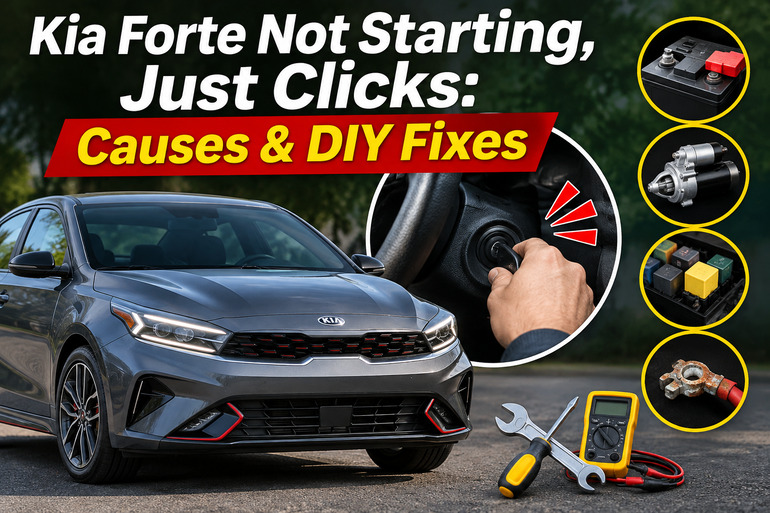
Why Your Kia Forte Clicks But Won’t Start
When your Kia Forte makes a clicking sound without starting, it usually means the starter system is receiving some electrical power but cannot turn the engine. The problem could involve the battery, electrical connections, starter motor, or another component responsible for starting the vehicle.
Normally, the battery supplies electricity to the starter motor when you turn the ignition key or press the start button. A small electrical switch called the starter solenoid engages the starter gear and allows the motor to turn the engine. If the available power is insufficient or the starter develops a fault, you may hear clicking instead of the usual engine cranking sound.
The type of clicking can help narrow down the problem. Rapid, repeated clicking often points to a weak battery or poor electrical connection. A single, louder click can indicate a faulty starter motor, although a discharged battery or damaged cable can produce similar symptoms.
You might also notice dim headlights, flickering dashboard lights, or electronic features resetting when you attempt to start the car. These signs suggest an electrical problem. However, if you hear grinding, notice smoke, or detect a strong burning smell, stop attempting to start the engine until a qualified technician has inspected the vehicle.
Kia Forte Not Starting, Just Clicks: Common Causes
Several faults can prevent your Kia Forte from starting, even when its electrical accessories appear to work normally. The following five causes are particularly relevant when you hear clicking but the engine doesn’t crank.
1. Weak or Discharged Battery
A weak or discharged battery is one of the most common reasons a Kia Forte clicks without starting. The starter motor needs considerably more electrical current than the dashboard lights, radio, or interior lighting. Consequently, your battery might have enough power to operate these accessories but lack the current needed to crank the engine.
This can happen when you leave the headlights or interior lights on while the vehicle is parked. Batteries also lose their ability to hold a charge as they age. Cold weather, frequent short trips, and extended periods without driving can make an already weakened battery more likely to cause starting problems.
When the battery cannot supply enough current, the starter solenoid may repeatedly engage and release, creating a rapid clicking sound. You may also notice that the dashboard lights flicker or become noticeably dimmer whenever you attempt to start the engine.
2. Corroded or Loose Battery Connections
Your Forte’s battery terminals provide the electrical connection between the battery and the vehicle’s systems. Over time, corrosion can develop around these connections, creating resistance that prevents sufficient current from reaching the starter.
Corrosion commonly appears as a white, bluish, or greenish deposit around the battery posts. Similarly, a loose battery clamp may interrupt the flow of electricity when the starter draws a large amount of current. As a result, the car can click repeatedly even when the battery itself has a reasonable charge.
The negative battery cable and engine ground connections also deserve attention. These provide the return path for electrical current, so a loose or damaged ground can produce symptoms similar to a weak battery. A battery test may appear satisfactory while the starting system still struggles because of resistance elsewhere in the circuit.
3. Faulty Starter Motor or Solenoid
The starter motor is responsible for turning your Forte’s engine until combustion can keep it running. Its solenoid helps engage the starter gear and connects the electrical power needed to operate the motor.
With age and repeated use, the starter’s internal contacts, brushes, or mechanical parts can wear out. The solenoid may still make an audible click when you attempt to start the vehicle, but the motor might fail to rotate. In some cases, the problem appears intermittently before the starter stops working completely.
A common clue is a single, distinct click accompanied by dashboard lights that remain relatively bright. You might also find that the engine occasionally starts normally after several unsuccessful attempts.
However, a single click does not automatically confirm starter failure. Low battery voltage, damaged cables, and poor ground connections can produce similar behavior. A technician should verify that the starter receives adequate power before recommending replacement.
4. Faulty Starter Relay or Starting Circuit
Your Kia Forte uses electrical controls to determine when the starter should operate. Depending on the model year and configuration, these can include a starter relay, ignition switch, transmission range switch, clutch switch, and associated wiring.
A damaged relay may click without reliably supplying power to the starter. Similarly, a faulty transmission range switch might prevent the vehicle from recognizing that the gear selector is in Park or Neutral. Problems with the ignition switch, related fuses, or wiring can also interrupt the starting process.
These faults often produce intermittent starting problems or complete silence, although some can cause audible clicking. The exact symptoms depend on which part of the starting circuit has failed. Kia Forte service information identifies relays, switches, fuses, and wiring among the possible causes of a no-crank condition.
5. Alternator Problems or Excessive Battery Drain
Sometimes the battery becomes discharged because another component isn’t maintaining its charge. The alternator normally generates electricity while your Forte’s engine runs, supplying electrical accessories and replenishing the battery.
If the alternator or charging system develops a fault, the battery may gradually lose its charge while driving. Eventually, it won’t have enough power to start the engine. You might notice a battery warning light, unusual electrical behavior, or repeated starting problems after the vehicle has been jump-started.
An excessive electrical drain while the vehicle is parked can produce similar symptoms. For example, a malfunctioning electronic module or improperly installed accessory may continue consuming electricity after you switch off the ignition. In either case, replacing the battery alone might temporarily restore normal starting without addressing the underlying fault.
Kia Forte Not Starting, Just Clicks: DIY Fixes
The right solution depends on whether your Forte has a discharged battery, a poor connection, or a fault elsewhere in the starting system. Begin with simple checks that don’t require dismantling electrical components, then proceed to battery testing and other appropriate fixes.
1. Confirm the Starting Conditions and Check the Symptoms
Before opening the hood, make sure your Forte is parked safely and the parking brake is engaged. If your vehicle has an automatic transmission or Intelligent Variable Transmission, place the gear selector firmly in Park. You can also try starting it in Neutral if your owner’s manual permits this. For a manual transmission, fully depress the clutch pedal.
If your Forte has push-button ignition, keep the smart key inside the vehicle and press the brake pedal while starting. Some Forte models also allow you to start with a weak smart key battery by pressing the engine start button directly with the appropriate end of the key fob. Follow the instructions for your model year.
Next, watch the interior lights while making one brief starting attempt. If they become very dim or go out, insufficient battery power is a strong possibility. If the lights stay bright and you hear one distinct click, the starter and its connections deserve closer attention. These observations provide useful clues, although they cannot establish a diagnosis by themselves.
2. Inspect and Clean the Battery Terminals
Open the hood with the engine switched off and locate the battery. Look closely at the positive and negative terminals for corrosion, damaged clamps, or visible signs of looseness. A secure connection should not move freely around the battery post.
If there is minor corrosion and you’re familiar with basic battery maintenance, you can clean the terminals using a battery terminal brush and a small amount of baking soda mixed with water. Wear protective gloves and safety glasses. Disconnect the negative cable first, followed by the positive cable, before cleaning the contact surfaces. Keep cleaning liquid out of the battery openings and away from surrounding electrical components.
Once the cleaned connections are dry, reconnect the positive terminal first and the negative terminal last. Make sure the clamps are secure without overtightening them. Some Forte models have a battery sensor attached to the negative terminal, which requires special care. If the clamps are damaged, heavily corroded, or difficult to remove, have a technician service them rather than forcing them loose.
Afterward, attempt to start your Forte again. If the engine now cranks normally, a poor battery connection may have been responsible.
3. Test the Battery’s Voltage and Condition
If the battery connections appear clean and secure, the next step is to determine whether the battery has enough charge. A digital multimeter can provide a useful initial reading.
With the engine off and the battery rested, set the multimeter to measure DC voltage. Place the red probe against the positive battery terminal and the black probe against the negative terminal. Avoid allowing the probes to touch each other or nearby metal parts.
A typical 12-volt automotive battery should measure around 12.6 volts or slightly higher when fully charged. A reading near 12.2 volts suggests that it is substantially discharged, while a reading around 12.0 volts indicates an even lower state of charge. These are general guidelines, since temperature and recent charging activity can affect the reading.
However, voltage alone doesn’t reveal whether a battery can supply sufficient starting current. A worn battery may show an acceptable resting voltage yet fail under the heavy load of the starter motor. If the result is uncertain, arrange a professional battery load test before purchasing a replacement.
4. Jump-Start Your Kia Forte Safely
If testing or the vehicle’s symptoms suggest a discharged battery, jump-starting may restore enough power to start the engine. You can use a suitable 12-volt portable jump starter or jumper cables connected to another vehicle’s 12-volt battery.
Before proceeding, inspect the battery for swelling, cracks, leaks, or other signs of damage. Never jump-start a damaged or frozen battery. Also, keep sparks, flames, and cigarettes away from the battery, since the gases produced by automotive batteries can be explosive.
For a conventional jumper cable setup, the general connection sequence in Kia Forte owner’s information is as follows.
-
Switch off both vehicles, place them in Park, and engage their parking brakes. Keep the vehicles from touching.
-
Connect the red jumper cable to the Forte’s designated positive connection, then connect its other end to the assisting battery’s positive terminal.
-
Connect the black cable to the assisting battery’s negative terminal. Attach the remaining black clamp to the designated solid metal ground point on your Forte, away from the battery and moving engine parts.
-
Follow the owner’s manual for starting the assisting vehicle and then attempt to start your Forte. Once it starts, disconnect the cables in the reverse order.
The exact connection points and operating steps may differ between model years, so use the instructions in your vehicle’s owner’s manual rather than relying solely on this general sequence. Kia also warns against using a 24-volt power supply or attempting to push-start the vehicle.
If the engine starts successfully, the battery was likely discharged or unable to supply sufficient current on its own. However, a successful jump-start doesn’t prove that the battery is defective. Have the battery and charging system tested to identify why the starting problem occurred.
If jump-starting fails after following the correct procedure, stop making repeated attempts and consider the possibility of a starter or electrical circuit fault.
5. Recharge or Replace the Battery if Necessary
A battery that became discharged because you accidentally left the lights on may still be usable. Once the engine starts, the alternator can replenish some of the lost charge. However, driving for a short period may not fully recharge a deeply discharged battery.
For a battery that needs substantial recharging, use a suitable automotive battery charger according to the battery manufacturer’s instructions and Kia’s guidance for your model. Some Forte manuals specify precautions for charging the battery outside the vehicle. If you’re unfamiliar with battery removal or charging procedures, a battery service technician can handle this safely.
On the other hand, a battery that repeatedly fails a load test, cannot hold its charge, or shows physical damage may require replacement. Choose a replacement with the correct size, type, terminal arrangement, and electrical rating for your particular Forte.
After fitting a suitable battery, the engine should crank at its normal speed if insufficient battery power was the only problem. If the clicking continues with a verified healthy battery and clean connections, further diagnosis is necessary.
6. Check Relevant Fuses and Starting System Warnings
A blown fuse or starting control problem can sometimes prevent your Kia Forte from activating the starter. With the ignition off, locate the fuse boxes using your owner’s manual and identify any accessible fuses associated with the starting system.
If you find a blown, user-serviceable fuse, replace it only with one of the same specified type and amperage. Never install a higher-rated fuse or bridge its terminals with metal. If the replacement blows again, stop and arrange professional electrical diagnosis. Also, pay attention to warnings involving the smart key, immobilizer, or gear selector, since these may indicate that the vehicle isn’t authorizing a start.
If the fuse appears normal and the car continues clicking, avoid attempting to bypass the starter relay or connect power directly to the starter motor. Such tests involve high electrical current and can cause injury, component damage, or unexpected engine operation. These checks are better handled by an automotive technician.
7. Contact a Qualified Automotive Technician
If your Forte still won’t start after checking the battery, connections, and basic starting conditions, a qualified mechanic can determine which component is preventing the engine from cranking.
A technician can perform battery load testing, measure voltage loss through the starter cables, inspect engine ground connections, and test the starter motor and its control circuit. These tests help distinguish a defective starter from a faulty relay, switch, or wiring connection without replacing parts unnecessarily.
Professional attention is particularly important if the car repeatedly needs jump-starting, the battery warning light stays illuminated while driving, or the vehicle makes grinding noises during starting attempts. Smoke, overheating cables, or a damaged battery also require immediate attention.
Although a faulty starter may need replacement, an electrical connection or battery problem could be considerably simpler to repair. Proper diagnosis helps ensure that you pay for the component that actually needs attention.
Wrap-Up
A Kia Forte that clicks but refuses to start usually has a problem somewhere in its battery or starting system. Fortunately, the sound itself, along with the behavior of your dashboard lights and other electrical accessories, can help you narrow down the possibilities.
Start by confirming the correct starting conditions, checking the battery connections, and testing the battery’s condition. If those checks don’t identify the problem, professional diagnosis is the safest way forward. Addressing the fault promptly can prevent repeated starting failures and help restore dependable operation without unnecessary repairs.