
Your Kia Sonet refusing to start while displaying a “Check ESC” warning can be frustrating, especially when the dashboard lights come on but the engine won’t respond. Sometimes, you might hear a clicking sound, while other times, pressing the start button produces no response at all.
Although the warning points toward the vehicle’s stability control system, the starting problem may involve something else. Understanding what triggers these symptoms can help you identify the fault and avoid unnecessary repairs.
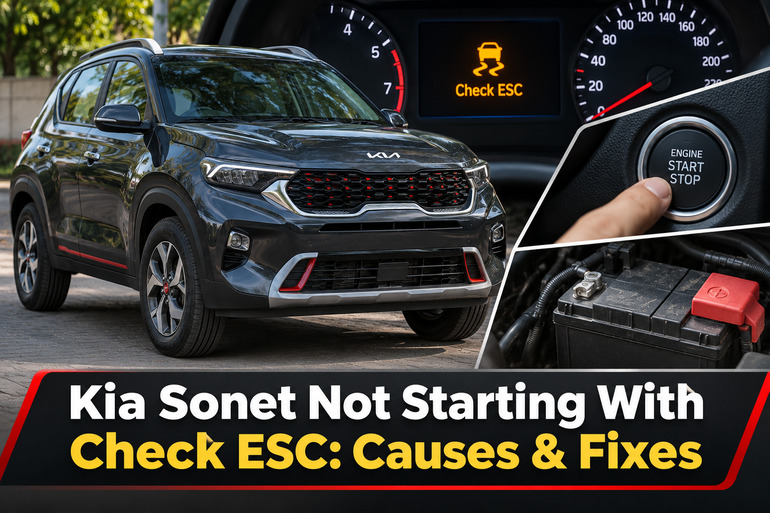
What Does Check ESC Mean on a Kia Sonet That Won’t Start?
The “Check ESC” warning relates to your Kia Sonet’s Electronic Stability Control system. ESC helps maintain vehicle stability by controlling engine power and applying braking force to individual wheels when the system detects a possible loss of traction. It’s particularly useful when turning or driving on slippery surfaces.
When the ESC system detects a malfunction, its warning indicator may remain illuminated. However, an ESC fault doesn’t automatically mean the engine cannot start. The warning and starting problem may share an electrical cause, or two separate faults may be present.
Pay attention to how your Sonet responds when you attempt to start it. A weak battery might cause rapid clicking, dim dashboard lights, or no cranking. A faulty starting interlock may leave the dashboard illuminated without engaging the starter. If the engine cranks normally but won’t fire, the problem may involve fuel delivery, ignition, or engine management.
Also, distinguish a genuine warning from normal system behavior. According to Kia’s Sonet owner’s manual, the ESC indicator normally illuminates for approximately three seconds when the ignition is switched on. A warning that remains after startup or repeatedly returns requires attention. A brief warning during an unsuccessful start does not, by itself, identify a defective ESC component.
Kia Sonet Not Starting With Check ESC: Common Causes
Several electrical and mechanical faults can prevent your Kia Sonet from starting while an ESC warning appears. The most useful clues are the condition of the battery, the response of the starter, and any additional dashboard messages.
1. Weak Battery or Poor Battery Connections
A weak 12V battery is one of the first things to investigate when your Sonet won’t start and several dashboard warnings appear. The battery supplies the electrical power needed to operate the starter motor, control modules, and other electronic systems.
When the battery voltage drops too low, the starter may struggle to turn the engine. At the same time, the vehicle’s electronic modules may receive insufficient power, resulting in warning lights or interrupted system checks.
Kia acknowledges that low battery voltage can temporarily illuminate ESC and other warning indicators during automatic engine restarts. This demonstrates why an ESC warning may accompany a battery problem without indicating that the ESC system itself has failed.
A discharged battery can develop after the vehicle remains unused for an extended period, electrical accessories are left running, or the charging system fails to replenish its power. Loose or corroded battery terminals can produce similar symptoms because they interrupt the electrical connection.
Watch for slow cranking, repeated clicking, flickering dashboard lights, or headlights that become noticeably dimmer when you attempt to start the engine. However, bright headlights don’t completely rule out a weak battery, since starting the engine requires much more current.
2. Faulty Brake Switch or Incorrect Starting Conditions
Your Kia Sonet has starting requirements that depend on its transmission and ignition system. Automatic versions generally require the transmission to be in Park or Neutral, along with the appropriate brake pedal input.
Manual transmission versions require the clutch pedal to be fully depressed, while intelligent manual transmission models use a different starting procedure. If the vehicle doesn’t recognize the required input, it may refuse to engage the starter.
A faulty brake light switch can create this problem on compatible push button start models. The switch provides information about brake pedal operation, and problems with its electrical circuit may prevent the starting system from recognizing that you’re pressing the pedal.
You might notice that the brake lights don’t illuminate, the transmission selector behaves unusually, or the dashboard displays a message instructing you to press the brake pedal.
The ESC warning may be a separate issue, so avoid assuming the brake switch is responsible without checking its operation. Kia also identifies a blown stop lamp fuse as a possible reason some Sonet models cannot start normally.
3. Smart Key Detection or Immobilizer Problems
If your Sonet uses a smart key and push button ignition, the vehicle must recognize an authorized key before allowing the engine to start.
A weak smart key battery, communication interference, or a fault in the key recognition system may prevent that recognition. Depending on the problem, the ignition might switch on without the engine starting, or the dashboard may display a key detection warning.
The immobilizer provides another layer of security by preventing unauthorized engine starting. If it cannot verify the key properly, the engine may remain disabled even when other electrical systems appear to work.
Look for messages such as “Key not detected” or “Key not in vehicle.” An immobilizer warning may also flash. These clues are especially helpful when the dashboard lights are normal but the starter doesn’t respond.
Although the ESC warning could appear at the same time, the key recognition fault requires its own diagnosis.
4. ESC, ABS Sensor, or Electrical Communication Faults
The ESC system relies on information from several electronic components, including wheel speed sensors and other sensors that monitor vehicle movement. It also communicates with other control systems to manage braking and engine power.
If a sensor provides incorrect information or an electrical connection fails, the system may register a fault and illuminate the ESC indicator. A damaged wheel speed sensor cable, faulty control module, or communication problem could be responsible.
These faults can become noticeable after electrical repairs, exposure to moisture, or physical damage near a wheel. However, the warning alone cannot establish which component has failed.
A genuine ESC fault usually affects stability control operation rather than directly preventing the engine from starting. When the Sonet displays an ESC warning and refuses to start, a shared power supply or communication problem deserves particular attention.
For example, a poor electrical connection or failing control module could interfere with multiple vehicle systems. If the ABS warning, steering warning, or other messages appear alongside “Check ESC,” those additional clues may help a technician narrow down the problem.
Proper diagnosis requires checking fault codes and the relevant electrical circuits before replacing sensors or modules.
5. Starter Motor or Engine Management Problems
Sometimes, the Sonet won’t start because of a conventional starting or engine fault, while the ESC warning is a separate symptom.
A faulty starter motor, starter relay, or associated electrical connection can prevent the engine from turning over. You may hear a single click, repeated clicking, or no response when pressing the start button.
If the engine cranks at its normal speed but doesn’t start, the investigation changes. Possible faults include fuel delivery problems, ignition system issues on gasoline engines, or an engine management sensor malfunction.
Diesel versions may experience starting difficulty because of fuel filter restrictions or fuel system faults. These issues don’t automatically indicate a problem with the ESC system.
The distinction matters because replacing stability control components won’t repair a defective starter or restore missing fuel pressure. Identifying whether the engine cranks is therefore one of the most useful early diagnostic steps.
Kia Sonet Not Starting With Check ESC: DIY Fixes
The correct solution depends on what is preventing your Sonet from starting and why the ESC warning has appeared. Begin with simple checks that don’t require dismantling electrical systems or replacing expensive components.
1. Switch Off the Ignition and Check the Warning Messages
Start by placing the vehicle in a safe, stationary position and applying the parking brake. Switch off the ignition, turn off unnecessary electrical accessories, and wait briefly before attempting another normal start.
This allows the vehicle to perform another startup check. A temporary electronic communication problem may disappear, although restarting the system won’t repair a faulty sensor, damaged wiring, or weak battery.
When you switch on the ignition again, observe the dashboard carefully. Check whether the ESC warning remains visible and whether other warning messages appear.
Pay particular attention to messages involving the brake pedal, transmission position, smart key, battery, or immobilizer. These may provide a more direct explanation for the starting failure.
If the engine starts successfully, watch whether the ESC warning clears after its normal startup check. If the warning remains illuminated, don’t assume the problem has been repaired simply because the engine now runs.
Avoid repeatedly cycling the ignition or cranking the engine for long periods. Excessive attempts can drain the battery further and make diagnosis more difficult.
2. Confirm the Correct Starting Procedure
Before suspecting a failed component, make sure the Sonet is receiving the required starting inputs.
Different transmission versions have different procedures, so follow the instructions for your particular model.
For automatic or dual clutch transmission versions with push button start:
- Apply the parking brake and keep your foot firmly on the brake pedal.
- Confirm that the transmission selector is fully in Park.
- Make sure the smart key is inside the vehicle.
- Press the ENGINE START/STOP button normally.
- If the engine doesn’t start, check the dashboard for any message about the transmission or brake pedal.
Some versions also permit starting in Neutral. However, only attempt this while the vehicle is stationary, properly secured, and in accordance with the owner’s manual.
For conventional manual transmission models, select Neutral and fully depress the clutch pedal before starting. Some models also require the brake pedal. Intelligent manual transmission versions have separate requirements, including selecting Neutral and pressing the brake.
Kia’s official starting instructions explain these differences.
If the Sonet starts after correcting the pedal or selector position, the immediate problem may have been an unmet starting condition. However, repeated failure to recognize the correct position could indicate a defective switch or sensor requiring professional inspection.
3. Check the Battery and Arrange a Proper Jump Start if Necessary
Because weak battery voltage can affect several systems simultaneously, checking the battery is particularly useful when the ESC warning appears with a no-start condition.
With the engine and ignition switched off, open the hood and visually examine the battery area. Look for loose connections, obvious corrosion around the terminals, or damage to the battery casing.
A white or bluish buildup around a terminal can suggest corrosion. However, avoid touching exposed deposits or attempting repairs if the battery is leaking, swollen, hot, or visibly damaged.
If the terminals appear damaged or loose, have them serviced rather than forcing the connections into place.
A battery test is more reliable than judging its condition from the dashboard lights. A technician can check the battery’s charge, starting performance, and charging system.
If the battery is discharged, a properly performed jump start may restore enough power to start the vehicle.
Kia specifies a 12V booster system for the Sonet and warns that incorrect jump starting can cause serious injury or electrical damage. Follow the exact procedure in the Sonet jump starting instructions, or have a qualified roadside assistance technician perform it.
Never attempt to jump start a frozen, leaking, or damaged battery.
If the engine starts after receiving external battery power, have the battery and alternator tested. A battery that repeatedly loses charge may be worn out, or the charging system may not be working properly.
Also, check whether the ESC warning disappears after normal battery power is restored. If it remains illuminated, the stability control system may have an independent fault.
4. Try the Smart Key Backup Starting Method
If your Sonet has push button ignition and displays a key detection warning, the smart key may be responsible for the starting problem.
First, make sure the key is inside the vehicle and away from objects that might interfere with its signal. If you have a second programmed smart key, try using it to start the vehicle.
When the spare key works normally, the original key or its battery becomes a stronger suspect.
Kia also provides a backup starting method for compatible Sonet models. If the smart key battery is weak or the key isn’t functioning normally, the engine may still start when the key is placed directly against the ENGINE START/STOP button.
Follow these steps where supported by your vehicle’s manual.
- Sit in the driver’s seat with the smart key.
- Secure the vehicle and select the correct transmission position.
- Depress the required brake or clutch pedal.
- Hold the smart key directly against the start button, making contact at a right angle.
- Press the button using the key while maintaining the required pedal input.
This procedure allows the vehicle to recognize the key through its backup detection method.
If the engine starts, replace the smart key battery with the correct type specified for your key.
However, if neither key works and the immobilizer warning remains active, the fault may involve the vehicle’s key detection antenna, immobilizer system, or related electronics. These components require proper diagnostic equipment.
5. Check the Brake Lights and Relevant Fuse Circuit
A malfunctioning brake switch or stop lamp circuit can prevent certain Sonet models from starting normally.
A useful initial check involves observing the brake lights. Ask another person to stand safely behind the parked vehicle while you press and release the brake pedal.
The brake lights should respond normally. If they remain off or stay illuminated after releasing the pedal, the brake switch or its circuit may need attention.
However, brake light behavior alone doesn’t confirm the condition of the starting interlock.
Next, consult your owner’s manual for the location and identification of the relevant stop lamp or brake switch fuse. Fuse panel layouts and labels may differ between model years and equipment versions.
If a blown fuse is suspected, arrange for it to be inspected and replaced using the manufacturer’s safety procedure. Any replacement must have the specified rating.
Never install a higher-rated fuse or bridge the circuit with wire or foil. If the replacement fuse blows again, the circuit needs professional electrical diagnosis.
Kia’s Sonet manual also describes an emergency starting method for some push button models when the stop lamp fuse has blown. It involves holding the start button for 10 seconds from the ACC position.
Because this procedure bypasses the usual brake input requirement, use it only if the exact instructions apply to your model and the problem has been identified. It isn’t a general solution for an ESC warning.
If your brake lights aren’t functioning, don’t drive the vehicle until they have been repaired. Other drivers need those lights to recognize when you’re slowing down or stopping.
6. Read the Fault Codes With a Suitable Diagnostic Scanner
If the battery, starting procedure, and smart key appear normal but the warning persists, diagnostic fault codes can help identify the affected system.
Modern vehicles store diagnostic trouble codes when electronic control modules detect certain problems.
However, a basic engine code reader may not access the Sonet’s ABS and ESC control systems. You’ll need a scanner that supports the relevant Kia vehicle systems.
Ask a qualified technician or use suitable diagnostic equipment to check the stored codes. The results may indicate problems involving wheel speed sensors, brake switch signals, electrical supply, or communication between control modules.
A code identifies the system or condition that needs investigation. It doesn’t always prove that the named component is defective.
For example, a wheel speed sensor fault code could result from the sensor itself, damaged wiring, an electrical connection, or another related issue.
Record the codes and their descriptions before any repairs are attempted. Avoid clearing fault codes simply to switch off the warning light, because doing so can remove useful diagnostic information without correcting the underlying problem.
7. Contact a Qualified Kia Technician
If the Sonet still refuses to start after the basic checks, the next step is professional diagnosis.
A qualified Kia technician can test the battery under load, inspect the starting circuit, verify the brake and transmission input signals, and check communication between the vehicle’s electronic control modules.
If the ESC warning is genuine, the technician can examine the ABS and stability control systems using suitable diagnostic equipment. This may involve checking sensor signals, electrical connections, and stored fault codes.
Explain exactly what happens when you try to start the vehicle. Mention whether the starter clicks, whether the engine cranks, which dashboard warnings appear, and whether the problem began after battery replacement or another repair.
These observations can reduce unnecessary testing and help identify the fault.
If the ESC warning remains active after the engine starts, have the system inspected before relying on the vehicle for regular driving. A malfunction could reduce the assistance available from stability control.
If additional brake system warnings appear, braking feels abnormal, or the vehicle develops steering problems, stop using it and arrange professional assistance. Towing is the safer option when the vehicle’s condition is uncertain.
Wrap-Up
A Kia Sonet that won’t start while displaying “Check ESC” needs careful diagnosis because the warning doesn’t always identify the cause of the starting failure. Battery condition, starting inputs, key recognition, and the vehicle’s electronic systems all deserve attention before any parts are replaced.
Start with the simple checks that match your symptoms, and avoid attempting repairs that require specialized equipment. If the warning persists or the engine still refuses to start, a qualified Kia technician can identify the underlying fault and help restore reliable, safe operation.