
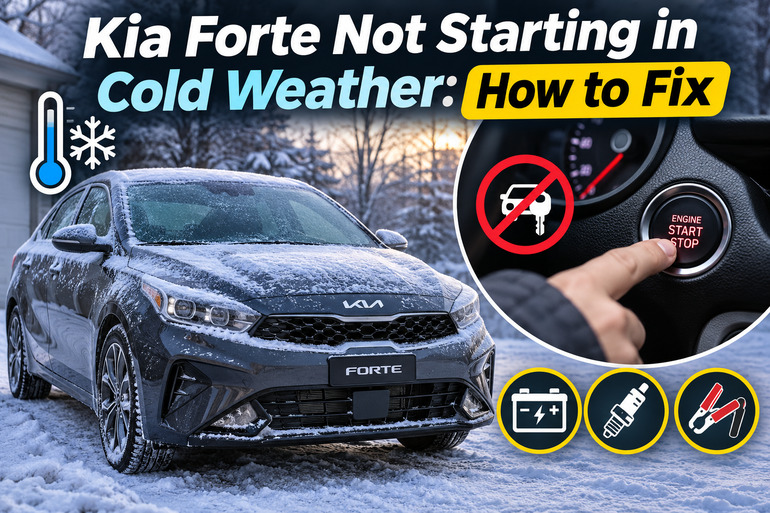
Cold mornings can make starting your Kia Forte surprisingly difficult, even if the car worked perfectly the previous day. You might hear the engine struggling to turn over, notice repeated clicking sounds, or find that nothing happens when you try to start it.
Cold weather places extra demands on several vehicle components, especially the battery and starting system. Understanding what causes these problems can help you identify the fault, avoid unnecessary repairs, and get your Forte running reliably again.
Why Your Kia Forte Struggles to Start in Cold Weather
Your Kia Forte relies on several components working together to start its engine. The battery supplies electrical power, the starter motor turns the engine, and the ignition and fuel systems provide what the engine needs to begin running. A problem with any of these systems can prevent your car from starting.
Cold temperatures make this process harder. The chemical reactions inside the battery slow down, reducing the power available for starting. Meanwhile, engine oil becomes thicker as temperatures fall, increasing the effort required to turn the engine. These changes can expose weaknesses that aren’t noticeable during warmer months.
The symptoms often provide useful clues. Slow cranking or repeated clicking usually points toward a battery or electrical problem, while a complete lack of response may indicate a starting control or starter circuit fault. If the engine turns over at its normal speed but refuses to run, the problem may involve fuel delivery or ignition.
However, cold weather doesn’t automatically mean the battery has failed. A worn starter motor, poor electrical connection, or existing engine problem can produce similar symptoms. Identifying whether the engine cranks normally, cranks slowly, or doesn’t crank at all is the most useful starting point for diagnosis.
Kia Forte Not Starting in Cold Weather: Common Causes
Several faults can prevent a Kia Forte from starting during freezing weather. Some become noticeable only when temperatures drop, while others may have been developing gradually before winter arrived.
1. Weak or Discharged Battery
A weak battery is one of the most common reasons a Kia Forte struggles to start in cold weather. Your battery uses chemical reactions to produce electrical energy, and these reactions become less effective as temperatures fall. Consequently, a battery that starts your engine comfortably in warm weather may struggle when it’s freezing outside.
This problem becomes particularly noticeable as the battery ages. Batteries gradually lose their ability to store and deliver electrical power. Frequent short trips, extended periods without driving, and accessories left running while the engine is off can also contribute to a low charge.
You may hear several rapid clicks when attempting to start your Forte, or the engine might turn unusually slowly before stopping. The dashboard lights may also flicker or become noticeably dimmer during cranking. According to AAA’s cold weather battery guidance, slow cranking and dim lights are common warning signs of a weakening battery.
2. Corroded or Loose Battery Connections
Even a healthy battery can struggle to start your Forte if its electrical connections are poor. The battery terminals connect the battery to the vehicle’s electrical system, allowing current to reach the starter motor and other components.
Over time, corrosion can develop around these connections. It often appears as a white, greenish, or bluish powder around the battery terminals. Loose connections can also increase electrical resistance, preventing the starter from receiving enough power.
You might notice that the dashboard lights work normally until you try starting the engine. Sometimes the car starts after several attempts, while other times it produces only a clicking sound. Cold temperatures increase the demand on the electrical system, making existing connection problems easier to notice.
3. Incorrect or Excessively Thick Engine Oil
Your Kia Forte’s engine oil helps protect moving components by reducing friction. However, engine oil becomes thicker when temperatures drop, making it harder for the starter motor to turn the engine during cold starts.
Using oil with an unsuitable viscosity can make this problem worse. Viscosity describes how easily oil flows. If the oil is thicker than the grade specified for your engine, starting may become noticeably more difficult in freezing conditions.
For example, the 2023 Kia Forte owner’s manual specifies full synthetic SAE 5W-20 for its 2.0 liter engine and SAE 5W-30 for its 1.6 liter turbocharged engine. These specifications should not be assumed to apply to every model year. Always use the oil grade recommended for your particular Forte.
4. Faulty Starter Motor or Starting Controls
The starter motor is responsible for turning the engine until combustion begins. Like other mechanical components, it can wear out over time, making it less effective at starting the engine.
When temperatures fall, the starter has to overcome greater resistance from the cold engine. An aging starter motor, worn internal contacts, or a faulty starter solenoid may struggle under these conditions. You might hear a single loud click when attempting to start the vehicle, even though the dashboard lights remain bright.
However, a clicking sound doesn’t confirm starter failure. A weak battery or poor cable connection can produce almost identical symptoms.
Starting controls can also prevent the engine from turning. Depending on your Forte’s model and transmission, the vehicle must recognize the correct gear position, brake pedal input, or clutch pedal input before allowing the engine to start. A weak smart key battery or failed key recognition can create a similar no-start condition.
5. Ignition or Fuel Delivery Problems
If your Kia Forte’s engine turns over at its normal speed but refuses to start, the problem may involve fuel delivery or ignition. The engine needs the correct amount of gasoline and a properly timed spark to begin running.
Worn spark plugs or faulty ignition coils can prevent the fuel mixture from igniting correctly. In some cases, these faults cause difficult starting, rough idling, or engine misfires before they eventually result in a complete starting failure.
Fuel system problems can produce similar symptoms. A failing fuel pump, restricted fuel delivery, or incorrect information from an engine temperature sensor can interfere with starting. Although cold weather may make an existing fault more noticeable, these components require proper testing before they can be identified as the cause.
Kia Forte Not Starting in Cold Weather: DIY Fixes
The right solution depends on what happens when you attempt to start your Forte. Begin with simple checks that help distinguish a discharged battery from a starting system or engine problem before considering replacement parts.
1. Confirm the Starting Procedure and Check the Smart Key
Start by making sure your Forte is in the correct condition to start. For automatic transmission models, place the gear selector firmly in Park and apply the parking brake. Press the brake pedal fully before turning the key or pressing the engine start button.
If you drive a manual transmission Forte, shift into Neutral and press the clutch pedal fully, along with the brake pedal as instructed in your owner’s manual. Avoid pressing the accelerator while starting the engine. Kia recommends starting its gasoline engines without accelerator input.
For models equipped with a smart key, check whether the dashboard displays a message indicating that the key isn’t detected. If the smart key battery is weak, some Forte models allow you to start the engine by pressing the start button directly with the key fob. The 2023 manual specifies placing the side with the lock button against the start button at a right angle. Replace the fob battery if this procedure works, and follow your particular model’s instructions.
2. Inspect the Battery and Its Connections
If the engine cranks slowly or refuses to crank, inspect the battery before assuming the starter motor has failed. Switch off the ignition, headlights, climate control, and other electrical accessories. Make sure the vehicle is parked safely before opening the hood.
Look at the battery casing and visible connections. Check for corrosion around the terminals, damaged cable insulation, or connections that appear loose. A battery with a swollen case, cracks, leaks, or signs of freezing requires professional attention. Don’t attempt to jump-start or charge it.
If you find corrosion or loose connections, arrange for them to be cleaned and secured safely. Avoid touching exposed conductors with metal tools or attempting repairs without the proper equipment. Once the connections are sound, try starting the vehicle again. If the problem continues, the battery itself may need testing.
3. Use a Jump Starter When the Battery Is Discharged
A jump start may get your Kia Forte running when its battery doesn’t have enough power to operate the starter motor. However, this method is appropriate only when the battery is physically sound and the problem appears to involve a low charge.
Use a compatible 12 volt jump starter or seek roadside assistance. Follow the exact connection instructions in your Forte’s owner’s manual and the jump starter manufacturer’s instructions. Never attempt to jump-start a frozen, leaking, swollen, or otherwise damaged battery. Incorrect connections can cause injury or damage to the vehicle’s electrical system.
If your Forte starts successfully after receiving external power, this strongly suggests that insufficient electrical power contributed to the problem. However, it doesn’t prove that the battery needs replacement. A faulty charging system or an electrical drain while the car is parked could also be responsible. Have the battery and charging system checked before relying on the vehicle for another cold morning.
4. Test the Battery and Charging System
A battery can power your headlights and radio while still being too weak to start the engine. These accessories require considerably less current than the starter motor, so working dashboard lights don’t guarantee that the battery is healthy.
Have the battery tested using a suitable automotive battery tester. A proper test checks its condition and ability to deliver the current needed for starting. This is especially useful if the battery is several years old or the engine repeatedly struggles after sitting overnight.
The technician should also check the alternator and charging system. The alternator replenishes the battery while the engine runs, and a charging fault can leave the battery discharged even after a drive. If replacement is necessary, choose a battery that meets your Forte’s required size, type, and cold cranking amp rating. Cold cranking amps describe the battery’s ability to supply starting power at low temperatures.
5. Check the Engine Oil Level and Recommended Grade
If your Kia Forte turns over slowly despite having a healthy battery and sound electrical connections, the engine oil deserves attention. Incorrect oil viscosity can increase resistance during cold starts, particularly when temperatures drop well below freezing.
Begin by checking the oil level with the vehicle parked on level ground. Follow your owner’s manual for the correct checking procedure, including any required waiting period after switching off the engine. The oil level should remain within the indicated range on the dipstick.
Next, review your last oil change receipt to confirm that the correct viscosity and oil specification were used. If the oil doesn’t meet Kia’s recommendations, arrange for an appropriate oil change. Don’t choose a thinner grade simply because winter has arrived unless that grade is approved for your specific engine and operating temperatures. Also, avoid operating the engine if the oil level is dangerously low or you notice signs of severe mechanical trouble.
6. Check for Fuel and Ignition Warning Signs
If the engine cranks normally but won’t start, check the fuel gauge first. Make sure the tank contains enough gasoline, particularly if the fuel level was already low before the starting problem developed.
Next, pay attention to symptoms that appeared before the failure. Rough idling, hesitation during acceleration, engine misfires, or an illuminated check engine light may indicate an ignition or fuel system problem. If the check engine light had appeared previously, a technician can use a diagnostic scanner to retrieve stored fault codes and guide further testing.
Avoid repeatedly cranking the engine or attempting to repair fuel lines, ignition wiring, or electrical components yourself. If you smell gasoline, notice a fuel leak, or hear unusual mechanical noises, stop trying to start the vehicle and seek qualified assistance. Fuel pressure testing, ignition diagnosis, and sensor testing require the proper equipment and safety precautions.
7. Contact a Qualified Mechanic
If your Kia Forte still won’t start after the basic checks, have a qualified mechanic diagnose the problem. This is especially important if the engine cranks normally without starting, the starter makes unusual grinding noises, or the vehicle repeatedly needs a jump start.
A technician can perform battery load testing, inspect the starter circuit, measure charging system performance, and check for stored engine fault codes. Depending on the symptoms, further tests may involve the fuel pump, ignition coils, crankshaft position sensor, or engine temperature sensor.
Explain exactly what happens when you attempt to start the vehicle, including whether the engine cranks, the sounds you hear, and how cold it was when the problem occurred. Mention whether the car starts normally after warming up or being jump-started. These details can help narrow down the cause and prevent unnecessary parts replacement.
Wrapping Up
A Kia Forte that refuses to start in cold weather often has an underlying problem that becomes more noticeable when temperatures fall. Battery condition, electrical connections, engine oil, and starting system performance all play a part in reliable winter operation.
Pay attention to how your engine responds before attempting repairs. Simple observations can help you identify the most likely fault and decide whether a basic check or professional diagnosis is needed. Addressing early warning signs and maintaining the correct battery and oil specifications can also help prevent another frustrating cold morning.