
Your Kia Telluride key fob can suddenly stop unlocking the doors, responding to button presses, or allowing the engine to start. Sometimes the problem appears gradually as the remote range gets shorter. Other times, it seems to fail without warning.
A weak battery is a common explanation, but it isn’t the only one. Knowing how to separate a fob problem from a vehicle problem can save you time, prevent unnecessary replacement, and help you get moving safely.
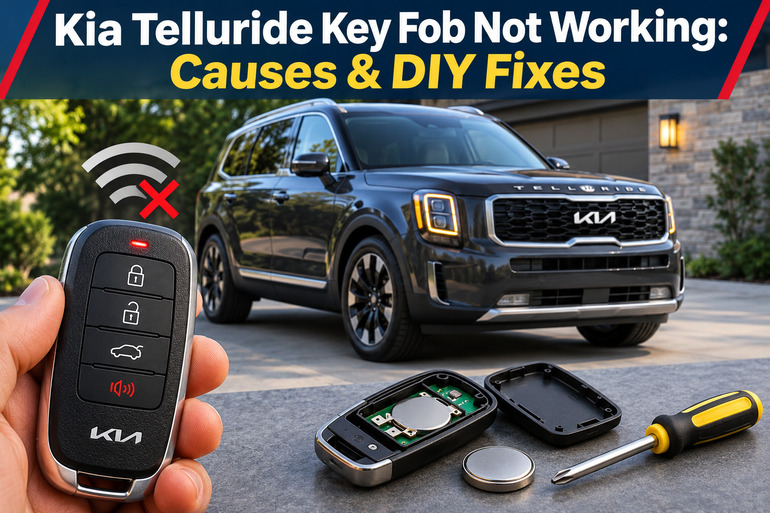
Understanding Kia Telluride Key Fob Problems
The Kia Telluride uses a smart key system that lets you lock and unlock the doors, access the liftgate, and start the engine without inserting a traditional ignition key. The fob communicates wirelessly with electronic receivers in the vehicle. When everything works properly, the Telluride recognizes your authorized key and responds to the appropriate command.
However, different parts of this system perform different jobs. The fob’s battery powers its normal wireless functions, while the vehicle’s security system checks whether an authorized key is present before allowing the engine to start. Consequently, a fob with a dead battery may still allow you to start the engine through Kia’s emergency recognition procedure.
The symptoms often provide useful clues. A fob that only works when you’re standing close to the vehicle may have a weak battery or signal interference. If the buttons stop responding entirely, the battery, internal contacts, or electronic components could be responsible. You might also see messages such as “Low Key Battery” or “Key Not Detected” on the dashboard. These messages indicate different conditions and should be investigated accordingly.
It’s also worth distinguishing a complete key fob failure from a problem with one feature. For example, if your Telluride unlocks normally but refuses to start remotely, the issue could involve the remote start procedure or the conditions required for that feature. Understanding exactly what has stopped working makes it easier to identify the cause.
Kia Telluride Key Fob Not Working: Common Causes
Several problems can interfere with your Telluride’s smart key system, ranging from a depleted battery to faults in the vehicle’s electronics. The following causes are worth considering before deciding whether your key fob needs replacing.
1. Weak or Dead Key Fob Battery
A weak battery is one of the first things to suspect when your Kia Telluride key fob stops responding. The fob uses a small lithium battery to power its electronic transmitter. As that battery loses its charge, the signal can become too weak for the vehicle to receive consistently.
You may initially notice that you need to stand closer to your Telluride before the doors unlock. Sometimes, pressing the same button several times produces a response, while other attempts do nothing. Eventually, the remote functions may stop working altogether.
Kia states that a smart key battery normally lasts several years, although its actual service life depends on usage and other conditions. If the dashboard displays a Low Key Battery warning, replacing the battery is a sensible first step. However, a sudden failure immediately after installing a new battery may indicate incorrect installation or another problem.
2. Interference From Nearby Electronic Devices
Your Telluride’s key fob communicates through radio signals, which can sometimes be affected by nearby electronic equipment. Mobile phones, radio transmitters, and other wireless devices may interfere with communication between the key and vehicle.
Kia specifically warns that keeping your smart key next to an active smartphone can prevent it from operating properly. Interference may also occur near certain radio installations or when another vehicle’s smart key is operating nearby.
Unlike a depleted battery, interference may cause the problem to appear only in certain locations. For example, your fob might work normally at home but respond poorly in a particular parking area. Moving the key away from nearby electronics or changing your location can help establish whether signal interference is responsible.
3. Physical Damage or Internal Key Fob Problems
A key fob can develop internal problems even when its outer casing looks fine. Repeated drops, moisture exposure, or excessive heat can damage the electronic components responsible for transmitting signals.
The buttons can also become worn or damaged. If one button feels unusually soft, sticks when pressed, or requires excessive pressure, its internal switch may no longer make reliable contact. This can explain why the lock button stops working while the unlock or panic button still responds.
Moisture damage deserves particular attention because it may affect the circuit board without producing obvious external signs. A fob that stopped working after being dropped into water or exposed to a spilled drink may have internal corrosion or damaged electronics.
A battery replacement won’t necessarily restore a physically damaged fob. In fact, repeatedly forcing its buttons or opening a damaged casing can make the problem worse.
4. Weak or Discharged Vehicle Battery
Sometimes, the problem comes from your Telluride rather than its key fob. The vehicle’s 12 volt battery supplies power to the electronic systems that receive and process smart key commands.
If the battery becomes severely discharged, the vehicle may fail to unlock electronically or recognize the key properly. You might notice additional symptoms, including dim interior lights, a weak sounding horn, or a dashboard that doesn’t illuminate normally.
A useful distinction is whether your spare fob also fails. If both keys suddenly stop communicating with the Telluride, particularly when other electrical features are acting strangely, the vehicle’s battery and electrical system deserve attention.
5. Faulty Smart Key Receiver or Recognition System
Your Telluride relies on electronic receivers, antennas, and security controls to recognize an authorized key. If one of these components develops a fault, the vehicle may fail to respond even when the fob itself is functioning correctly.
For instance, a problem with the key recognition system may trigger repeated Key Not Detected warnings despite having a working fob inside the cabin. A replacement key that hasn’t been properly registered to the vehicle can produce similar symptoms.
These faults are harder to identify without diagnostic equipment. However, if a known working spare key also fails and the vehicle battery is healthy, a problem with the vehicle’s recognition system becomes more plausible. Professional testing can help distinguish a receiver fault from an incorrectly registered key or another electronic issue.
Kia Telluride Key Fob Not Working: DIY Fixes
The best approach is to start with simple checks that can resolve common problems without specialized tools. If your key still doesn’t respond, the results of each check can help identify whether the fob or vehicle needs further attention.
1. Replace the Key Fob Battery
Replacing the battery is a practical first step when the fob has reduced range, responds inconsistently, or displays a battery warning. However, the correct battery size depends on your Telluride’s model year.
Kia’s manuals specify CR2032 batteries for 2020 through 2022 Telluride smart keys, while the 2023 through 2025 models use CR2450 batteries. Both are 3 volt lithium batteries, but they aren’t interchangeable. Confirm the correct type using your owner’s manual or the battery already installed in your fob.
Follow these steps to replace the battery.
- Locate the battery cover on your key fob. On older models, remove the built in mechanical key first.
- Use a small, suitable tool to gently open the cover at the designated opening point.
- Remove the old battery without damaging the surrounding contacts.
- Insert a fresh battery of the correct type, matching the positive and negative markings.
- Refit the cover securely, then test the lock and unlock buttons near your Telluride.
If the fob still doesn’t work, reopen the cover and check that the battery is properly seated. Make sure the cover closes correctly and that no internal components were accidentally displaced.
Safety precaution: Keep new and used button batteries away from children. Swallowing one can cause life threatening internal injuries, so seek immediate medical attention if ingestion is suspected. Dispose of the old battery according to local regulations.
2. Eliminate Signal Interference
If the fob occasionally works but fails in certain places, try eliminating possible interference before replacing anything.
First, remove the key from your pocket or bag and separate it from your smartphone, other keys, and nearby electronic devices. Stand close to the driver’s door and press the unlock button. If nothing happens, try again after moving to a different position around the vehicle.
Pay attention to whether the problem occurs in the same location repeatedly. If the fob works consistently elsewhere, interference becomes a stronger possibility. However, if it continues failing in different locations, the battery or another component may be responsible.
3. Test the Spare Key and Use the Mechanical Key
Your spare key can provide a useful comparison because it communicates with the same vehicle electronics.
Try locking and unlocking the Telluride with your second registered fob. If the spare works normally, the original key likely has a battery, button, or internal electronic problem. If neither works, check the vehicle battery and other possible causes before assuming both fobs are defective.
If you can’t unlock the driver’s door electronically, use the mechanical backup key. The procedure varies with the key design.
- On older Telluride models, press the release button and remove the mechanical key from the fob.
- Some newer designs, including the 2025 Telluride, have a separately supplied mechanical backup key.
- Use the mechanical key to unlock the driver’s door, following the owner’s manual if the lock cylinder has a protective cover.
Kia confirms that the mechanical key provides a way to access the vehicle when the smart key isn’t operating correctly. However, the mechanical key doesn’t restore the fob’s electronic functions.
4. Start Your Kia Telluride With a Dead Key Fob Battery
A dead key fob battery doesn’t necessarily mean you can’t start your Telluride. Kia provides an emergency starting procedure that allows the vehicle to recognize the smart key at close range.
For Telluride models using the Start/Stop button recognition method, follow these steps.
- Sit in the driver’s seat with your smart key inside the vehicle.
- Apply the parking brake and place the transmission in Park.
- Press and hold the brake pedal firmly.
- Hold the key fob directly against the ENGINE START/STOP button, making contact at a right angle.
- Press the Start/Stop button using the fob.
Kia documents this procedure for the 2025 Telluride and earlier models. If your vehicle uses a different emergency recognition location, follow its specific owner’s manual instructions.
If the engine starts successfully, the key is still being recognized through the backup method. Replace the fob battery and check whether normal operation returns. If the emergency procedure also fails, consider the vehicle battery, security system, and other starting conditions.
5. Check the Vehicle’s 12 Volt Battery
If neither key fob works, inspect the vehicle for signs of a discharged 12 volt battery.
Start by checking whether the interior lights, headlights, and instrument panel operate normally. If several electrical features are weak or completely unresponsive, the vehicle battery may not have enough charge.
A severely discharged battery should be tested and recharged or replaced as needed. A qualified technician or roadside assistance provider can perform a battery test and determine whether the charging system is working properly.
Avoid disconnecting battery cables or attempting electrical repairs without the proper knowledge and equipment. If you notice a swollen battery case, leaking fluid, excessive heat, or damaged wiring, leave the vehicle unused until it has been inspected.
If the vehicle battery tests healthy but the key recognition problem continues, further electronic diagnosis may be necessary.
6. Check the Remote Start Procedure
If your Telluride locks and unlocks normally but refuses to start remotely, the key fob may still be working correctly.
On equipped 2025 Telluride models, Kia specifies the following remote start procedure.
- Make sure the vehicle is parked safely, with the engine switched off.
- Confirm that the doors and liftgate are properly closed.
- Press the lock button on the key fob.
- Within four seconds, press and hold the remote start button for more than two seconds.
- Watch for the vehicle’s confirmation signals and check whether the engine starts.
These steps are based on Kia’s remote start instructions. Button arrangements and operating conditions can differ by model year and equipment, so follow the instructions for your particular Telluride.
If the engine starts normally from inside the vehicle but won’t respond to remote start, check for open door or liftgate warnings and confirm that you’re using the correct button sequence. A persistent failure may require diagnosis of the remote start system rather than replacement of the entire fob.
7. Contact a Qualified Kia Technician
If you’ve replaced the correct battery, ruled out obvious interference, and tested the spare key without success, it’s time to have the system professionally inspected.
An authorized Kia dealer or qualified automotive locksmith can test the fob’s signal, assess its electronic condition, and determine whether it requires replacement or programming.
For problems affecting both keys, a Kia technician can also inspect the vehicle’s antennas, electronic control modules, and immobilizer system. These components may require specialized diagnostic equipment.
Avoid purchasing an expensive replacement fob before confirming the fault. A new key won’t solve a defective receiver or vehicle electrical problem. If the Telluride won’t recognize any registered key, professional diagnosis is the safer choice.
Wrapping Up
A Kia Telluride key fob that stops working can be frustrating, especially when it prevents you from unlocking the doors or starting the engine. Fortunately, many problems can be traced to a weak battery, temporary signal interference, or another issue that can be identified through simple checks.
Start by observing the symptoms, checking the battery, and testing your spare key. If normal operation doesn’t return, avoid forcing damaged components or attempting complicated electrical repairs. Identifying the source of the failure early can help you choose the right repair and avoid unnecessary replacement costs.