
A Hyundai Elantra horn that suddenly stops working can leave you unable to warn other drivers, cyclists, or pedestrians when danger appears. Sometimes, the horn remains completely silent. In other cases, it produces a weak sound or works only occasionally when you press the steering wheel.
Several faults can cause these symptoms, ranging from a blown fuse to a damaged horn assembly or an electrical problem inside the steering column. You can perform a few simple checks at home before deciding whether professional repairs are necessary.
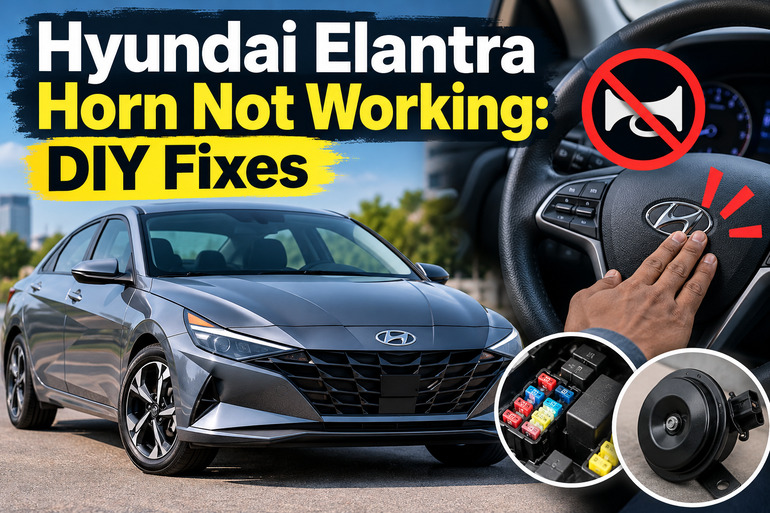
What a Nonworking Hyundai Elantra Horn Means
Your Hyundai Elantra uses an electrical circuit to operate the horn. When you press the horn pad on the steering wheel, a switch completes a control circuit, allowing the horn circuit to activate. Depending on the model year, this system includes a fuse, a relay or integrated electronic control, wiring, and one or more horn units.
If any part of the circuit fails, the horn may stop working even when the rest of the car’s electrical systems function normally. A blown fuse can interrupt power, while a damaged horn or corroded connector can prevent the electrical energy from producing sound.
The symptoms often provide useful clues. A completely silent horn may indicate an electrical fault or a failed horn unit. A noticeably weaker or different sound can indicate that one of two horn units has stopped working. If the horn operates intermittently, particularly when you turn the steering wheel, the fault could involve a damaged connection or the clock spring inside the steering column.
A nonworking horn deserves prompt attention because you may need it to warn someone of an immediate hazard. Avoid assuming that a new fuse will solve the problem permanently. If the replacement fuse blows again, an electrical fault may be present and requires further diagnosis.
Hyundai Elantra Horn Not Working: Likely Causes
Several faults can prevent your Elantra’s horn from sounding. The most useful starting point is to identify the symptoms, check the simple electrical components, and avoid replacing parts before confirming the underlying problem.
1. A Blown Horn Fuse
The horn fuse protects the electrical circuit against excessive current. If a fault causes the current to rise beyond the fuse’s rating, its internal metal element melts and interrupts the circuit. The horn then loses its electrical supply.
A blown fuse may result from a short circuit, damaged wiring, a faulty horn, or another electrical problem. It can sometimes occur during a component failure, but a fuse that repeatedly blows usually indicates an underlying issue that needs attention.
Your Elantra’s fuse box may be located in the engine compartment, inside the passenger compartment, or in both areas. The precise location and fuse rating depend on the model year and equipment. Check the fuse diagram on the fuse box cover and consult your owner’s manual to identify the correct horn fuse.
A fuse that looks intact is not always guaranteed to be functional. You can inspect the fuse’s internal metal element for a break, although electrical testing may be needed to confirm its condition.
2. A Failed Horn Assembly
The horn unit converts electrical energy into sound. Most automotive horns contain an electrically operated mechanism that vibrates a diaphragm, producing the familiar warning tone. When the internal mechanism fails, the horn may become weak, produce an unusual sound, or stop working completely.
Horn failure can develop after prolonged exposure to rainwater, road spray, dirt, and moisture. Corrosion inside the housing can damage electrical connections or interfere with the vibrating mechanism. Physical damage and ordinary wear can also contribute to failure.
Some Hyundai Elantra models use separate high-pitched and low-pitched horn units. If one fails, the remaining unit may still sound, but the horn’s usual tone can become noticeably different. If both units are inoperative, the horn may remain completely silent.
The horn units are generally mounted toward the front of the vehicle, often behind the grille or bumper area. Access varies by model, so locating and testing them may require more work than checking the fuse.
3. Loose, Corroded, or Damaged Wiring
The horn needs a complete electrical path to operate. Power must reach the horn, and the circuit must have a suitable return path. A loose connector, damaged wire, or poor ground connection can interrupt that path even when the horn itself remains functional.
Because the horn is typically mounted near the front of the vehicle, its electrical connections may be exposed to water, road dirt, and other contaminants. Over time, corrosion can form around a connector, increasing electrical resistance and reducing the current available to operate the horn.
You may notice intermittent operation, a weak sound, or complete silence. The fault can also develop after front-end repairs, a minor collision, bumper removal, or other work that disturbs wiring near the horn.
A visible loose connector may provide a useful clue, but avoid pulling on wires or probing exposed electrical terminals without suitable tools and knowledge. A technician can test the circuit to determine whether power, ground, or wiring continuity is missing.
4. A Faulty Horn Relay or Electronic Control
A relay acts as an electrically operated switch. In a conventional horn circuit, the steering wheel switch activates the relay, which then allows current to reach the horn. A failed relay can prevent the horn from receiving power even if the fuse and horn unit are functional.
The design varies across Elantra generations. Some versions use a separate, replaceable relay, while others incorporate the horn relay into an engine compartment fuse and relay block. Certain 2016 to 2020 Elantra models, for example, use an integrated horn relay within the engine compartment’s PCB block that cannot be replaced separately.
This difference matters because a relay-swapping test is appropriate only when your particular model has a removable relay and the owner’s manual or service information confirms the correct replacement. Pulling an unrelated relay or attempting to replace an integrated electronic component without diagnosis can create additional problems.
A clicking sound from the fuse box while you press the horn may help narrow the fault, but it does not prove that the relay is working correctly or that power is reaching the horn. The circuit may need electrical testing before the defective component can be identified.
5. A Faulty Horn Switch or Clock Spring
The horn switch is generally built into the steering wheel’s horn pad. It sends the signal that activates the horn circuit. If the switch wears out or its electrical contacts fail, pressing the horn pad may produce no sound.
Another possible cause is a damaged clock spring. This component contains a flexible electrical ribbon that maintains connections between the steering wheel and the vehicle’s electrical systems while the wheel turns. Depending on the vehicle, those connections can include the horn, steering wheel controls, and driver’s airbag.
A clock spring fault becomes more likely when the horn stops working alongside steering wheel button failures, an airbag warning light, or intermittent operation as the wheel turns. However, these symptoms are clues rather than conclusive proof.
Because the clock spring is associated with the airbag system, diagnosing or replacing it involves safety considerations beyond an ordinary electrical repair. Never remove the steering wheel or handle airbag components as a beginner-level horn repair.
Hyundai Elantra Horn Not Working: How to Fix
Start with checks that do not require dismantling the steering wheel or exposing electrical components. The following methods can help identify a simple fault and determine when further testing is necessary.
1. Check the Horn Fuse
Inspecting the horn fuse is a sensible first step because it is relatively straightforward and does not require specialist diagnostic equipment.
Park your Elantra on level ground, switch off the ignition, and remove the key or turn off the vehicle according to its starting system. Consult the owner’s manual to locate the correct fuse box and identify the fuse marked for the horn. Do not rely on a fuse diagram from a different model year.
Open the fuse box and locate the specified fuse. Use the fuse puller provided in the vehicle, if available, and remove the fuse carefully. Hold it up to a light and inspect the metal element inside. A broken or melted element indicates that the fuse has blown.
Replace a damaged fuse only with another fuse of the same amperage rating and type. Never install a higher-rated fuse to prevent it from blowing, because doing so can allow the wiring to overheat and increase the risk of fire.
After replacing the fuse, operate the horn while the vehicle is safely parked. If it works normally, the immediate problem may have been a blown fuse. If the replacement fuse blows again, stop replacing it and arrange an electrical diagnosis.
2. Inspect the Horn and Its Accessible Connections
A loose or corroded connection can prevent a functional horn from operating. If you can view the horn and its connectors without removing major components, a visual inspection may reveal damage.
With the ignition switched off, look toward the front of the vehicle for visible wiring damage, a disconnected plug, or signs of severe corrosion. Do not reach into a moving engine compartment or place yourself beneath a vehicle supported only by a jack. Some Elantra models require removal of underbody panels or bumper components to access the horn safely.
If the connector is visibly disconnected and readily accessible, reconnecting it may resolve the problem, provided the connector and surrounding wiring are undamaged. Avoid forcing a plug into place or scraping corrosion from terminals with improvised metal tools.
A connector that appears clean can still have an internal electrical fault. If reconnecting an accessible plug does not restore operation, a technician can test the circuit rather than having you replace the horn without confirmation.
3. Check the Relay Using Model-Specific Information
If the fuse is intact, the horn relay or its integrated electronic control may be the next part of the circuit to investigate. The method depends on your Elantra’s year and electrical design.
Consult the owner’s manual to establish whether your model has a separate horn relay and where it is located. If the relay is removable, inspect it for obvious damage and check that it is seated correctly. Do not pull out random relays because they may operate safety-related or essential vehicle systems.
Some vehicles permit a controlled relay-swapping test when two relays have identical specifications and compatible terminal arrangements. Only use this approach if the vehicle documentation confirms that the relays are interchangeable. A similar physical appearance alone does not establish compatibility.
If your Elantra uses an integrated relay inside a fuse and relay block, a simple swap may not be possible. In that situation, electrical testing is the appropriate next step. A mechanic can determine whether the control signal reaches the relay and whether its output supplies the horn correctly.
4. Compare the Horn’s Symptoms With Other Electrical Problems
Pay attention to exactly what happens when you press the horn pad. This can help narrow the likely fault before you purchase replacement parts.
If the horn makes a weak or unusual sound, one of the horn units may have failed. If it is completely silent, the fuse, wiring, relay, horn assembly, or steering wheel controls may require examination.
Check whether the steering wheel’s audio, phone, or cruise control buttons also work, where fitted. If several steering wheel functions fail together, a fault involving the steering wheel wiring or clock spring becomes a stronger possibility. An illuminated airbag warning light makes professional diagnosis particularly important.
Avoid dismantling the steering wheel to test the horn switch. The symptoms can help a technician identify the right circuit to examine, but they cannot establish a clock spring failure on their own.
5. Check for a Hyundai Horn Warranty Extension
If you own a newer Elantra, check whether the problem may be covered by a manufacturer warranty extension before paying for a replacement horn.
Hyundai issued a horn assembly warranty extension in the United States in March 2025 for certain vehicles, including specified 2021 to 2025 Elantra models, some 2021 to 2023 Elantra CN7A models, and certain 2021 to 2025 Elantra Hybrid vehicles. Eligible vehicles may receive covered horn replacement for up to 10 years or 120,000 miles from the original retail delivery date or date of first use, whichever occurs first. The program applies only to qualifying vehicles and the covered condition.
This coverage is specific to the listed vehicles and the U.S. program. Model year alone does not guarantee eligibility, and coverage rules may differ in other countries. Contact an authorized Hyundai dealer and provide your vehicle identification number (VIN) to check whether your car qualifies.
If the vehicle is eligible and the horn failure matches the covered condition, the dealer can explain the approved repair procedure and any associated costs. Checking first may help you avoid paying for a repair that qualifies for coverage.
6. Contact a Qualified Automotive Technician
Professional diagnosis is necessary when the basic checks do not resolve the problem, the fuse repeatedly blows, or the fault involves wiring, an integrated relay, the steering wheel switch, or the clock spring.
A technician can use a wiring diagram and suitable electrical testing equipment to verify the circuit’s power supply, ground connection, control signal, and horn operation. These tests help distinguish a failed horn from a fault elsewhere in the circuit.
Avoid directly connecting the horn to the battery with improvised jumper wires if you lack experience with automotive electrical testing. An incorrect connection can cause a short circuit, damage wiring, or create other hazards. Steering wheel and airbag repairs should be left to appropriately trained personnel.
Seek prompt professional attention if the airbag warning light is illuminated alongside a failed horn, or if you suspect damaged wiring near an airbag component. Until the horn is restored, drive only as necessary and use extra caution because you cannot rely on it to warn others of an immediate hazard.
Wrap-Up
A Hyundai Elantra horn that stops working may have a simple cause, such as a blown fuse or loose connector, but the same symptom can also result from a failed horn assembly, relay, wiring fault, or steering wheel component. Start with the safe checks that apply to your specific model and avoid replacing electrical parts based on symptoms alone.
If the problem persists, professional diagnosis can identify the defective component and help prevent unnecessary repairs. Owners of eligible newer U.S. models should also check the applicable horn warranty extension before paying for replacement. Restoring the horn promptly helps maintain an essential safety feature of your vehicle.