
When your Hyundai Veloster refuses to go into gear, the cause can range from a faulty brake switch to a worn clutch or a transmission control problem. The symptoms often provide useful clues. A gear selector stuck in Park requires different checks from a manual transmission that grinds during shifting or a dual clutch transmission that selects Drive but fails to move the car.
Start with simple, safe checks before deciding whether the vehicle needs professional transmission repairs.
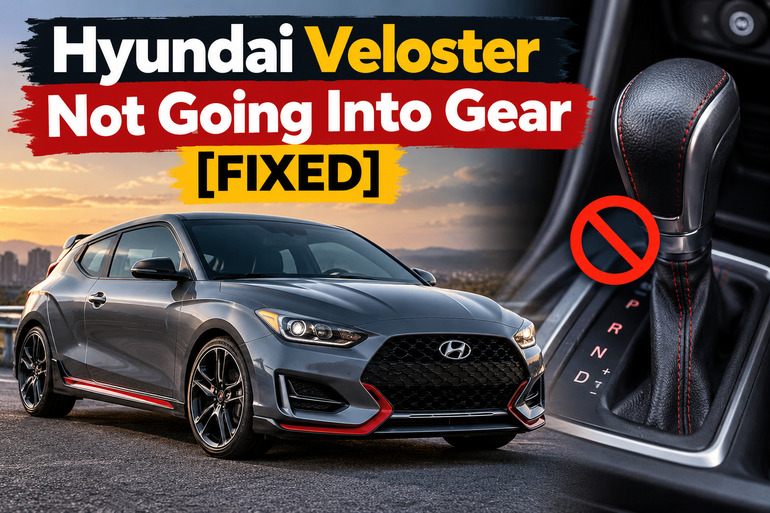
What It Means When a Hyundai Veloster Will Not Go Into Gear
A Hyundai Veloster that will not go into gear may have a problem with the gear selector, clutch, transmission linkage, hydraulic system, or electronic controls. The exact fault depends on the model year and transmission type. The Veloster has been offered with manual, conventional automatic, and dual clutch transmissions, so a repair that applies to one version may be unsuitable for another.
Pay attention to what happens when you try to select a gear. If the automatic gear lever remains stuck in Park, the brake pedal switch or shift lock system may be responsible. If the lever moves but the dashboard indicator does not change, the selector mechanism or its electrical controls may have failed.
A manual Veloster can develop a different set of symptoms. The gear lever might feel unusually stiff, refuse to engage first or reverse, or produce a grinding noise when you press the clutch pedal and attempt to shift. These symptoms can indicate that the clutch is failing to disconnect the engine from the transmission properly.
Another possibility is that the gear selector works normally, but the car does not move after Drive or Reverse is selected. This can indicate a clutch, actuator, fluid, electronic control, or internal transmission fault. Continuing to accelerate in this condition may cause further damage, particularly if the transmission is slipping or overheating.
The distinction matters because a gear selector problem does not automatically mean the entire transmission needs replacement. Correct diagnosis can identify whether the fault is electrical, hydraulic, mechanical, or related to the transmission’s control system.
Hyundai Veloster Not Going Into Gear [FIXED]: Likely Causes
Several faults can produce similar symptoms, so the most useful approach is to match the behavior of your vehicle with the components that control gear selection. The following are five important causes to investigate, depending on the transmission fitted to your Veloster.
1. Faulty Brake Light Switch or Shift Lock System
If your automatic Hyundai Veloster is stuck in Park, start by considering the brake pedal switch and shift lock system. The shift lock prevents the selector from moving out of Park until the required brake pedal signal is received. This safety feature helps prevent unintended vehicle movement.
When the brake light switch fails, it may stop sending the correct signal even though you press the brake pedal. The shift lock may consequently remain engaged. A blown fuse, damaged wiring, or a faulty shift lock solenoid can produce similar symptoms.
Check whether your brake lights illuminate when you press the pedal. If they remain off or operate intermittently, the brake switch, its electrical supply, or the associated wiring may need attention. Working brake lights do not completely rule out a switch fault because some switches have separate electrical contacts or circuits.
Hyundai has published technical service bulletins covering intermittent difficulty shifting out of Park on certain Veloster models. The applicable model years and repair procedures vary, so the vehicle identification number and model details should be checked before selecting a repair.

2. Worn Clutch or Faulty Clutch Hydraulic System
On a manual Hyundai Veloster, a clutch that fails to disengage fully can prevent you from selecting gears smoothly. Pressing the clutch pedal should separate the engine’s power from the transmission so the gears can be selected without being driven by the engine.
A worn or damaged clutch assembly can make shifting difficult, although a clutch that is simply worn out may initially show up as slipping during acceleration. Hydraulic faults are another possibility. The clutch master cylinder, slave cylinder where fitted, or hydraulic line may leak or fail to develop sufficient pressure.
Watch for a clutch pedal that suddenly becomes soft, sinks toward the floor, or fails to return normally. Difficulty engaging reverse and first gear, especially while the engine is running, can also indicate incomplete clutch disengagement. Grinding during gear selection is another warning sign.
If the gear lever moves more easily with the engine switched off than with it running, the clutch or its release system deserves closer inspection. This observation helps narrow the possibilities, but it does not confirm a failed clutch by itself. Internal transmission faults can produce overlapping symptoms.
3. Damaged Gear Selector Cable or Linkage
The gear lever inside your Veloster operates a mechanism that communicates your selection to the transmission. Depending on the transmission type, this may involve cables, selector linkages, or an electronic control system.
A worn cable, disconnected linkage, damaged bushing, or faulty selector assembly can prevent the transmission from receiving the gear selection you intended. You might notice that the lever feels loose, moves farther than usual, or fails to produce the expected gear indication on the dashboard.
In some cases, the lever moves normally, but the transmission remains in Park or Neutral. In others, selecting a gear becomes unusually difficult because the linkage is binding or damaged.
A selector fault can imitate an internal transmission failure, which is why replacing the transmission without testing the selector mechanism can lead to unnecessary expense. A technician can check whether the lever movement is being transmitted correctly and whether the transmission responds to the selected position.
4. Dual Clutch Transmission Actuator or Control Problem
Some Hyundai Veloster models use a dual clutch transmission, often abbreviated as DCT. This system combines automatic gear selection with electronically controlled clutches. Electric actuators and control electronics coordinate clutch engagement and gear changes.
A failed clutch actuator, gear actuator, speed sensor, wiring connection, or transmission control unit can interrupt this process. Depending on the fault, the vehicle may refuse to engage Drive or Reverse, display a transmission warning, hesitate when moving off, or remain in Neutral.
A small amount of audible or tactile feedback during gear changes can be normal for a DCT. However, persistent juddering, failure to engage a gear, abnormal warning messages, or a complete loss of drive should not be dismissed as normal behavior.
Hyundai’s technical documentation explains that certain DCT repairs require a learning procedure after components such as the transmission, clutch actuator, gear actuator, input sensor, or control unit are replaced. If the required setup is incomplete or unsuccessful, the transmission may fail to shift. This is a workshop procedure, rather than a routine owner adjustment.
A separate Hyundai service bulletin addresses abnormal low speed clutch vibration on certain 2016 and 2017 Veloster 1.6-liter turbo models fitted with a seven speed DCT. The bulletin describes inspection, clutch replacement where indicated, and a control unit software update. It does not mean every Veloster with shifting trouble needs a new clutch.
5. Low Transmission Fluid or Internal Transmission Damage
Transmission fluid helps lubricate internal components and, in applicable automatic transmissions, supports hydraulic operation. If the fluid level is too low because of a leak, the transmission may struggle to engage a gear or transmit engine power properly.
Possible clues include visible fluid beneath the vehicle, delayed engagement, slipping, unusual transmission noises, or a burning smell. However, these symptoms do not establish that low fluid is the cause. The correct fluid specification and level checking procedure depend on the transmission fitted to your particular Veloster.
Internal problems can create similar symptoms. Damaged gears, bearings, clutch components, or other transmission parts may prevent proper engagement. An electronic fault can also cause the transmission control unit to restrict gear selection or place the system in a protective operating mode.
For certain 2021 and 2022 Veloster N vehicles, Hyundai issued safety recall 236, also listed as NHTSA campaign 22V-746, involving a possible transmission oil pump malfunction that could result in a complete loss of drive power. This recall applies to specified vehicles, not every Veloster or every transmission problem. Owners should check their vehicle identification number for outstanding campaigns.
Hyundai Veloster Not Going Into Gear [FIXED]: DIY Fixes
The appropriate repair depends on whether the problem comes from the selector, clutch, electrical supply, or transmission itself. These checks can help you identify a straightforward issue without forcing a gear or attempting a repair that requires specialist equipment.
1. Confirm the Transmission Type and Exact Symptoms
Begin by identifying whether your Veloster has a manual transmission, a conventional automatic transmission, or a dual clutch transmission. Your owner’s manual, vehicle specifications, or a Hyundai service center can confirm this.
Next, observe what happens when you attempt to select a gear. Does the selector remain in Park? Does the dashboard display the selected gear? Does the engine start normally, but the car refuse to move? Does the clutch pedal feel different from usual?
Record any warning lights, dashboard messages, grinding sounds, or unusual vibrations. These details can help a technician distinguish a selector fault from a clutch or transmission fault.
If the vehicle is stuck in gear or fails to engage Drive or Reverse, do not repeatedly move the lever or press the accelerator in an attempt to force engagement. Apply the parking brake, keep the vehicle secure, and arrange professional assistance if you cannot select a gear safely.
2. Check the Brake Pedal and Brake Lights
If the automatic gear selector is stuck in Park, press the brake pedal firmly and check whether the brake lights illuminate. You can ask another person to observe the rear lights while you press the pedal, or check their operation using a safe reflection.
If the brake lights do not work, inspect the relevant fuse only if you can identify the correct fuse and follow the owner’s manual. Replace a blown fuse only with one of the specified rating. If the replacement blows again, the electrical circuit requires diagnosis.
Do not assume the shift lock has failed solely because the gear lever will not move. A faulty switch, fuse, wiring connection, or shift lock mechanism may produce the same symptom.
Some Hyundai models provide a manual shift lock release for emergencies. Use it only if the instructions in your specific owner’s manual permit it and you can follow them safely. If the release is needed, arrange an inspection rather than treating it as a permanent fix. Never force the selector.
3. Inspect the Battery and Look for Electrical Warning Signs
A weak battery or poor electrical connection can interfere with electronic systems, particularly on vehicles that rely on electrical actuators and control modules for gear selection. This is more relevant when the car also cranks slowly, displays several warning lights, or behaves unusually when starting.
With the engine off, inspect the battery terminals visually for obvious looseness or corrosion. Avoid touching exposed conductors or attempting electrical repairs if you are unsure how to do them safely. If the battery is old, discharged, or associated with repeated starting problems, have its charge and condition tested.
A battery that starts the engine normally can still have an electrical issue elsewhere. If the gear selector remains unresponsive or transmission warning messages persist, a battery replacement alone may not solve the problem.
Do not disconnect the battery in an attempt to reset the transmission without checking the manufacturer’s guidance. Some faults require diagnostic testing, stored fault codes, or a specific service procedure to resolve them.
4. Check for Visible Leaks and Clutch Pedal Changes
Park the vehicle on a safe, level surface and look for fluid beneath it. Fluid that appears red or brown may come from a transmission on some models, while other fluids may be difficult to distinguish by appearance alone. Avoid touching unknown fluid or crawling underneath a vehicle supported only by a jack.
If your manual Veloster has a hydraulic clutch, notice whether the clutch pedal feels unusually soft, stays on the floor, or has suddenly lost resistance. These changes can indicate a hydraulic leak or a failed component in the release system.
You can inspect an accessible fluid reservoir visually if your owner’s manual identifies it and explains the correct level range. If the level is below its minimum mark, do not simply top it up and continue driving without investigating the cause. The system may have a leak that needs repair.
Never open a transmission housing, disconnect hydraulic lines, or add an unspecified fluid in an attempt to restore shifting. Incorrect fluid or an improper level can create further problems.
5. Check for Warning Messages and Outstanding Recalls
Write down every transmission-related message or warning light displayed when the problem occurs. A photograph of the dashboard can help preserve the exact message for diagnosis.
An OBD-II diagnostic scanner may retrieve fault codes related to the engine or transmission. Basic scanners do not always access transmission control modules, so a scan that shows no fault codes does not guarantee that the transmission is healthy. A suitable professional diagnostic tool may be required.
If you own a 2021 or 2022 Veloster N, check whether recall 236 applies to your vehicle. You can use the NHTSA recall lookup with your vehicle identification number. Other model years can also have vehicle-specific campaigns or service information, so consult Hyundai if the symptoms persist.
If the transmission was recently repaired or a control module was replaced, tell the technician. Certain DCT models require a prescribed learning procedure after particular component replacements. Repeating gear selections or attempting to reproduce workshop calibration steps at home is not an appropriate substitute for that procedure.
6. Contact a Qualified Transmission Technician
Arrange a professional inspection if your Veloster still refuses to engage a gear after the basic checks, if the fault repeatedly returns, or if warning messages appear with shifting problems. A technician can check the brake switch, shift lock, selector linkage, clutch hydraulic system, fluid condition, electrical circuits, and transmission control unit as appropriate.
Seek assistance promptly if you notice a burning smell, fluid leaking heavily, loud mechanical noises, severe grinding, or a sudden loss of drive while moving. Stop driving as soon as it is safe and arrange recovery rather than attempting to reach a repair shop under the vehicle’s own power.
Ask for the diagnostic findings before authorizing an expensive replacement. The shop should be able to explain which component failed, what test supports that diagnosis, and whether a repair, software update, adjustment, or replacement is required. If a recall applies, ask whether the repair can be completed without charge.
Wrap-Up
A Hyundai Veloster that will not go into gear may have a problem with the brake switch, clutch, selector linkage, electrical controls, or transmission. The symptoms and the type of transmission provide the best starting point for diagnosis.
Check the simple items first, avoid forcing the gear selector, and stop driving if the vehicle loses drive or shows signs of serious mechanical trouble. Accurate diagnosis can help prevent further damage and unnecessary parts replacement. When basic checks do not resolve the fault, a qualified technician can identify the failed component and determine the appropriate repair for your specific Veloster.