
A Hyundai Veloster that struggles to gain speed can hesitate when you press the gas pedal, rev without moving properly, or lose power during an uphill climb. The cause may be a faulty fuel pump, worn spark plugs, an electronic throttle problem, or a transmission fault.
Several issues produce similar symptoms, so replacing parts without proper checks can waste money. Start by identifying how the engine behaves, checking the warning lights, and looking for model specific recalls that could affect your Veloster.
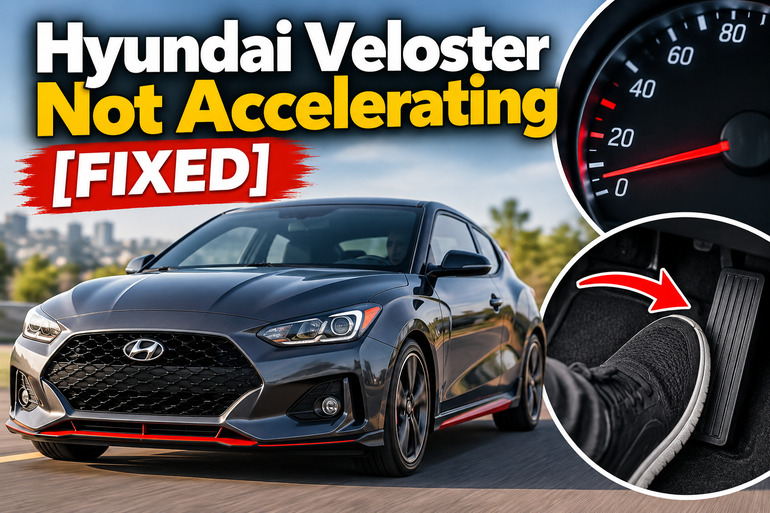
What It Means When a Hyundai Veloster Is Not Accelerating
When your Hyundai Veloster fails to accelerate, the engine may be running but producing insufficient power, or the transmission may be struggling to transfer that power to the wheels. These situations can feel similar from the driver’s seat, but they require different repairs.
Pay attention to the tachometer, which measures engine speed in revolutions per minute (RPM). If the engine struggles to gain RPM when you press the accelerator, an air intake, ignition, fuel delivery, or electronic throttle fault may be responsible. If the RPM rises sharply while the vehicle barely gains speed, a slipping clutch or transmission problem becomes more likely.
Your Veloster may also enter limp mode, a protective operating state in which the engine computer limits power or engine speed after detecting a problem. Depending on the fault, you may notice a check engine light, reduced throttle response, rough running, or difficulty climbing hills. A diagnostic scan is often needed to determine why the computer has restricted performance.
Certain model years also have specific safety concerns. For example, Hyundai recalled certain 2013 Veloster 1.6-liter turbo models over engine management software that could contribute to premature combustion, engine damage, and reduced power. A separate campaign affected certain 2019 to 2022 Veloster N vehicles because of a high-pressure fuel pump problem. These issues apply to particular vehicles, so your model year and VIN are essential when checking eligibility.
Hyundai Veloster Not Accelerating [FIXED]: Likely Causes
Several mechanical and electronic faults can prevent your Veloster from accelerating normally. The symptoms that accompany the loss of power will help narrow down the possibilities before any parts are replaced.
1. A Weak Fuel Pump or Restricted Fuel Delivery
Your Veloster needs a steady supply of fuel to produce the power you request through the accelerator. The fuel pump delivers gasoline from the tank, while the fuel system regulates the pressure needed for the engine to operate correctly.
A weak pump, restricted fuel filter where separately serviceable, faulty pressure regulator, or another fuel delivery problem can prevent the engine from receiving sufficient fuel under load. You may notice the car accelerating normally at low speeds but losing power when climbing a hill, merging onto a highway, or trying to overtake another vehicle. Some fuel delivery faults also cause hesitation, stalling, or difficulty starting.
Direct injection engines use high-pressure fuel equipment, which requires particular care during diagnosis. On certain 2019 to 2022 Veloster N vehicles, Hyundai identified a high-pressure fuel pump control valve issue that could cause reduced or lost driving power. The prescribed recall procedure includes checking for diagnostic code P0088, updating engine control software, and replacing the pump where required. A technician should verify whether your vehicle falls within the affected group.
2. Worn Spark Plugs or Faulty Ignition Coils
The ignition system creates the spark needed to ignite the air and fuel mixture inside each cylinder. Worn spark plugs or failing ignition coils can interrupt combustion, leaving the engine unable to produce its usual power.
A Veloster with an ignition fault may jerk during acceleration, vibrate at idle, hesitate when climbing hills, or produce a rough engine sound. You may also notice increased fuel consumption or a check engine light. Misfires sometimes become more obvious when the engine is under load because cylinder pressure increases and a weak ignition system may struggle to fire the mixture consistently.
Diagnostic trouble codes such as P0300, which indicates random or multiple cylinder misfires, or P0301, which indicates a misfire in cylinder one, can help identify the problem. However, these codes do not automatically prove that the spark plugs are faulty. Ignition coils, injectors, compression problems, and other faults can cause similar findings. The correct repair depends on test results and the maintenance requirements for your particular engine.
3. A Faulty Electronic Throttle Body or Accelerator Pedal Sensor
The accelerator pedal in many Veloster models sends an electronic signal to the engine control module. The computer uses this signal, along with other operating information, to control the throttle opening and engine output.
If the pedal position sensor, throttle position sensor, throttle body, wiring, or related electronic control system develops a fault, the engine may fail to respond properly when you press the pedal. You might experience delayed acceleration, an engine that refuses to increase speed, or a sudden reduction in available power. In some cases, the vehicle enters limp mode.
A dirty throttle body can contribute to poor throttle response, but cleaning it is not the answer to every acceleration problem. Electronic faults may require live data testing, wiring checks, or a manufacturer specified relearn procedure after repairs. Replacing the accelerator pedal or throttle body without confirming the fault can leave the original problem unresolved.
4. A Blocked Air Filter or an Air Intake Leak
The engine needs a controlled supply of air to burn fuel efficiently. A heavily restricted air filter can reduce airflow, while a cracked intake hose or loose connection can allow unmetered air to enter the engine. A faulty mass airflow sensor, where fitted, can also cause the computer to calculate the wrong air supply.
These problems may produce slow acceleration, rough idling, hesitation, or inconsistent engine response. A damaged intake hose can sometimes create a hissing sound, especially while the engine is running. If the mixture becomes too lean or the airflow readings become unreliable, the engine computer may store a fault code.
Start with the air filter and visible intake ducting because these are relatively simple components to inspect. A clean-looking filter does not rule out a sensor fault or a hidden leak, however. An intake leak may require a professional smoke test, which introduces controlled smoke into the system to reveal openings where air escapes.
5. A Slipping Clutch or Faulty Transmission
The transmission transfers engine power to the wheels through the selected gear. If it cannot maintain the correct connection, your Veloster may struggle to move even when the engine appears to be working normally.
A slipping clutch in a manual model can cause engine RPM to rise without a matching increase in road speed. An automatic or dual clutch transmission may hesitate when selecting gears, shift irregularly, or fail to engage a gear correctly. Transmission warning lights, unusual noises, burning smells, and sudden changes in driving behavior can provide further clues.
These symptoms require particular attention because the underlying problem may involve clutch wear, a hydraulic fault, a transmission control issue, or an internal mechanical failure. Different Veloster model years and trims use different transmission configurations, so a procedure suitable for one vehicle may be inappropriate for another. Avoid assuming that a fluid change or computer reset will correct a slipping transmission.
Hyundai Veloster Not Accelerating [FIXED]: DIY Fixes
The right repair depends on the fault causing the power loss. Begin with safe checks that can reveal obvious problems, then use diagnostic information to decide whether the vehicle needs specialist attention.
1. Check the Dashboard Warnings and Identify the Symptoms
Before attempting any repair, observe what happens when you press the accelerator. Note whether the engine shakes, struggles to increase RPM, responds after a delay, or revs normally while the vehicle remains slow.
Check the dashboard for a check engine light, transmission warning, or other unusual indicator. A steady check engine light generally calls for prompt diagnosis, while a flashing check engine light can indicate an active misfire that may damage the catalytic converter. Reduce the load on the engine and stop driving if the flashing continues.
Stop safely and arrange assistance if the vehicle loses substantial power in traffic, stalls repeatedly, produces heavy smoke, or develops loud engine knocking. Stop the engine immediately if the oil pressure warning stays illuminated while it is running. Continuing to drive through these symptoms can turn a repairable fault into serious engine damage.
2. Scan the Engine Computer for Diagnostic Trouble Codes
An OBD II scanner can retrieve fault codes stored by the engine computer. The diagnostic connector is generally located beneath the dashboard, although its precise position varies by model.
With the vehicle safely parked, connect a compatible scanner according to its instructions. Switch on the ignition and follow the device prompts to read the stored codes. Record the codes and any available freeze frame information, which captures operating conditions when a fault was detected.
Codes can help narrow the investigation. A misfire code may point toward the ignition or fuel system, while a throttle related code may direct attention to the electronic controls. Code P0088 is particularly relevant to the fuel pressure condition addressed in the specified Veloster N recall campaign.
Do not clear the codes before recording them. Clearing them can remove useful diagnostic information without repairing the underlying issue. If you do not own a scanner, many repair shops can perform an initial scan before recommending further testing.
3. Inspect the Air Filter and Intake Hose
A visibly clogged air filter or disconnected intake hose is a reasonable place to begin. Park the car on level ground, engage the parking brake, turn off the engine, and allow hot components to cool before opening the hood.
Locate the air filter housing and inspect the filter according to the owner’s manual. If it is heavily clogged, damaged, or due for replacement, fit the correct replacement part. Check the visible intake duct for loose clamps, cracks, or sections that have come apart. Secure an obviously loose connection only if you can do so safely and without disturbing electrical connectors or other components.
Start the engine after the inspection and check whether normal performance returns. If the loss of power remains, avoid replacing airflow sensors simply because the filter appears dirty. A faulty sensor, hidden intake leak, or unrelated mechanical problem may require additional testing.
4. Check the Fuel Level and Look Up Applicable Recalls
Begin with the basic fuel supply. Confirm that the tank contains enough gasoline and consider whether the symptoms started immediately after refueling. If the engine began running poorly after a recent fill-up, tell the technician because contaminated or incorrect fuel may need investigation.
Do not disconnect fuel lines or attempt to test a high-pressure fuel pump at home. Fuel injection systems can retain dangerous pressure even after the engine is switched off, and an incorrect repair can cause injury or a fire.
If your Veloster is a 2019 to 2022 N model, check whether the fuel pump campaign applies to your VIN. For vehicles covered by a U.S. safety recall, repairs under that campaign are generally handled through the manufacturer’s recall process. You can search by VIN through the NHTSA recall lookup. The site also explains the limits of its recall results, including that some non-safety campaigns and vehicles outside the U.S. may not appear.
5. Pay Attention to Transmission Behavior
Observe the relationship between engine RPM and vehicle speed during ordinary, low risk driving only if the vehicle is safe to operate. Do not perform aggressive acceleration tests to reproduce the fault.
If the engine revs higher but the vehicle barely accelerates, tell the technician that the engine speed rises without a matching increase in speed. If the engine struggles to rev at all, report that distinction too. Note any delayed engagement, harsh gear changes, warning messages, vibration, or burning smell.
These details help separate an engine power problem from a transmission fault. Avoid forcing the vehicle to move by repeatedly pressing the accelerator, and do not add transmission fluid or attempt a transmission reset unless the correct model specific procedure confirms it is appropriate. If the transmission slips badly or the vehicle cannot move reliably, arrange a tow rather than continuing to drive.
6. Contact a Qualified Automotive Technician
Professional diagnosis is necessary when the basic checks fail, warning lights return, or your Veloster continues to lose power. A technician can use the correct service information and diagnostic equipment to investigate faults that are difficult to identify through visual inspection alone.
Depending on the symptoms, testing may include checking fuel pressure, reviewing throttle sensor data, examining ignition performance, testing for intake leaks, measuring exhaust restriction, or inspecting the transmission and clutch. A proper diagnosis should identify the failed component or system before replacement parts are ordered.
Ask the technician to check for applicable recalls and technical service information using your VIN. This is particularly important if you own an affected turbocharged or Veloster N model. If engine knocking, repeated stalling, severe misfiring, or sudden loss of driving power occurs, avoid driving the car to the workshop. Arrange recovery instead.
Wrap-Up
A Hyundai Veloster that will not accelerate can have a fuel delivery fault, ignition problem, air intake issue, electronic throttle malfunction, or transmission defect. The way engine RPM changes, the warning lights, and any unusual noises provide useful clues, but these symptoms do not confirm a particular failed part.
Start with safe visual checks and a diagnostic scan, then follow the test results rather than replacing components at random. Check applicable recalls for your exact vehicle and seek professional help if the loss of power persists or becomes severe. Early diagnosis can reduce the risk of further damage and help restore predictable acceleration.