
A Hyundai Santa Fe that refuses to start can leave you stranded, particularly when the dashboard lights are working but the engine refuses to turn over. The cause may be something simple, such as a weak battery or an incorrect gear position, or a more serious fault involving the starter, fuel system, or engine electronics.
Understanding the symptoms helps you narrow down the likely problem and avoid replacing parts unnecessarily. Several checks can be performed at home before arranging professional repairs.
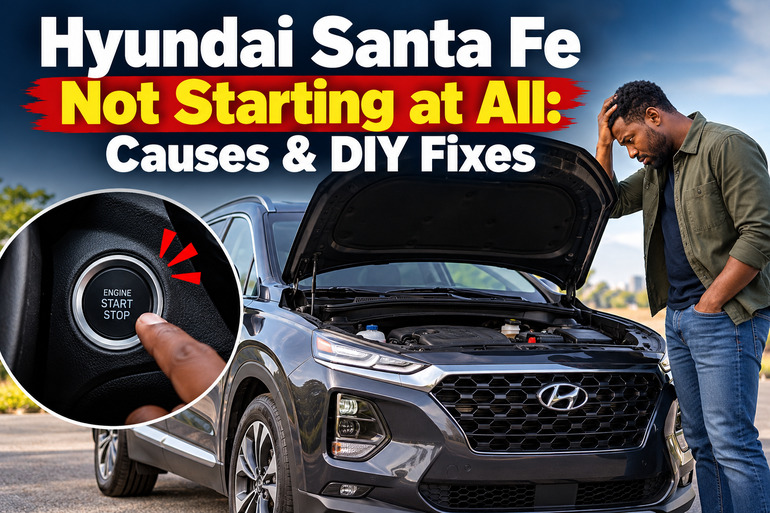
What It Means When Your Hyundai Santa Fe Won’t Start
When your Hyundai Santa Fe doesn’t start at all, the first thing to establish is whether the engine is failing to crank or cranking without starting. These are two different problems, and distinguishing between them makes diagnosis easier.
If you turn the ignition key or press the start button and nothing happens, the engine may not be receiving enough electrical power to operate the starter. You might hear a single click, rapid clicking, or complete silence. These symptoms often point to the battery, its connections, the starter motor, or an electrical control problem.
However, if the engine turns over repeatedly but never runs, the starter is probably doing its job. The problem may involve fuel delivery, ignition, or the sensors responsible for telling the engine computer when to supply fuel and spark. The exact possibilities depend on the engine and model year. 【turn155425search0】【turn155425search1】
Some Santa Fe models also use smart keys and push button starting, while hybrid versions have additional starting system requirements. A vehicle that displays a key warning or fails to enter its ready state may need a different diagnosis from a conventional gasoline model.
Hyundai Santa Fe Not Starting at All: Common Causes
Several faults can prevent your Santa Fe from starting, even when the vehicle appeared to be working normally the previous day. The following are common possibilities, although the symptoms alone cannot confirm which component has failed.
1. A Weak or Dead Battery
The 12 volt battery supplies the electrical power needed to operate the starter and other starting system components. If its charge is too low, the starter may turn slowly, produce repeated clicking sounds, or fail to operate altogether.
Battery problems can develop because of age, extended periods without driving, lights left on, poor charging, or an alternator that isn’t replenishing the battery while the engine runs. Corrosion around the terminals can also restrict electrical current, even when the battery itself still holds some charge.
Pay attention to your dashboard lights and headlights. If they become noticeably dim when you attempt to start the engine, the battery may be discharged or unable to deliver enough current. Hyundai specifically identifies dimming or extinguished interior lights during a starting attempt as a possible indication of a discharged battery. 【turn970069search0】
2. A Faulty Starter Motor or Starter Circuit
The starter motor turns the engine until combustion can begin. If the starter motor, its solenoid, the starter relay, or the associated wiring develops a fault, your Santa Fe may not crank even when the battery has sufficient power.
A single click when you attempt to start the vehicle can indicate a starter problem, although a weak battery or poor cable connection can produce a similar symptom. Grinding sounds may indicate a problem involving the starter drive or its engagement with the engine.
One useful clue is the behavior of the dashboard lights. If they remain bright but the engine does not turn, a starter circuit fault becomes a possibility. However, a battery test and electrical checks are still necessary before condemning the starter. 【turn155425search7】
3. A Failed Fuel Pump or Fuel Delivery Problem
Your engine needs a suitable supply of fuel to start and run. The fuel pump draws fuel from the tank and delivers it to the engine at the required pressure. If the pump fails, a fuel pump relay stops working, or a fuse or wiring connection interrupts the circuit, the engine may crank without starting.
You might notice that the vehicle had been hesitating, losing power, or stalling before the failure occurred. In other cases, the problem appears suddenly, with the engine turning over but never firing.
Some fuel pumps produce a faint humming sound when the ignition is switched on, but this behavior varies with the vehicle’s design and operating conditions. Silence alone doesn’t prove that the pump has failed. Measuring fuel pressure and checking the pump’s electrical supply provide stronger diagnostic evidence. 【turn155425search6】
4. An Ignition System or Engine Sensor Fault
A gasoline engine requires fuel, compression, and a correctly timed spark to start. Faulty ignition coils, spark plugs, wiring, or engine position sensors can prevent this process from occurring.
The crankshaft position sensor is particularly significant because it provides information about the crankshaft’s position and movement. The engine computer uses this information to coordinate ignition and fuel injection. If the sensor or its wiring fails, the engine may crank normally without starting.
Depending on the fault, you may also notice a check engine light, an engine that stalls unexpectedly, or intermittent starting difficulties before the complete failure. However, warning lights may not always appear, and several unrelated faults can produce similar symptoms. A diagnostic scan and appropriate electrical tests are usually needed to identify the actual cause. 【turn155425search5】
5. A Key Recognition, Gear Selector, or Electrical Control Problem
Your Santa Fe’s starting system must recognize the appropriate starting conditions before it allows the engine to crank. On automatic models, the transmission generally needs to be in Park or Neutral. A faulty range sensor or selector related problem can prevent the vehicle from recognizing the correct gear position.
Smart key problems can also interrupt starting. A weak key fob battery, an unrecognized key, or a fault in the immobilizer system may prevent the vehicle from authorizing the start. Some models provide a warning message when the key isn’t detected.
A blown fuse, faulty brake pedal switch, damaged wiring, or another electrical control fault may produce similar symptoms. These possibilities become particularly relevant when the dashboard powers up but the start button produces no response. Hyundai’s instructions for its push button systems identify the brake pedal, gear position, and presence of the smart key as relevant starting conditions. 【turn970069search10】【turn970069search11】
Hyundai Santa Fe Not Starting at All: DIY Fixes
Start with the simplest checks before considering component replacement. The following methods can help you identify or resolve straightforward problems, but more complicated faults require proper diagnostic equipment.
1. Check the Battery and Its Connections
Begin by switching off the headlights, air conditioning, radio, and other electrical accessories. Set the parking brake and make sure the vehicle is in Park.
Open the hood and inspect the 12 volt battery if it is safely accessible. Look for loose battery clamps, visible corrosion around the terminals, damaged cables, or a swollen battery case. Do not attempt to jump start a swollen, leaking, frozen, or visibly damaged battery. Contact roadside assistance instead.
If you have a multimeter and know how to use it safely, you can measure the battery voltage across its terminals. A fully charged conventional 12 volt lead acid battery commonly reads around 12.6 volts at rest, although temperature, battery condition, and vehicle design affect the reading. A proper load or conductance test is more useful for determining whether the battery can supply the current needed to start the engine.
Do not disconnect battery cables while the engine is running, and avoid shorting the terminals with a tool. If the connections look sound but the battery is discharged, move on to the manufacturer’s recommended jump starting procedure.
2. Try a Proper Jump Start
If the battery is weak or discharged, an approved jump start may restore enough power to operate the starter. This is particularly worth considering when the dashboard lights are dim or the starter produces rapid clicking sounds.
Use a suitable 12 volt jump pack or a compatible vehicle battery. Before making any connections, consult your specific Santa Fe owner’s manual for the correct terminals and connection sequence. Some models use dedicated jump starting points rather than direct battery connections. Hybrid versions may also have specific procedures for their 12 volt systems.
Follow the prescribed instructions carefully, keep the cables away from moving engine components, and never allow the positive and negative clamps to touch. If you aren’t confident about the procedure, have a trained technician perform it. Hyundai warns that incorrect jump starting can cause serious injury or damage to the vehicle. 【turn870727search5】
If the vehicle starts, that does not necessarily mean the battery is healthy. Have the battery and charging system tested, particularly if the problem returns after the vehicle has been switched off. A weak battery, charging fault, or unwanted electrical drain may still be present.
3. Confirm the Gear Position, Brake Pedal, and Smart Key
A simple starting interlock can sometimes prevent the engine from cranking even when the electrical system appears normal.
On an automatic Santa Fe, press the brake pedal firmly and ensure the gear selector is in Park. If the vehicle still doesn’t respond, apply the parking brake and try selecting Neutral, then attempt to start it while holding the brake pedal down. Use this method only when the vehicle is securely stationary and the owner’s manual permits it.
For a push button model, ensure the smart key is inside the vehicle. If a key warning appears, try the spare key if one is available. When the key fob battery is weak, some models allow you to hold the fob against the designated start button or another specified location while pressing the button. Check the exact procedure in your owner’s manual because the method varies by model.
If pressing the start button produces no response, check whether the dashboard displays a brake pedal, key recognition, or gear position warning. Persistent warnings may indicate a faulty switch, sensor, or immobilizer component that needs further diagnosis.
4. Check the Fuel Level and Relevant Fuses
An empty fuel tank can prevent the engine from starting, even if the dashboard and accessories continue to operate normally. Check the fuel gauge and add the correct fuel if the tank is empty or nearly empty.
If your Santa Fe has sufficient fuel but the engine cranks without starting, a fuel pump circuit fault may be responsible. Consult the fuse diagram in the owner’s manual to identify any fuse associated with the fuel pump, engine control system, or starter circuit.
With the vehicle switched off and the ignition in the required state, inspect the relevant fuse using the procedure specified in the manual. Replace a blown fuse only with one of the same rating. Never bridge a fuse with wire or install a higher rated fuse to force the circuit to work.
If the replacement fuse blows again, stop there. A repeated failure can indicate a short circuit or another electrical fault that requires professional testing. Avoid probing fuel system wiring or opening fuel lines at home.
5. Observe the Symptoms and Arrange a Diagnostic Scan
If the battery has sufficient power and the basic starting conditions are correct, note exactly what happens when you attempt to start the engine.
A rapid series of clicks often points toward insufficient battery power or poor electrical connections. A single click or silence with bright dashboard lights makes a starter or control circuit fault worth investigating. If the engine cranks at its normal speed without firing, fuel delivery, ignition, or engine sensor faults become more relevant.
A compatible OBD II diagnostic scanner may retrieve fault codes from the engine computer. Record any codes before clearing them, since they can provide important clues. However, a fault code doesn’t automatically prove that the named component needs replacement. Further testing may be needed to distinguish a failed sensor from a wiring or power supply problem.
Avoid repeated long starting attempts, particularly if you hear grinding, smell fuel, or notice smoke. Repeated cranking can drain the battery, overheat the starter, or worsen an existing problem.
6. Contact a Qualified Mechanic or Hyundai Service Center
Professional diagnosis becomes necessary when the battery checks out, the basic starting conditions are correct, and the vehicle still refuses to start. It is also the appropriate next step if a jump start fails, the same problem keeps returning, or the engine produces unusual mechanical noises.
A qualified technician can perform battery load testing, starter circuit measurements, fuel pressure testing, ignition checks, and diagnostic scanning. Depending on the findings, the repair might involve a starter motor, fuel pump, sensor, damaged cable, control module, or another component.
If the engine suddenly stopped while driving, or you notice smoke, a strong fuel smell, leaking fuel, or signs of overheating, avoid further starting attempts. Arrange suitable roadside assistance or towing instead.
For a hybrid Santa Fe, tell the technician that the vehicle is a hybrid before work begins. Do not attempt to handle or jump start its high voltage battery. The appropriate procedure depends on the precise model and the fault involved.
Wrap-Up
A Hyundai Santa Fe that won’t start can have an electrical, fuel delivery, ignition, or starting authorization problem. The most useful first step is to determine whether the engine cranks, clicks, or remains completely silent. That observation helps narrow the possibilities before you spend money on replacement parts.
Check the battery, starting conditions, and fuel level first, then follow the procedures in your owner’s manual. If those checks don’t resolve the fault, professional testing can identify the failed component and prevent unnecessary repairs.