
A Kia hybrid that refuses to start can leave you wondering whether the problem involves the regular battery, the hybrid system, or something much simpler. Sometimes, the dashboard lights up normally, but the vehicle won’t move. Other times, pressing the start button produces no response at all.
Fortunately, several starting problems have straightforward solutions. Understanding what prevents your Kia hybrid from starting can help you identify the likely cause, perform safe checks, and avoid unnecessary repairs.
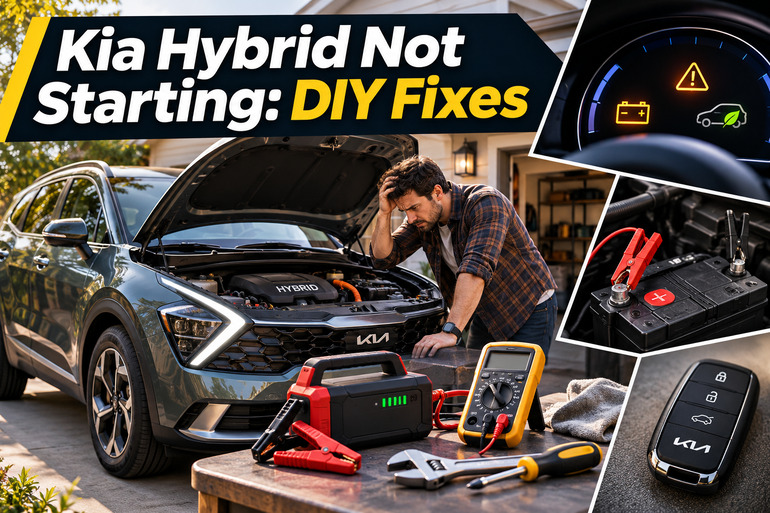
Understanding Why Your Kia Hybrid Won’t Start
Kia hybrid vehicles use a gasoline engine and an electric motor to power the wheels. They also have two electrical systems with different responsibilities. The high voltage hybrid battery supplies energy to the electric motor, while the 12V electrical system powers essential electronics, including the systems involved in starting the vehicle.
Unlike conventional gasoline vehicles, a Kia hybrid doesn’t always start its gasoline engine immediately. After you press the brake pedal and start button, the vehicle may enter READY mode without making any engine noise. If the READY indicator appears on the instrument cluster, the hybrid system has successfully started, even if the gasoline engine remains off.
When there’s an actual starting problem, the symptoms can vary. You might notice a completely dark dashboard, dim interior lights, a message saying the smart key isn’t detected, or an illuminated dashboard without the READY indicator. Some vehicles also display warnings about the hybrid system, braking system, or power supply.
These symptoms matter because different faults require different solutions. A weak 12V battery may prevent the electronics from operating, while an unrecognized key can stop the starting process even when the battery is healthy. More serious hybrid system faults may require professional diagnosis. Also, starting procedures and battery arrangements differ between Kia Niro, Sportage, Sorento, Carnival, and other hybrid models, particularly between standard hybrids and plug in hybrids.
Kia Hybrid Not Starting: Common Causes
Several mechanical and electrical problems can prevent your Kia hybrid from starting. The following causes are worth considering because they affect essential systems involved in starting or operating the vehicle.
1. Weak or Discharged 12V Battery
A weak 12V battery is one possible explanation when your Kia hybrid won’t respond to the start button. Although the vehicle has a larger hybrid battery, its low voltage electrical system must still power the computers and other components responsible for starting and controlling the vehicle.
The 12V battery can lose power when the vehicle sits unused for an extended period or electrical accessories continue drawing power while it’s parked. Devices such as aftermarket dash cameras may contribute to battery discharge, particularly when they remain active after the vehicle is switched off.
One useful clue is how the electrical accessories behave. If the interior lights are unusually dim, the door locks won’t respond, or the dashboard stays completely dark, the 12V electrical supply deserves attention. However, a working dashboard doesn’t completely rule out a battery problem.
Battery arrangements also differ between models. Certain Kia hybrids, including the 2026 Niro Hybrid, have an integrated lithium based 12V battery and a dedicated reset button. Other versions use a separate 12V battery, so the appropriate recovery procedure depends on the vehicle.
2. Smart Key Battery or Recognition Problems
Your Kia hybrid needs to recognize an authorized key before allowing the normal starting process. If the smart key battery becomes weak, the vehicle may struggle to detect it, even when the key is inside the cabin.
You might see messages such as “Key not detected” or “Key not in vehicle.” Sometimes, the remote buttons stop working reliably before the vehicle develops starting problems. However, these symptoms can also result from a damaged key or interference with its wireless signal.
Keeping the key close to a phone or certain electronic devices may affect communication. If moving the key closer to the start button allows the vehicle to respond, a key recognition issue becomes more likely than a major hybrid battery fault.
3. Brake Pedal or Gear Position Problems
Kia hybrids have starting conditions intended to prevent unintended vehicle movement. Generally, the transmission must be in Park, and you must press the brake pedal before pressing the ENGINE START/STOP button.
If the vehicle doesn’t detect the brake pedal being pressed, the start button may only activate the accessory or ignition electronics. A faulty brake pedal switch or a related electrical problem can produce this condition. Similarly, the vehicle may refuse to start if it doesn’t recognize that the transmission is in Park.
Dashboard messages can provide useful clues. For example, some Kia hybrids display “Press brake pedal to start engine” or “Shift to P to start engine.” These messages help distinguish an incomplete starting procedure from a battery or hybrid system failure.
4. Insufficient Fuel or Hybrid Battery Charge
A Kia hybrid still depends on gasoline for normal operation, even though its electric motor can provide propulsion under certain conditions. An empty fuel tank can prevent the hybrid system from operating properly, especially when the high voltage battery has insufficient energy.
A low hybrid battery charge can also cause starting or operating difficulties. Under normal conditions, the vehicle manages battery charging automatically. However, severe discharge or certain system faults can prevent normal operation.
Kia warns that a hybrid vehicle may shut down when its fuel tank is empty or either battery system becomes discharged. If the vehicle has already stopped because of insufficient fuel, attempting to continue driving using electric power alone can worsen the situation.
5. Electrical or Hybrid System Malfunctions
Sometimes, the starting problem originates from a component that controls the vehicle’s electrical or hybrid functions. Possible faults include a damaged fuse, a malfunctioning brake switch, a power supply problem, or an issue with the hybrid control system.
A blown fuse can interrupt power to an important circuit. For example, Kia notes that a failed stop lamp fuse can interfere with normal starting. However, if several electrical functions stop working together, the fault may involve a wider power supply problem.
Hybrid system failures often produce specific dashboard warnings. Messages such as “Check Hybrid system” or “Stop safely and check Hybrid system” indicate problems that require professional attention. They shouldn’t be treated as ordinary reminders that can be cleared simply by restarting the vehicle.
Although a warning message may appear alongside a discharged battery, it doesn’t automatically mean the hybrid battery needs replacement. Accurate diagnosis may require a technician to examine stored fault codes and test the affected systems.
Kia Hybrid Not Starting: DIY Fixes
The best approach is to begin with simple checks before considering battery assistance or electrical repairs. These methods can help you identify common starting problems without disturbing sensitive hybrid components.
1. Confirm the Correct Starting Procedure
Start by checking whether your Kia hybrid is actually failing to start or simply operating without the gasoline engine running. Since hybrids can start quietly, relying on engine noise alone can lead to confusion.
Use the following procedure while the vehicle is safely parked.
- Sit in the driver’s seat with your smart key inside the vehicle.
- Make sure the transmission is in Park.
- Apply the parking brake.
- Press and hold the brake pedal firmly.
- Press the ENGINE START/STOP button once.
- Check the instrument cluster for the READY indicator.
If READY appears, the hybrid system has started successfully. There’s no need to press the accelerator to make the gasoline engine run. However, if the indicator doesn’t appear, pay attention to any messages describing why the vehicle cannot start.
2. Check the Smart Key and Replace Its Battery
If your Kia displays a key detection warning, begin by making sure the smart key is inside the cabin and close to the driver’s seat. Remove it from your bag or pocket and keep it away from your phone or other electronic devices.
Next, try the emergency key recognition method. On many Kia models with a push button ignition, you can press the ENGINE START/STOP button directly with the smart key while holding the brake pedal. Kia specifies that the key should contact the button at a right angle on certain models. This may allow the vehicle to recognize the key when its battery is weak.
If this works, replacing the key battery is a sensible next step. On models such as the 2026 Niro, Kia specifies a CR2032 battery. You can remove the mechanical key, carefully open the key housing, install the correct replacement battery with its polarity matching the markings, and close the housing securely. Check your specific owner’s manual before opening the key because designs vary.
Afterward, test the remote locking functions and try starting the vehicle normally. Keep the small replacement battery away from children because swallowed button batteries can cause severe internal injuries. If the key still isn’t recognized, try a properly programmed spare key or seek professional assistance.
3. Use the 12V Battery Reset Button if Equipped
Some Kia hybrids have a 12V Battery Reset button that can restore the low voltage electrical supply after the battery protection system disconnects it. This feature is particularly useful when the vehicle seems completely unresponsive.
On supported models, the procedure is straightforward.
- Locate the 12V Battery Reset button using your owner’s manual. On certain models, it’s positioned to the left of the steering wheel.
- Press the button once to reconnect the battery.
- Within 15 seconds, press the brake pedal and start the vehicle normally.
- Confirm that the READY indicator appears.
For the 2026 Kia Niro Hybrid, Kia recommends keeping the vehicle in READY mode safely outdoors or driving it for a total of approximately 30 minutes after a successful reset. This allows the 12V battery to recharge. The gasoline engine doesn’t need to run continuously during this process.
Avoid repeatedly pressing the reset button without giving the battery time to recover. Kia warns that repeated resets without a sufficient READY period can result in further discharge. Also, don’t assume every Kia hybrid has this feature. Plug in hybrid models may use different 12V battery arrangements and emergency procedures.
4. Check the Fuel Level and Dashboard Warnings
Before attempting more involved electrical checks, look at the fuel gauge. If the tank is empty or extremely low, add the correct gasoline specified for your vehicle.
Once you’ve added fuel, follow the normal starting procedure and observe the instrument cluster. If the hybrid system starts successfully and no concerning warnings remain, insufficient fuel may have contributed to the problem. However, if the vehicle still won’t enter READY mode, don’t assume the issue has been resolved.
Pay particular attention to warning messages. If you see “Check Hybrid system,” “Check Hybrid system. Do not start engine,” or “Stop vehicle and check power supply,” follow the instructions in your owner’s manual. Kia advises against driving with certain hybrid system warnings and recommends professional inspection.
If the vehicle displays a warning about a serious braking system problem, don’t attempt to drive it. Braking performance may be reduced, and towing may be necessary.
5. Inspect the Brake Lights and Relevant Fuses
If the dashboard turns on but the vehicle repeatedly asks you to press the brake pedal, check whether the brake lights operate normally. With the vehicle safely parked, ask another person to observe the rear brake lights while you press and release the pedal.
If the brake lights don’t illuminate, the problem could involve a stop lamp fuse, brake pedal switch, or another part of the brake light circuit. However, functioning brake lights don’t guarantee that every signal from the brake switch is working correctly.
For a simple fuse check, locate the appropriate fuse panel and identify the stop lamp circuit using your owner’s manual or the fuse panel label. Switch the vehicle off before removing a standard accessible fuse with the proper fuse puller. If the fuse is visibly blown, replace it only with one of the same amperage rating. Kia specifically warns against fitting a higher rated fuse because it can create electrical damage or a fire risk.
If the new fuse blows again, stop replacing it and arrange an electrical inspection. Don’t attempt to repair wiring, bypass the brake switch, or disturb high voltage components. Also, avoid driving if the brake lights remain inoperative, even if you manage to start the vehicle.
6. Jump Start the 12V System When Necessary
If your Kia hybrid still has no electrical power after the appropriate basic checks, its 12V system may need external assistance. A jump start can sometimes restore enough power for the vehicle to enter READY mode, but it must be performed correctly.
Before attempting this, check your specific owner’s manual. Some Kia hybrids use designated jump terminals in the engine compartment, while other models have different arrangements. Always use a compatible 12V power source, and never connect a booster pack to the high voltage hybrid battery or any orange high voltage cables.
If your manual permits jump starting, follow its exact connection sequence and use only the designated terminals or grounding points. Keep both vehicles secured in Park, apply their parking brakes, and switch off unnecessary electrical accessories before connecting the equipment. Kia recommends using a qualified technician or towing service if you’re uncertain about the procedure.
Once the vehicle starts and READY appears, follow the charging instructions for your particular model. On supported Niro Hybrid models, Kia recommends approximately 30 minutes in READY mode or driving to recharge the 12V battery.
A successful jump start doesn’t necessarily mean the underlying problem has disappeared. If the battery loses power again, the vehicle may have a battery fault, an abnormal electrical drain, or a charging system problem that requires testing.
7. Contact a Qualified Kia Technician
If the vehicle still won’t start after these checks, it’s time to contact an authorized Kia dealership or a qualified technician familiar with hybrid vehicles.
Professional diagnosis becomes particularly important when the READY indicator never appears despite adequate 12V power, the starting fault keeps returning, or the vehicle displays hybrid system warnings. A technician can check battery condition, electrical supply, control modules, brake switch signals, and stored diagnostic trouble codes.
The high voltage battery, inverter, orange electrical cables, and associated connectors should never be opened or disconnected as part of ordinary DIY troubleshooting. These components can retain dangerous electrical energy even when the vehicle is switched off.
If you notice damaged electrical cables, smoke, unusual burning smells, or signs of overheating, stop using the vehicle and arrange appropriate emergency assistance. If it needs transporting, tell the recovery operator that it’s a hybrid so the correct towing method can be used.
Wrap-Up
A Kia hybrid that won’t start doesn’t automatically have a damaged hybrid battery. In many cases, the symptoms point to a more manageable issue involving the 12V electrical supply, smart key, starting conditions, or fuel level. Recognizing these differences can save you from replacing parts unnecessarily.
Begin with the safest checks, confirm whether READY mode is active, and follow the instructions for your specific Kia model. If the problem continues or serious warnings appear, proper professional diagnosis is the safest way to get your hybrid running reliably again.