
Your Kia’s headlights are essential for safe driving, especially at night or during heavy rain. When they suddenly stop working, you might notice that one headlight stays dark, both headlights fail, or the lights only work when you select certain settings. These symptoms can make driving difficult and potentially dangerous.
Fortunately, some headlight problems have straightforward solutions. Understanding what causes the lights to fail can help you identify the fault, avoid unnecessary repairs, and restore proper lighting.
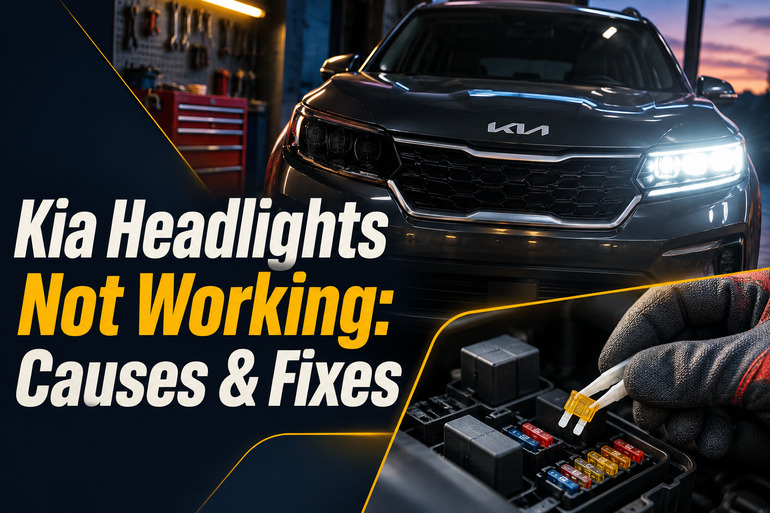
Why Are Your Kia Headlights Not Working?
Your Kia’s headlights depend on several electrical components working together. These include the headlight bulbs or LED units, fuses, wiring, lighting controls, and electronic control systems. When you turn on the headlights, the vehicle’s electrical system supplies power to the lamps. A problem anywhere along the relevant circuit can prevent them from illuminating.
The way your headlights behave can provide useful clues. For example, if only one headlight stops working, a failed bulb or a problem with that lamp’s electrical connection may be responsible. However, when both headlights fail simultaneously, a shared electrical supply problem, lighting control fault, or other system malfunction becomes a stronger possibility.
You might also notice that the high beams work while the low beams remain off. This can happen because the two functions may use different bulbs, circuits, or electronic controls, depending on your Kia’s model and headlight design. Similarly, headlights that flicker or turn off intermittently may indicate an unstable electrical connection or a malfunctioning lighting component.
It’s also worth understanding that not every apparent headlight failure involves a damaged component. Some Kia models have automatic headlights that respond to surrounding light conditions, while daytime running lights operate differently from the regular headlights. Incorrect switch settings can therefore create confusion.
Regardless of the cause, avoid driving at night or in poor visibility until the headlights work correctly. If both headlights have failed, arrange safe transportation or professional assistance rather than relying on daytime running lights or high beams.
Kia Headlights Not Working: Common Causes
Several problems can prevent your Kia’s headlights from operating normally. The most likely cause depends on whether one or both headlights are affected, how the lights behave, and whether other electrical features are experiencing problems.
1. Burned Out Headlight Bulbs or Failed LED Units
A failed headlight bulb is one of the first things to consider when only one of your Kia’s headlights stops working. On models equipped with halogen bulbs, the internal filament can eventually break after repeated heating and cooling during normal use. Once the filament breaks, electricity can no longer produce light.
You may notice that one headlight becomes noticeably dimmer before failing, although some bulbs stop working without an obvious warning. If the other headlight continues operating normally, the failed side deserves closer attention. However, a broken connector or interrupted electrical supply can produce the same symptom.
Some Kia vehicles use integrated LED headlights instead of replaceable halogen bulbs. These systems contain electronic components that control the LEDs and their power supply. A fault in the LED assembly or its control electronics can cause the light to flicker, become dim, or stop working completely.
Unlike conventional bulbs, certain integrated LED units cannot be repaired by replacing an individual light source. Kia recommends professional inspection when these assemblies fail, because their construction and replacement requirements differ between models.
2. Blown Headlight Fuse or Electrical Supply Problem
Your Kia’s electrical system uses fuses to protect circuits from excessive current. If a protected circuit develops an overload or short circuit, the fuse can blow and interrupt the electricity flowing through that circuit.
A blown fuse may leave one headlight or an entire lighting function inoperative, depending on how the vehicle’s electrical system is arranged. Some models use separate circuits for different lighting functions, so the exact symptoms can vary.
A fuse can fail because of damaged wiring, an internal electrical fault, or an unsuitable electrical modification. If the replacement fuse blows again, the underlying problem still exists and requires proper diagnosis. Repeatedly replacing it without finding the cause could allow further electrical damage.
3. Faulty Headlight Switch or Automatic Light Sensor
Your Kia’s headlight switch allows you to select different lighting modes. Depending on the model, these may include OFF, AUTO, parking lights, and regular headlights. If the switch develops an internal fault, it may fail to send the correct command to the lighting system.
An automatic lighting problem can produce similar symptoms. Kia models equipped with AUTO headlights use a sensor to detect surrounding light levels. If the sensor is obstructed or the system malfunctions, the headlights may switch on or off unexpectedly.
A useful clue is whether the headlights operate when you manually select the regular headlight position but behave incorrectly in AUTO mode. That difference suggests the lamps themselves are capable of working and directs attention toward the automatic lighting controls.
4. Damaged Wiring or Loose Electrical Connections
The electrical connections supplying your Kia’s headlights can deteriorate over time. Loose connectors, damaged wires, and corrosion may interfere with the flow of electricity, causing the headlights to stop working or behave unpredictably.
For example, a connector that no longer makes proper contact may interrupt power whenever the vehicle vibrates. Consequently, the headlight might work occasionally and then suddenly go dark. A damaged wire can produce similar intermittent symptoms.
Moisture can also contribute to electrical problems if water enters a damaged headlight assembly or reaches its electrical connections. Corrosion may gradually develop on affected contacts, making the electrical connection less reliable.
However, light condensation inside a headlight doesn’t automatically indicate an electrical fault. Kia explains that temporary moisture can appear after rain or washing because of temperature differences. Persistent moisture, substantial water accumulation, or signs of leakage deserve professional inspection.
5. Battery, Charging System, or Electronic Control Faults
Your Kia’s headlights also depend on a functioning electrical supply and, on many models, electronic control units that manage lighting operations. Problems involving these systems can interfere with normal headlight performance.
A weak 12 volt battery or charging system fault may contribute to dim or unstable lighting, particularly when other electrical features are also affected. However, a battery problem is less convincing when the vehicle starts normally and every other electrical function operates correctly.
Some Kia models also monitor LED headlights through electronic control systems. When a fault is detected, the instrument cluster may display a lighting warning or illuminate an LED headlamp warning light. Such warnings help identify problems that ordinary bulb and fuse checks cannot resolve.
Kia Headlights Not Working: DIY Fixes
Once you’ve identified the possible causes, you can begin with a few straightforward checks. Start with the lighting controls and other visible symptoms before considering component replacement or professional electrical diagnosis.
1. Check the Headlight Switch and Lighting Settings
Before assuming that your Kia has an electrical problem, confirm that the headlights are switched on correctly. This simple check is particularly useful if you’ve recently changed the lighting settings or noticed that the headlights behave differently during daytime and nighttime driving.
Park the vehicle safely and follow these steps.
-
Place the vehicle in the appropriate ON or READY state specified in your owner’s manual.
-
Locate the lighting control switch, usually on the stalk beside the steering wheel.
-
Turn the switch to the regular headlight position rather than AUTO or the parking light setting.
-
Check whether both low beam headlights illuminate.
-
Test the high beams briefly while parked and observe whether they operate.
-
Return the switch to the regular headlight position after testing.
If the headlights work in the manual setting but fail to activate automatically in darkness, inspect the area around the automatic light sensor. It is typically located on the upper dashboard, although its position varies. Remove objects obstructing it and verify that the system responds normally under appropriate lighting conditions.
Also, don’t confuse daytime running lights with low beam headlights. These lights serve different purposes and may operate under different conditions. For instance, Kia notes that daytime running lights on certain models switch off when the parking brake is engaged or the regular headlights are operating.
2. Inspect the Headlight Fuse
If the lighting controls are correctly set but your Kia’s headlights still don’t operate, checking the relevant fuse is a reasonable next step.
Consult your owner’s manual to identify the correct fuse panel and lighting circuit. Kia vehicles commonly have fuse panels inside the cabin and under the hood, although the specific locations, labels, and circuit arrangements vary by model and year.
If your manual permits checking an accessible blade fuse, use the following procedure.
-
Turn off the vehicle and all electrical switches.
-
Follow the owner’s manual instructions for electrical isolation before touching the fuse.
-
Open the appropriate fuse panel cover and locate the specified fuse.
-
Use the supplied fuse puller to remove it, if the procedure allows.
-
Inspect the metal element inside the fuse for a visible break.
-
If the fuse is blown, install an approved replacement with exactly the same amperage rating.
-
Refit the cover securely and test the headlights.
Never use a higher rated fuse, wire, or metal foil as a substitute. Also, leave bolted fuses, high voltage components, and unfamiliar fuse assemblies to a qualified technician.
If the new fuse blows immediately or shortly after installation, stop troubleshooting that circuit yourself. Kia identifies repeated fuse failure as a sign of an electrical problem requiring professional inspection.
3. Replace a Burned Out Halogen Headlight Bulb
If only one headlight has failed and your Kia uses replaceable halogen bulbs, replacing the defective bulb may restore normal operation. However, first confirm that your particular model allows the bulb to be replaced without removing major vehicle components.
Check your owner’s manual for the correct bulb specification and replacement instructions. Different Kia models and trim levels can use different headlight designs, so purchasing a bulb based solely on the vehicle brand is unreliable.
For a headlight with an accessible, owner replaceable bulb, the general process is as follows.
-
Park safely, switch off the vehicle, and allow the headlight assembly to cool.
-
Follow the manual’s instructions for isolating the electrical supply.
-
Open the hood and locate the access cover behind the affected headlight.
-
Remove the cover and release the bulb connector or retaining mechanism as instructed.
-
Carefully remove the old bulb.
-
Install the correct replacement bulb without touching its glass surface.
-
Secure the bulb, reconnect the appropriate components, and refit the cover.
-
Restore power according to the manual and test the headlight.
Kia warns that halogen bulbs contain pressurized gas and should be handled carefully, with suitable eye protection. Skin oils left on the glass may also cause overheating, so avoid touching the bulb directly.
Some Kia headlights require bumper removal or substantial disassembly to reach the bulb. In those situations, professional replacement is the safer option. If your vehicle has integrated LED headlights or high voltage HID lighting, avoid attempting to open or repair the electrical components yourself.
4. Look for Moisture or Visible Headlight Damage
Physical damage around the headlights can sometimes explain why they have stopped working. This is particularly relevant if the problem appeared after an accident, severe weather, or recent work around the front of the vehicle.
With the vehicle switched off, examine the exterior of the affected headlight assembly. Look for cracked lenses, broken mounting points, water collecting inside the housing, or obvious damage around the accessible parts of the assembly.
You can also check whether the headlight covers and surrounding panels appear properly fitted. However, avoid pulling electrical connectors apart or probing wiring. If you find melted plastic, exposed wiring, heavy corrosion, or significant water intrusion, arrange professional inspection before operating the lights again.
Light surface condensation may clear under normal operating conditions. However, persistent water inside the assembly can indicate a sealing problem. Simply replacing a bulb without addressing water entry may leave the underlying fault unresolved.
5. Check for Signs of Battery or Electrical System Trouble
If both headlights are dim, flickering, or completely inoperative, pay attention to how the rest of your Kia’s electrical system behaves.
For example, difficulty starting the engine, unusually weak interior lighting, repeated low battery warnings, or several electrical features malfunctioning together can suggest a broader power supply problem. These symptoms deserve attention because replacing headlight bulbs won’t correct inadequate electrical power.
You can begin with simple observations. Check whether the vehicle starts normally, whether the instrument cluster displays any electrical warnings, and whether other exterior lights operate as expected. If you recently installed electrical accessories, consider whether the problem began around the same time.
Avoid disconnecting battery cables, working on charging system wiring, or attempting electrical measurements unless you have the proper training and your vehicle’s service instructions permit the work. This caution is particularly important with hybrid and electric Kia vehicles.
A qualified technician can test the 12 volt battery, charging system, and related electrical connections. If the battery and charging system are healthy, further testing may reveal a lighting control or wiring fault instead.
6. Contact a Qualified Kia Technician
If your Kia’s headlights still don’t work after the basic checks, professional diagnosis is the most reliable next step. This is especially important when both headlights have failed, the problem keeps returning, or you notice damaged wiring, a burning smell, or a persistent lighting warning.
A qualified automotive technician can inspect the complete headlight circuit using appropriate diagnostic equipment. Depending on your Kia’s model, this may involve testing electrical supply and ground connections, checking lighting switch signals, inspecting control modules, or examining stored fault codes.
Professional service is also recommended for integrated LED headlight failures, suspected electronic control problems, and repairs that require major headlight assembly removal.
If the headlights have been removed or replaced following an accident, their alignment may also need checking. Proper headlight aiming helps you see the road clearly without directing excessive light into other drivers’ eyes.
Where possible, provide the technician with specific details about the failure. Explain whether one or both headlights stopped working, whether the high beams operate, and whether the fault is constant or intermittent. These observations can make diagnosis more efficient and help avoid replacing parts unnecessarily.
Wrap-Up
Kia headlight problems can result from something as simple as an incorrect lighting setting or a failed bulb, but they can also indicate faults within the vehicle’s electrical system. Paying attention to which lights fail, when the problem occurs, and whether other electrical features are affected can help you identify the most likely cause.
Start with safe, basic checks and follow the instructions for your specific Kia model. If the problem involves damaged wiring, integrated LED components, or repeated electrical failures, professional diagnosis is the safest way to restore dependable lighting.