
When your Hyundai Terracan’s four-wheel-drive system stops working, you may find that the vehicle struggles on muddy roads, loses traction on slippery surfaces, or refuses to engage 4H or 4L. The dashboard may also display a flashing 4WD warning light, even after you turn the selector.
Several faults can produce these symptoms, ranging from damaged vacuum hoses to an electrical problem or a worn transfer case. Identifying the specific fault helps you avoid unnecessary parts replacement and get your Terracan’s four-wheel-drive system working again.
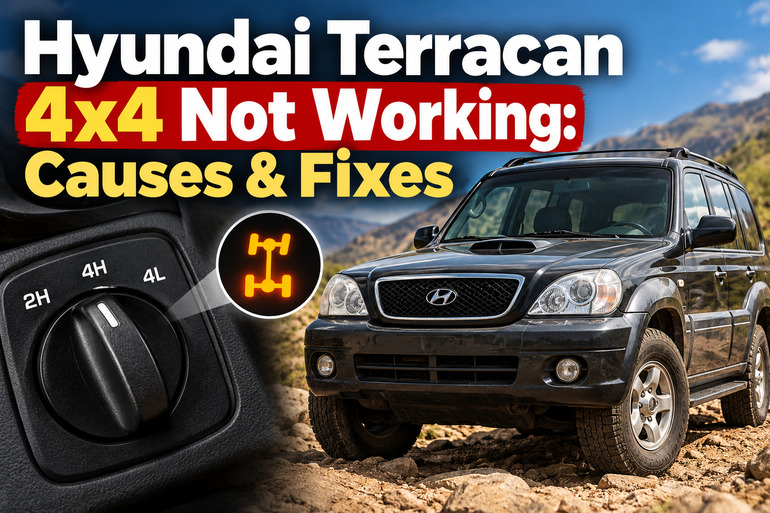
What It Means When the Hyundai Terracan’s 4×4 Stops Working
The Hyundai Terracan uses a four-wheel-drive system that distributes engine power to the front and rear axles. However, the exact arrangement varies by model, year, engine, and market. Some versions have a part-time system with 2H, 4H, and 4L settings, while others have a full-time system with automatic four-wheel drive and a low-range setting.
The 2H setting generally drives the rear wheels, while 4H provides four-wheel drive for suitable slippery surfaces and off-road conditions. The 4L setting provides low-range gearing, which increases the tractive force available at low speeds for steep climbs, descents, and difficult terrain. The selector’s position does not always confirm that the mechanical components have engaged successfully.
Your Terracan may therefore appear to have four-wheel drive selected while the front wheels receive little or no engine power. A faulty front axle disconnect mechanism, for example, can prevent the front axle from engaging even when the transfer case has shifted into four-wheel-drive mode. A leaking vacuum actuator is a possible cause of this particular symptom.
Warning lights provide another useful clue. On the 2004 Terracan, a flashing full-time 4WD warning light, or simultaneous illumination of the 4WD HIGH and LOW indicators on applicable part-time models, can indicate a system malfunction. These indicators should be investigated rather than ignored. The correct diagnosis depends on the system installed in your vehicle.
Hyundai Terracan 4×4 Not Working: Likely Causes
Several components must operate together for the Terracan’s four-wheel-drive system to engage correctly. The following faults are worth investigating, starting with the components that commonly prevent drive from reaching the front wheels.
1. A Leaking Front Axle Vacuum Actuator
A leaking vacuum actuator is a particularly relevant suspect when the selector appears to engage four-wheel drive but the front wheels receive no power. Certain Terracan configurations use a centre axle disconnect mechanism that connects part of the front axle when four-wheel drive is selected.
The actuator uses vacuum pressure to move the disconnect mechanism. A damaged internal diaphragm, a cracked vacuum hose, or a loose connection can prevent the mechanism from moving into the required position. The transfer case may engage while the front axle remains disconnected.
Age, heat, dirt, and repeated exposure to engine vibration can gradually damage rubber vacuum lines. The resulting leak may be intermittent at first, allowing the system to work occasionally before the fault becomes consistent.
Look for visible signs of deteriorated hoses or disconnected connections, but avoid assuming that a damaged hose is the only possible cause. A technician can use a suitable hand vacuum pump to determine whether the actuator holds vacuum and moves correctly.
2. A Faulty Transfer Case Shift Motor or Actuator
The transfer case directs engine power through the drivetrain according to the selected operating mode. On Terracan versions with electronically controlled shifting, an electric motor or actuator moves the internal mechanism between the available settings.
If the shift motor becomes worn, its internal gears become damaged, or the mechanism sticks, the system may fail to move out of 2H or enter low range. You might turn the selector and hear a short clicking sound, experience a delay, or see the relevant dashboard indicator continue flashing.
A position sensor can also fail to report the transfer case’s actual position correctly. In that situation, the mechanical system may have moved partially or completely, but the control system may not register the expected result.
Replacing the motor without testing it first can waste money because the underlying fault may lie in the wiring, control circuit, or transfer case itself. Proper diagnosis should establish whether the actuator receives the correct electrical command and whether the mechanism can complete its movement.
3. Blown Fuses, Damaged Wiring, or a Faulty Selector Switch
Electrical faults can prevent the four-wheel-drive system from receiving or interpreting the command to engage. These faults may involve a blown fuse, corroded connector, damaged wiring, a faulty selector switch, or a problem with the control unit.
Water intrusion and corrosion can be particularly troublesome in an older SUV that has been driven through mud, water, or rough terrain. A loose connector may also create an intermittent problem, allowing the system to operate on one occasion and refuse to engage on another.
The symptoms may include a selector that produces no response, warning lights that behave unusually, or a system that works intermittently. However, a flashing indicator does not identify one specific failed component.
The correct fuse and wiring arrangement depends on the vehicle’s configuration. Checking the circuit against the appropriate wiring diagram is more reliable than replacing random fuses or disturbing connectors in the hope of restoring four-wheel drive.
4. Damaged Front Drivetrain Components
Even when the transfer case and axle disconnect mechanism operate correctly, mechanical damage can prevent power from reaching the front wheels.
Possible faults include a damaged front driveshaft, worn universal joints, damaged axle shafts, failed constant-velocity joints, or worn differential components. The splined connections that transmit rotation can also become damaged, interrupting power delivery.
The symptoms depend on the failed component. A damaged joint may produce clicking, clunking, vibration, or grinding, while a stripped connection may prevent the affected axle from receiving drive even though the system appears to engage.
A sudden loss of four-wheel drive following a loud clunk deserves particular attention. Continuing to drive with a damaged shaft or joint may cause further damage to surrounding components. Because these parts are located beneath the vehicle, inspection should be performed by a technician with appropriate lifting equipment.
5. Transfer Case or Internal Four-Wheel-Drive System Damage
The transfer case contains mechanical components that direct power to the appropriate parts of the drivetrain. Some full-time Terracan systems also depend on electronically controlled torque distribution, which introduces additional components that can fail.
Worn internal gears, a damaged engagement mechanism, bearing problems, or wear in a torque-transfer clutch can interfere with normal operation. Low or unsuitable transfer case lubricant may contribute to wear, overheating, or abnormal mechanical noise, depending on the fault and vehicle configuration.
This type of problem becomes more concerning when four-wheel-drive failure is accompanied by grinding, persistent whining, heavy drivetrain binding, or a visible lubricant leak. A vehicle that develops unusual resistance or repeated knocking when turning may also have a mechanical fault that should not be ignored.
Internal damage is less suitable for casual DIY diagnosis because the transfer case may require specialist testing and disassembly. A technician should first rule out simpler problems, such as vacuum leaks, electrical faults, and failed actuators, before recommending an expensive replacement or overhaul.
Hyundai Terracan 4×4 Not Working: DIY Fixes
You can carry out several preliminary checks before paying for a major repair. Begin with the operating procedure and visible components, then arrange specialist testing if the system still refuses to engage.
1. Confirm the Correct Four-Wheel-Drive Engagement Procedure
An incorrect engagement procedure can make a functioning system appear faulty, especially when you are trying to select low range.
First, confirm which four-wheel-drive configuration your Terracan has. If it uses the part-time 2H, 4H, and 4L arrangement, follow the instructions for those settings. If it uses a full-time system with AUTO and LOW, use the instructions specified for that configuration instead.
For the 2004 part-time Terracan, the owner’s manual permits shifting between 2H and 4H below 80 km/h (50 mph), while driving straight. Moving from 4H to 4L requires stopping the vehicle, depressing the clutch on a manual transmission or selecting neutral on an automatic transmission, and then selecting 4L. Confirm that these instructions apply to your model before attempting the shift.
Do not force the selector if it resists movement or the system fails to engage. Part-time four-wheel drive should also not be used on dry paved roads where the drivetrain cannot accommodate differences in front and rear wheel speeds during turns.
2. Check the Dashboard Indicators and Relevant Fuses
Start with the instrument cluster. Turn the ignition on and observe the warning lights, then note what happens when you select the required mode. Record whether the indicator illuminates steadily, flashes, or fails to appear.
These observations help narrow the diagnosis. A selector that produces no response may suggest an electrical supply, switch, or control issue, while a flashing warning light can indicate that the system has detected a malfunction.
With the ignition switched off, consult the fuse diagram in your owner’s manual and inspect the specified four-wheel-drive circuit fuse, where fitted. Replace a blown fuse only with one of the same rating. If the replacement fuse blows again, stop replacing it and have the circuit tested for an electrical fault.
A warning light that continues flashing, or the simultaneous illumination of HIGH and LOW indicators on a relevant model, warrants professional diagnosis.
3. Inspect Accessible Vacuum Hoses and Connections
If your Terracan has a vacuum-operated front axle disconnect, inspect the accessible vacuum hoses for obvious damage. Park on level ground, apply the parking brake, switch off the engine, and allow hot components to cool before opening the hood.
Look for hoses that are cracked, split, disconnected, or visibly deteriorated. Pay attention to any accessible connection that appears loose or damaged. Do not pull on unfamiliar hoses or disconnect lines simply to see whether the system responds.
If a clearly damaged hose is accessible and you can identify its correct routing, replacing it with the correct vacuum-rated hose may resolve the fault. If the affected line runs beneath the vehicle or you cannot identify the connection, leave the repair to a qualified technician.
A sound-looking hose does not prove that the actuator is working correctly. The actuator diaphragm, vacuum supply, and control solenoid may need testing with suitable equipment.
Safety warning: If your Terracan also develops a hard brake pedal or a brake vacuum warning, stop driving and seek professional assistance. A vacuum-related brake fault can reduce braking assistance and create an immediate safety risk.
4. Check for Visible Drivetrain Leaks and Other Warning Signs
Look at the ground beneath the parked vehicle for fresh lubricant leaks. A leak near the transfer case or differential may indicate a problem that needs attention, particularly if the loss of four-wheel drive is accompanied by unusual mechanical noise.
You can also check whether all four tires are the correct size and whether their pressures match the manufacturer’s specifications. Significant differences in rolling circumference can place additional stress on certain four-wheel-drive systems, especially electronically controlled full-time arrangements.
Keep the inspection limited to what you can see safely from outside the vehicle. Never crawl beneath a vehicle supported only by a jack, and do not attempt to rotate driveshafts or manipulate drivetrain components while the vehicle is running.
A leak, grinding noise, heavy binding, or a loose-looking driveshaft is a reason to arrange a proper mechanical inspection rather than continue testing the system on the road.
5. Have the Control System and Actuator Tested
If the basic checks do not reveal an obvious problem, the next useful step is a diagnostic assessment of the four-wheel-drive control system.
A suitable diagnostic scanner may retrieve fault codes from the relevant control unit, depending on the model and scanner capabilities. A basic engine-code reader may not access the transfer case or four-wheel-drive system.
A technician can then test the actuator, inspect its electrical supply and ground connections, verify position-sensor readings, and check the vacuum system where applicable. These tests help distinguish a failed actuator from a control problem or mechanical fault.
This is particularly useful when the warning light flashes repeatedly, the selector fails to change modes, or the vehicle reports that a mode has engaged without delivering the expected traction. A diagnosis based on test results is more reliable than replacing components one after another.
Contact a Qualified Automotive Technician
If the preceding checks do not restore four-wheel drive, arrange an inspection by a mechanic familiar with the Hyundai Terracan’s transfer case and front axle disconnect system.
Professional assistance is especially important when the system repeatedly fails to engage, the warning light remains active, or you hear grinding, knocking, or heavy drivetrain binding. The technician may need to test vacuum pressure, inspect the actuator, retrieve control-system fault codes, or examine the transfer case and front differential.
Avoid driving in conditions that require four-wheel drive until the fault is resolved. If the vehicle has severe drivetrain noise, a substantial lubricant leak, or a suspected damaged driveshaft, arrange recovery rather than driving it to a workshop.
Wrap-Up
A Hyundai Terracan with a non-functioning 4×4 system may have a simple vacuum leak, an electrical fault, a failed transfer case actuator, or damaged mechanical components. The most useful first step is to establish which four-wheel-drive system your particular vehicle uses and identify the symptoms that accompany the failure.
Check the operating procedure, observe the warning lights, and inspect accessible components without putting yourself beneath an unsupported vehicle. If these checks do not identify the cause, specialist testing can help pinpoint the fault and prevent unnecessary parts replacement. A correct diagnosis is the best starting point for restoring reliable four-wheel-drive performance.