
A Hyundai Santro Xing that refuses to start can leave you stranded, especially when the car was running normally before the problem appeared. You might hear repeated clicking when you turn the key, notice that the starter motor spins without starting the engine, or find that nothing happens at all.
The right solution depends on these symptoms. A weak battery, faulty starter circuit, fuel delivery problem, or ignition fault can produce similar trouble. Identifying what happens when you turn the key helps you avoid unnecessary part replacements and get your Santro Xing running again.
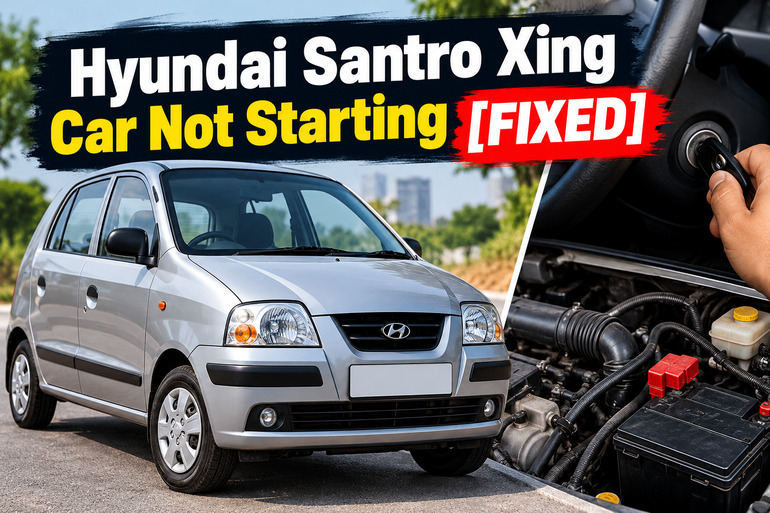
Understanding Why Your Hyundai Santro Xing Car Is Not Starting
The first step is to determine whether the engine cranks when you turn the ignition key. Cranking is the repeated turning motion produced by the starter motor as it attempts to start the engine. If you hear the engine turning but it never fires up, the fault is different from one in which the starter motor remains silent.
Pay attention to the dashboard lights, headlights, sounds from the engine compartment, and the behavior of the engine during each starting attempt. These clues help narrow down the possible causes before you spend money on repairs.
There are three main situations to identify. First, the engine may not crank at all, or it may turn very slowly. Second, it may crank at its usual speed without starting. Third, it may start briefly and then stall. The first situation points more strongly toward the battery or starting circuit, while the second often requires checks of the fuel system, ignition system, and engine sensors.
The Hyundai Santro Xing’s starting system depends on several components working together. These include the battery, starter motor, fuel delivery system, ignition components, wiring, and engine management system. The correct diagnosis depends on your particular Santro Xing model year, engine configuration, and observed symptoms.
Hyundai Santro Xing Car Not Starting [FIXED]: Common Causes
Several faults can prevent your Santro Xing from starting, and the symptoms often provide useful clues. Begin with the basic electrical supply before investigating fuel delivery or replacing engine components.
1. A Weak or Discharged Battery
A weak battery is one of the first things to investigate when a car refuses to start. The battery supplies the electrical power required to turn the starter motor and operate important vehicle systems during startup.
When the battery is discharged, you may hear rapid clicking, notice the dashboard lights dimming, or find that the starter motor turns the engine very slowly. In some cases, the dashboard illuminates normally, but the battery cannot supply enough current to start the engine.
A battery may become discharged because the headlights or interior lights were left on, the charging system is faulty, or the battery has deteriorated with age. Loose or corroded battery terminals can produce similar symptoms even when the battery itself remains usable.
Check whether the battery terminals are visibly corroded, loose, or damaged. If the dashboard lights become very dim when you attempt to start the car, have the battery and its connections tested. A battery test is more reliable than judging its condition from the dashboard lights alone.
2. Faulty Starter Motor or Starting Circuit
The starter motor turns the engine until combustion begins. If it fails, your Santro Xing may produce a single click, repeated clicks, or complete silence when you turn the key.
A single loud click can indicate a problem with the starter solenoid, starter motor, battery connections, or the wiring supplying the starter. Complete silence may point to the ignition switch, a starter relay, a blown fuse, a damaged connection, or a starting interlock where one is fitted.
The sound alone cannot identify the failed component. A weak battery can produce clicking that resembles a failed starter, so the battery and its connections should be tested before the starter motor is condemned.
If the battery is fully charged and the connections are sound, a technician can test whether the starter receives the correct electrical signal and whether the motor operates properly. Replacing the starter without these checks could leave the original problem unresolved.
3. Fuel Pump or Fuel Supply Failure
Your Santro Xing needs a suitable supply of petrol for the engine to start. The fuel pump draws fuel from the tank and delivers it to the engine at the required pressure.
If the pump fails, its electrical supply is interrupted, or the fuel filter becomes restricted, the engine may crank normally without starting. You might also notice that the car struggles to start after sitting for some time, loses power while driving, or stalls unexpectedly.
The fuel pump, fuel filter, fuel lines, and fuel pressure regulator are relevant parts of fuel system diagnosis. Testing fuel pressure and checking the pump’s electrical supply can help distinguish a failed pump from a wiring or relay problem.
Check the fuel gauge first and make sure there is sufficient petrol in the tank. A failed fuel pump relay, damaged wiring, or poor electrical connection can imitate a failed pump, so the pump should not be replaced simply because the engine will not start.
4. Faulty Spark Plugs, Ignition Coil, or High Tension Leads
Even when fuel reaches the engine, the Santro Xing cannot start properly without a suitable spark at the correct time. The spark plugs ignite the air and fuel mixture inside the cylinders, while the ignition coil and high tension leads, where fitted, help deliver the required electrical energy.
Worn or fouled spark plugs may cause hard starting, rough running, or repeated misfires. A failed ignition coil or damaged high tension lead can prevent one or more cylinders from receiving a reliable spark. If the ignition system fails more extensively, the engine may crank without starting at all.
Clues include a history of difficult starting, rough idling before the failure, or the engine occasionally firing without running continuously. However, these signs can overlap with fuel system problems.
A technician can test the ignition components and inspect the spark plugs for wear, fouling, or damage. Do not hold ignition leads or exposed electrical connectors while someone cranks the engine. Ignition systems generate high voltage, and proper test equipment is required.
5. Engine Sensor, Wiring, or Engine Control Fault
The engine management system controls important functions involved in starting. Depending on the vehicle’s configuration, sensors provide information about engine position and operating conditions so the control unit can coordinate fuel injection and ignition.
A faulty crankshaft position sensor, damaged wiring, poor electrical connections, or an engine control system fault can prevent the engine from starting even when the battery and starter motor are working normally. A crankshaft position sensor fault is particularly relevant when the engine cranks but does not fire.
Your Santro Xing may also have a fuel pump relay fault or an injector electrical problem. The exact components and diagnostic procedures depend on the model year and engine version.
A check engine warning light, if fitted and illuminated, may provide a useful clue, but its presence or absence cannot confirm a particular fault. A mechanic can scan the engine control unit where supported and use the stored fault codes alongside electrical tests. Replacing sensors based on guesses can be expensive and may fail to resolve the starting problem.
Hyundai Santro Xing Car Not Starting [FIXED]: DIY Fixes
You can perform several basic checks before arranging a repair. Start with simple observations and external inspections, then leave electrical testing, fuel pressure measurements, and component replacement to a suitably equipped technician when required.
1. Check the Battery and Battery Terminals
Begin by switching off the headlights, air conditioning, radio, and other electrical accessories. Make sure the car is parked safely, with the parking brake applied and the transmission in the appropriate starting position.
Inspect the battery terminals for visible corrosion, loose clamps, or damaged cables. Do not allow metal tools to bridge the battery terminals or connect a terminal to the vehicle body. If the battery is swollen, cracked, leaking, or unusually hot, do not attempt to jump-start it.
If the battery appears discharged, arrange a proper battery test. A qualified person can charge and test the battery or replace it if it no longer holds sufficient charge.
Once the battery has been tested, try starting the engine again. If the car starts after charging or jump-starting, the underlying cause still needs attention. A deteriorated battery, charging system fault, or electrical drain may discharge it again.
2. Confirm the Starting Procedure and Check the Fuses
An incorrect starting position or an interrupted electrical circuit can prevent the engine from cranking. For a manual transmission, place the gear lever in neutral and depress the clutch pedal before turning the key. If your particular version has an automatic transmission, select the manufacturer’s specified starting position, normally Park or Neutral.
Turn the ignition to the appropriate position and observe the dashboard. If the normal warning lights do not illuminate, the problem may involve the battery, main electrical supply, ignition switch, or a related connection.
You can also inspect the relevant fuses using the fuse diagram for your vehicle. Check for a blown fuse associated with the ignition or starter circuit, where identified in the diagram. Replace a blown fuse only with one of the specified ratings.
If the replacement fuse blows again, stop replacing it. A short circuit or other electrical fault may be present and needs proper diagnosis. Never bypass a fuse or fit a higher-rated one to force the car to start.
3. Verify the Fuel Level and Look for Signs of Leakage
A low fuel level can prevent the engine from receiving enough petrol, particularly if the gauge is inaccurate or the car is parked on an incline. Check the fuel gauge and add a suitable amount of petrol if necessary.
Next, look beneath the parked vehicle for signs of fresh fuel leakage. You may also notice a strong petrol smell around the car. If you suspect a leak, do not crank the engine, use electrical equipment near the suspected leak, or attempt to locate it with a flame. Keep away from ignition sources and arrange professional assistance.
If the fuel level is sufficient and there are no signs of leakage, listen for unusual changes in the car’s behavior during a starting attempt. Some versions may produce a brief fuel pump sound when the ignition is switched on, although the sound can be difficult to hear and pump operation varies with the system design.
The absence of an audible pump does not prove that the pump has failed. Its electrical supply, relay, wiring, and fuel pressure should be checked before replacement.
4. Inspect Accessible Ignition Components and Connections
If the engine cranks normally but refuses to start, the ignition system may require attention. Consider whether the car experienced rough idling, misfiring, or difficult starting before the complete failure.
With the engine switched off and the ignition key removed, you can look for obviously disconnected or damaged wiring and accessible connectors in the engine compartment. Do not pull on wiring, disconnect sensors at random, or handle ignition components while the engine is being cranked.
Spark plug removal and testing are better left to someone with the correct tools and experience, particularly if the plugs are difficult to access or the engine has not cooled. A technician can inspect the plugs and test the coil and associated wiring without causing damage to the ignition system.
If a plug or coil is faulty, replace the affected component with the correct specification for your Santro Xing. Where several components are worn or overdue for service, the technician can recommend what needs replacement based on inspection rather than replacing every ignition component at once.
5. Arrange Fuel System and Engine Diagnostic Tests
If the battery and starter operate normally but the engine still fails to start, the next step is to test the systems responsible for combustion.
A workshop can measure fuel pressure, test the fuel pump circuit and relay, check for ignition spark with suitable equipment, and evaluate engine sensor signals. These tests help distinguish between a pump that has failed, a pump that is not receiving power, an ignition fault, and a sensor that is providing an incorrect signal.
An electronic diagnostic scan may also help where the vehicle’s engine control system supports it. Fault codes should be interpreted alongside the symptoms and measurements because a code can indicate a circuit problem without proving that the named component itself has failed.
Avoid opening fuel lines or applying battery power directly to fuel pump wiring as a home test. Petrol under pressure can spray out, and sparks near fuel vapour can start a fire. Fuel pressure testing and electrical diagnosis are workshop jobs.
Final Solution: Contact a Qualified Automobile Technician
If your Hyundai Santro Xing still refuses to start after the basic checks, arrange an inspection by a qualified mechanic or automotive electrician. Provide a clear account of what happens when you turn the ignition key, including whether the engine cranks, whether the dashboard lights dim, and whether the car previously stalled or struggled to start.
This information helps the technician follow a logical diagnostic process. Depending on the findings, the repair could involve the battery, starter circuit, fuel pump, ignition system, engine sensor, wiring, or another fault.
Stop attempting to start the car if you notice fuel leakage, smoke, burning electrical smells, severely damaged wiring, or unusual mechanical noises. Have the vehicle recovered if it cannot be moved safely. Repeated cranking is unlikely to solve a failed component and can discharge the battery or overheat the starter motor.
Wrap-Up
A Hyundai Santro Xing that will not start needs a diagnosis based on its symptoms rather than guesswork. If the starter is silent or slow, begin with the battery, terminals, and starting circuit. If the engine cranks normally without firing, investigate fuel delivery, ignition, and engine management.
Simple checks can help identify the next step, but fuel pressure testing and electrical diagnosis require suitable equipment and training. Addressing the actual cause can prevent repeated starting failures and unnecessary spending on parts that are still working properly.