
If your Hyundai i30 refuses to start, the first clue is what happens when you turn the key or press the start button. A silent dashboard, rapid clicking, slow cranking, and an engine that turns over without firing point to different faults. Repeated starting attempts rarely solve the underlying problem and can drain the battery further.
Start with a few simple checks to narrow down the cause. You may be dealing with a weak battery, a faulty starter, a fuel supply problem, or an issue with the vehicle’s security system.
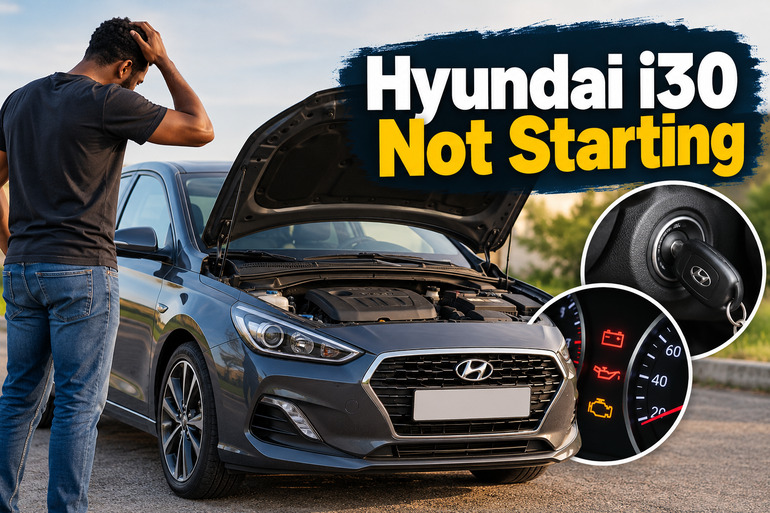
What It Means When Your Hyundai i30 Won’t Start
Your Hyundai i30 needs several systems to work together before the engine can run. The battery supplies electrical power, the starter motor turns the engine, and the fuel and engine management systems help produce combustion. Petrol models also need a functioning ignition system, while diesel engines rely on compression and suitable fuel injection, with additional cold starting assistance when required.
A failure in any of these systems can leave you stranded. However, the exact symptoms help narrow down the possibilities. If the dashboard lights barely illuminate, the battery or its connections deserve attention first. If the dashboard lights work normally but the engine makes a single click, the starter circuit may be responsible.
Another common situation occurs when the engine turns over normally but refuses to start. This means the starter is doing its job, but the engine isn’t running independently. Fuel delivery, ignition, engine sensors, or the immobilizer system may be preventing it from firing.
Your i30’s model year, engine type, and transmission also affect the starting procedure and the parts involved. The following checks apply broadly across many Hyundai i30 versions, but you should consult the owner’s manual for instructions specific to your vehicle.
Hyundai i30 Not Starting [FIXED]: Common Causes
Several faults can prevent a Hyundai i30 from starting, and the most useful starting point is to distinguish an engine that won’t crank from one that cranks without starting. The five causes below cover common possibilities and explain how you can recognize them before spending money on replacement parts.
1. A Weak or Faulty Battery
A discharged or failing 12-volt battery is one of the first things to investigate when your Hyundai i30 won’t start. The battery powers the starter motor and supplies electricity to the vehicle’s electronic systems. If its charge is too low, the starter may struggle to turn the engine or fail to operate altogether.
You may hear rapid clicking when you turn the key, notice the dashboard lights flickering, or find that the instrument panel goes dark during a starting attempt. In other cases, the lights and radio work normally, but the battery cannot deliver enough current to start the engine. Electrical accessories need much less power than the starter motor, so working accessories don’t prove the battery is healthy.
Battery trouble can develop after the headlights or interior lights remain on, following a long period without driving, or when the battery is worn. Loose or corroded battery connections can produce similar symptoms. A faulty alternator may also leave the battery discharged after driving, causing the starting problem to return even after a jump start.
2. A Faulty Starter Motor or Starting Circuit
The starter motor uses electricity to rotate the engine until combustion can keep it running. When the motor, its solenoid, the starter relay, or the associated wiring develops a fault, your Hyundai i30 may fail to crank despite having electrical power.
Listen carefully when you attempt to start the vehicle. A single loud click can indicate a faulty starter or a problem with the high current electrical connection. Rapid clicking is more commonly associated with a low battery or poor electrical connections. Complete silence may point to a control circuit fault, a battery connection problem, or a starting interlock that hasn’t been satisfied.
Transmission position and pedal switches can produce similar symptoms. Many automatic i30 models require the gear selector to be in Park or Neutral, while manual versions may require the clutch pedal to be fully depressed. If the relevant switch doesn’t detect the correct position, the vehicle may refuse to crank even when the starter motor itself is functional.
3. A Fuel Delivery Problem
Your Hyundai i30 may crank normally without starting because the engine isn’t receiving enough fuel. Depending on the engine, the problem could involve an empty tank, a failed fuel pump, a damaged pump relay, a blocked fuel filter, or a fault affecting fuel injection.
A faulty fuel pump can prevent petrol from reaching the engine at the required pressure. A blocked filter or an injector problem can also interfere with delivery. On diesel versions, air entering the fuel system or a problem with the high pressure fuel equipment may prevent the engine from starting.
These faults can be difficult to distinguish by sound alone. The engine may crank at its normal speed without firing, or it may start briefly and then stop. If the vehicle has recently run out of fuel, received contaminated fuel, or developed starting problems immediately after refueling, mention that information when seeking a diagnosis.
4. An Ignition or Engine Management Fault
Petrol engines need a properly timed spark to ignite the air and fuel mixture. Worn spark plugs, failed ignition coils, damaged wiring, or related electrical faults can prevent combustion even when the engine cranks normally.
Engine sensors can cause similar problems. The crankshaft position sensor, for example, helps the engine control unit determine the crankshaft’s position and speed. If its signal is missing or unreliable, the control unit may be unable to coordinate ignition and fuel injection correctly. Some sensor faults occur intermittently, so the engine may start one day and refuse to start the next.
Diesel engines have different requirements because they ignite fuel through compression rather than spark plugs. On a diesel i30, a glow plug or preheating system fault may make cold starting difficult, particularly in cold conditions. Fuel pressure, injector operation, and engine timing can also be involved. A diagnostic scan is often needed to distinguish these faults reliably.
5. An Immobilizer or Smart Key Problem
Your Hyundai i30’s immobilizer is an anti theft system that prevents unauthorized engine starting. It checks whether the vehicle recognizes the key or transponder before allowing the engine to run. If the system cannot authenticate the key, the engine may refuse to start even though the battery and starter are working.
A damaged key, a failed transponder, an immobilizer antenna fault, or an electronic communication problem can interrupt this process. On versions equipped with a smart key, a weak fob battery can also cause problems with key detection, although the exact symptoms vary by model.
Pay attention to any security indicator or key recognition warning on the dashboard. If the central locking and remote functions stop working as well, the key fob battery deserves attention. However, an immobilizer warning does not automatically mean that the key itself is faulty. The vehicle’s receiver, wiring, and control electronics may also require testing.
Hyundai i30 Not Starting [FIXED]: DIY Fixes
The most effective approach is to begin with checks that are easy to perform and carry little risk. Work through the following fixes in order, stopping when you identify a likely fault or encounter a problem that requires specialist equipment.
1. Check the Starting Procedure and Dashboard Indicators
Before testing any parts, make sure you’re starting the vehicle correctly. An incorrect gear position or an insufficiently depressed pedal can prevent the starter from operating, even when all the main components are working.
For an automatic Hyundai i30, apply the parking brake, select Park, and press the brake pedal before attempting to start the engine. If the engine doesn’t crank, confirm that the selector is fully in Park. When safe to do so, you can try Neutral as well if your owner’s manual permits it.
For a manual transmission, place the gear lever in Neutral, apply the parking brake, and fully depress the clutch pedal before starting. On a version with a start button, follow the pedal and key detection requirements in its handbook.
Next, observe the dashboard lights and listen for any clicking or cranking sounds. If the dashboard goes dark when you attempt to start the engine, suspect a discharged battery or a poor electrical connection. If the lights remain bright but nothing happens, investigate the starting controls and starter circuit.
2. Inspect the Battery and Arrange a Safe Jump Start
Open the hood and visually inspect the battery and its connections. Look for obvious corrosion, loose clamps, damaged cables, or a battery case that appears swollen or cracked. Do not attempt to jump start a swollen, leaking, or visibly damaged battery. Contact roadside assistance instead.
If the battery appears intact but is discharged, a compatible jump starter or another vehicle may help. Follow the jump starting procedure in your particular i30 owner’s manual, including the specified connection points and cable sequence. Battery layouts and manufacturer instructions can differ, so avoid guessing where to attach the cables.
If the engine starts successfully, that provides useful evidence of a battery or electrical supply problem, but it doesn’t prove the battery is the only fault. Have the battery tested and ask for the charging system to be checked. If the car repeatedly needs a jump start, the cause could be a failing battery, an alternator problem, or an electrical drain while the vehicle is parked.
3. Check the Key and Immobilizer System
If your i30 displays a key warning or fails to recognize the smart key, start by checking whether you have the correct key for the vehicle. If a spare registered key is available, try it. A successful start with the spare key makes a problem with the original key more likely.
For a smart key model, replace the fob battery if it’s weak and you know the correct battery type. Consult the owner’s manual for the emergency starting procedure. Some versions allow you to hold the smart key against or close to the start button while pressing it, but the exact method depends on the vehicle.
If the security warning remains or neither key works, avoid buying replacement keys without a diagnosis. A technician can check whether the immobilizer recognizes the key and whether its antenna and control systems communicate correctly. Programming may be required for replacement components.
4. Verify Fuel Supply and Observe Diesel Preheating
Check the fuel gauge before investigating complicated engine faults. A low reading or a vehicle parked on an incline can occasionally contribute to fuel starvation, particularly when the tank is nearly empty. Add the correct fuel if necessary, using the fuel type specified for your engine.
If your i30 has sufficient fuel but cranks without starting, pay attention to any recent changes. A problem that began immediately after refueling may justify checking for incorrect or contaminated fuel. A failed fuel pump, a blocked filter, or an injection fault requires further testing.
For a diesel model, follow the dashboard’s preheating instructions when starting from cold. Allow the glow indicator to go out when instructed by the owner’s manual before attempting to start the engine. If cold starting remains difficult or the engine fails to fire, arrange an inspection of the preheating and fuel systems. Avoid loosening fuel lines or attempting to test high pressure diesel components yourself because the fuel can cause serious injection injuries.
5. Check Warning Lights and Obtain a Diagnostic Scan
When basic checks don’t resolve the problem, a diagnostic scan may reveal useful information. The engine control unit and other vehicle modules can store fault codes associated with sensor signals, fuel delivery, ignition, or immobilizer communication.
A compatible OBD-II scanner can retrieve many engine related codes. However, a code identifies a detected condition and does not always confirm which component has failed. For example, a crankshaft position sensor related code may result from the sensor, its wiring, or a problem with its signal circuit.
Write down any dashboard warnings and the circumstances in which the fault occurs. Note whether the engine starts when cold, refuses to start when hot, cranks slowly, or starts briefly before stalling. This information helps a technician select the right tests instead of replacing components based on guesswork.
6. Contact a Qualified Automotive Technician
Professional diagnosis is necessary if your Hyundai i30 still refuses to start after the basic checks, particularly when the starter circuit, fuel system, or electronic controls may be faulty. A technician can perform battery load and charging tests, check starter current and voltage, measure fuel pressure where applicable, and inspect sensor signals using suitable equipment.
Seek assistance promptly if you notice burning smells, smoke, damaged wiring, fuel leakage, or a swollen battery. Stop attempting to start the vehicle if any of these warning signs appear. Do not push or tow start the car unless the manufacturer specifically permits the method. Hyundai warns that push or pull starting can damage the emissions control system on applicable models.
If the engine cranks at an unusually fast speed, produces severe mechanical noises, or repeatedly stops without explanation, avoid further starting attempts until the vehicle has been inspected. A qualified technician can check for mechanical timing or internal engine problems when the symptoms justify it.
Wrap-Up
A Hyundai i30 that won’t start can have a simple electrical fault or a problem requiring specialist diagnosis. The sounds the vehicle makes, the behavior of the dashboard lights, and any warning messages provide valuable clues. Start by confirming the correct starting procedure, checking the battery, and verifying fuel availability before investigating more complicated faults.
If the vehicle still won’t start, avoid replacing several parts in the hope that one will solve the problem. A systematic diagnosis is usually the more practical route. Identifying the cause early can prevent repeated breakdowns and help you return your i30 to reliable service.