
A Hyundai Tucson power liftgate that refuses to open, stops halfway, or closes unexpectedly can make loading groceries, luggage, and other items difficult. The fault may come from a simple obstruction, a discharged 12 volt battery, an incorrect setting, or a malfunction inside the liftgate mechanism.
Before replacing expensive components, check how the liftgate behaves and when the problem started. These clues can help you identify the likely cause, try safe troubleshooting steps, and determine when professional repairs are necessary.
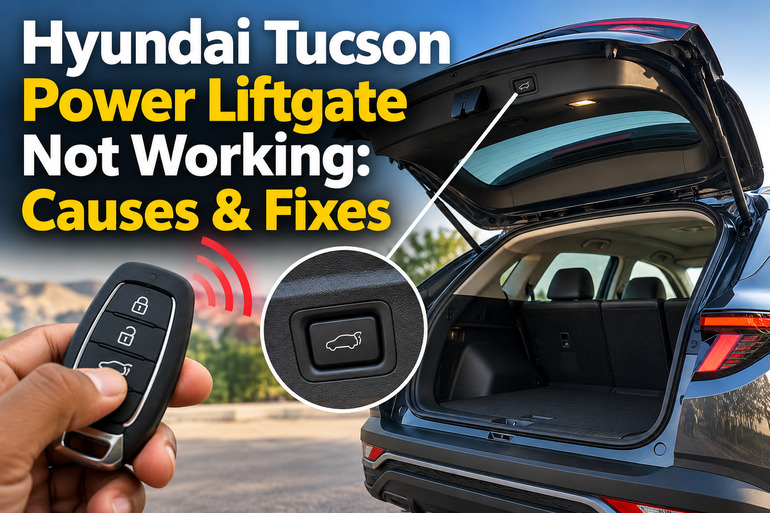 Hyundai Tucson Power Liftgate Not Working
What a Hyundai Tucson Power Liftgate Problem Means
The power liftgate is an electrically operated system that opens and closes the rear hatch using buttons inside the vehicle, on the liftgate, or on the smart key. Depending on the model year and equipment package, your Tucson may also have hands free opening features and adjustable opening height.
When you activate the system, the control electronics receive the command and operate the liftgate mechanism. Sensors monitor movement, and the system can stop or reverse the liftgate when it detects an obstacle. A fault in the electrical supply, switches, sensors, latch, or powered lifting mechanism can interrupt this process.
The symptoms often reveal which part deserves attention first. If nothing happens when you press any button, the problem may involve the power supply, fuse, control system, or operating conditions. If the liftgate clicks but stays closed, the latch or lifting mechanism may be struggling to operate.
A liftgate that begins opening before stopping, reverses unexpectedly, or moves much more slowly than usual may have an obstruction, a mechanical problem, or a system protection response. Cold weather can also affect the exterior opening button when ice forms around it. Avoid forcing the hatch, particularly when it is heavy or appears to be jammed.
Your Tucson’s model year and trim level matter because power liftgate equipment, button locations, settings, and reset procedures vary. The instructions below focus on common features found on equipped Tucson models. Consult the owner’s manual for your exact vehicle before carrying out model specific procedures.
Hyundai Tucson Power Liftgate Not Working: Likely Causes
Several faults can produce similar symptoms, so the way your liftgate responds is an important diagnostic clue. These are the five main areas to investigate before paying for replacement parts.
1. A Weak or Disconnected 12 Volt Battery
The power liftgate depends on the vehicle’s electrical supply. When the 12 volt battery is discharged, disconnected, or unable to provide adequate power, the liftgate system may fail to respond normally.
This can happen after the vehicle has been left unused for an extended period, the battery has deteriorated, or another electrical problem has drained it. A liftgate that worked before a battery replacement or jump start but stopped functioning afterward may also need its operating system reset.
Look for other electrical symptoms, such as slow engine cranking, dim interior lights, or warning messages. These signs do not prove that the battery is responsible, but they make a battery and charging system test a sensible starting point.
Hyundai’s owner documentation identifies a discharged or disconnected battery as a possible reason the power liftgate may not operate normally until it has been reset.
2. A Blown Power Liftgate Fuse
A fuse protects an electrical circuit against excessive current. If the fuse supplying the power liftgate blows, the motor or control system may stop receiving the power it needs.
A sudden loss of operation can point to this problem, particularly if the liftgate stopped working without any obvious mechanical warning. However, a blown fuse can also indicate an underlying electrical fault rather than being the original problem.
The correct fuse location and rating depend on your Tucson’s model year, engine configuration, market, and equipment. Use the diagram on the fuse box cover and the vehicle’s owner’s manual rather than relying on a generic online diagram.
If a replacement fuse blows again, stop replacing it and have the circuit inspected. A persistent electrical fault may damage other components if the system is repeatedly powered without diagnosis.
3. An Obstruction, Ice, or Excessive Resistance
The power liftgate needs a clear path to move safely. Luggage positioned against the hatch, debris near the latch, or snow accumulated on the liftgate can prevent normal operation.
The automatic reversal system may respond to resistance by stopping or reversing the hatch. Hyundai also explains that repeated reversal events can cause the system to stop operating automatically until the liftgate has been operated manually and the prescribed waiting period has passed.
In cold or wet weather, ice around the exterior opening button or hatch edges can prevent proper operation. The outside button may be particularly affected when frozen. If the liftgate works using another available control, the exterior button or its surrounding area deserves closer attention.
An obstruction is more likely if the problem began after carrying bulky cargo, parking in freezing conditions, or using the liftgate on an uneven surface. Never deliberately place an object or part of your body in the liftgate’s path to test the automatic reversal function.
4. A Faulty Button, Smart Key, or Operating Setting
The liftgate relies on switches and control signals to determine when to open or close. A worn exterior switch, damaged wiring, or an unreliable smart key can prevent the system from receiving the correct command.
The location of the failure offers a useful clue. If the liftgate works from the interior button but not the exterior switch, the exterior switch or its wiring may be faulty. If it responds to a physical button inside the vehicle but not to the smart key, check the key battery and whether the key is within the required operating range.
Operating conditions can also prevent activation. On the 2025 Tucson, for example, the power liftgate operates with the ignition on when the transmission is in Park. It can also operate with the engine off. The precise conditions and controls vary by model year.
An incorrect opening height setting can create another source of confusion. If the liftgate opens only partway but does so consistently, the selected height may be responsible rather than a mechanical fault.
5. A Faulty Latch, Lifting Mechanism, or Control Module
The liftgate uses a latch to hold the hatch closed and a powered mechanism to move it. Depending on the vehicle’s design, this includes powered spindles or support assemblies, electrical connections, sensors, and a control module.
A faulty latch may prevent the system from releasing the hatch properly. A worn or damaged powered lifting mechanism may cause the liftgate to struggle, stop during movement, or fail to complete its opening cycle. Wiring damage or a control module fault can also interrupt the commands sent between system components.
Listen carefully when you press a button. A clicking sound without movement may indicate that a command is being received but the latch or mechanism is unable to complete the action. Silence, however, does not establish that the motor is faulty because the switch, fuse, wiring, and control module can produce similar symptoms.
These components need proper testing before replacement. Powered liftgate mechanisms can be heavy and may move unexpectedly, so avoid dismantling the hatch or attempting repairs on the electrical drive system without the appropriate equipment and training.
Hyundai Tucson Power Liftgate Not Working: DIY Fixes
Start with simple checks that do not require dismantling the vehicle. Work through the following methods in order, stopping if the liftgate is jammed, damaged, or showing signs of an electrical or mechanical fault.
1. Remove Obstructions and Check for Ice
Begin by clearing the cargo area around the rear hatch. Move luggage away from the inside of the liftgate and check the visible opening edges for debris that could interfere with movement.
Inspect the exterior opening button and surrounding area for dirt or ice. If the hatch is frozen, allow the ice to thaw or remove it gently using a method suitable for automotive paint and trim. Do not use sharp tools, pour boiling water over the vehicle, or pull forcefully on the hatch.
Once the obstruction has been removed, park on level ground and try the liftgate again using an available control. Keep people, pets, and objects clear of the hatch’s path. If the mechanism continues to stop or reverse without an obvious obstruction, do not repeatedly activate it.
2. Confirm the Operating Conditions and Liftgate Settings
Make sure the vehicle meets the operating conditions specified in its owner’s manual. On a 2025 Tucson, place the transmission in Park when the ignition is on. If you are unsure whether the system is receiving the opening command, try another supported control while following the manual’s instructions.
If the liftgate opens but stops at a low height, inspect the power liftgate opening height setting in the vehicle settings menu, if your model has this feature. Depending on the configuration, the available selections may include a full opening, preset heights, or a user defined height.
Select the desired opening height and test the system again. If a user defined height is selected, follow your model’s instructions to program the position. Do not assume a partial opening indicates a failed motor until you have ruled out the height setting.
If the liftgate does not respond at all, proceed to the next check.
3. Test the Smart Key and Available Liftgate Buttons
Try the available liftgate controls one at a time. Depending on the model, these may include the smart key, an exterior button on the rear hatch, and a button inside the vehicle.
If the smart key is the only control that fails, replace its battery if necessary and check the operating instructions for the required button press. Some Tucson models require you to press and hold the smart key’s power liftgate button for a specified period rather than tapping it briefly.
For the 2025 Tucson, the smart key button is held for one second to initiate opening. The owner’s manual also specifies an operating range for the smart key. Other model years can differ.
If one switch consistently works while another does not, note that difference. It gives a technician useful diagnostic information and can help narrow the problem to the failed control or its electrical connection.
Avoid spraying liquid cleaners into the switches or attempting to bridge electrical contacts. If the buttons are damaged or unresponsive, professional testing may be necessary.
4. Inspect the Relevant Fuse and Check the Battery
If none of the controls operates the liftgate, inspect the vehicle’s electrical supply.
First, check whether the 12 volt battery appears weak or whether other electrical systems are malfunctioning. A battery test is more reliable than judging its condition from the appearance of the lights alone. If the battery is discharged, have it charged and tested appropriately.
Next, consult the owner’s manual and the label on the relevant fuse box cover to identify the power liftgate fuse. Switch the vehicle off before carrying out a permitted fuse inspection. Remove the fuse only as instructed in the manual and check whether its internal element is broken.
If the fuse is blown, replace it only with a fuse of the same rating. Never install a higher rated fuse or bypass it with wire or another substitute. Hyundai’s maintenance instructions specify using the correct replacement rating and consulting an authorized dealer when the fuse does not fit properly or related problems persist.
If you cannot identify the correct fuse, the battery requires electrical work, or the replacement fuse blows again, leave further diagnosis to a qualified technician.
5. Reset the Power Liftgate
A reset may help when the liftgate stopped working after the 12 volt battery was disconnected, discharged, or replaced, or after work involving the related fuse. Use this procedure only if it matches your Tucson’s owner’s manual.
For the 2025 Tucson, Hyundai specifies the following reset steps.
- With the vehicle turned off or on, place the transmission in Park.
- Press the power liftgate open/close button inside the liftgate and the exterior power liftgate open button simultaneously until a chime sounds.
- Slowly close the liftgate manually.
- Press the exterior power liftgate open button. The liftgate should open with a chime.
- Allow the liftgate to open completely. The reset is not complete if the hatch stops before reaching its full opening position.
Important: Button locations and reset procedures may differ on earlier or regional Tucson models. Check the correct manual before attempting these steps. Do not force the liftgate closed or open if it resists movement, appears jammed, or has a damaged support mechanism. If the prescribed reset fails, stop and arrange a professional inspection.
6. Contact a Qualified Automotive Technician
Seek professional help if the liftgate remains inoperative after the basic checks, the same fuse repeatedly blows, the hatch makes grinding or straining noises, or the mechanism moves unevenly. A liftgate that starts moving and then stalls can have an underlying mechanical or electrical fault that simple resets will not correct.
A qualified technician can test the switches, wiring, latch assembly, powered lifting mechanism, battery supply, and liftgate control module. Diagnostic equipment may also reveal stored fault codes that help identify the failing component.
Avoid removing interior hatch panels, dismantling powered spindles, or replacing the control module based solely on the symptoms. The hatch can be heavy, and a damaged support mechanism may allow it to fall. If the liftgate cannot close securely, have the vehicle assessed before driving rather than relying on an improvised restraint.
Wrap-Up
A Hyundai Tucson power liftgate that stops working may have a straightforward problem, such as ice around the opening button, an obstruction, a discharged battery, or a system that needs resetting. Checking the symptoms and operating conditions before replacing parts can help you avoid unnecessary expenses.
Start with the accessible checks, follow the instructions for your specific model year, and stop if the hatch is jammed or the mechanism appears damaged. When simple fixes do not restore normal operation, professional diagnosis is the safest way to identify the fault and restore reliable access to your cargo area.