
Your Kia EV6 should shift into Drive smoothly when you press the brake pedal and turn the gear selector. When it refuses to leave Park, keeps displaying a warning, or won’t respond to the shifter, something is preventing the vehicle from engaging the selected gear.
Sometimes, the cause is a simple operating condition. Other times, it involves the battery or electronic controls. Understanding the difference can help you identify the problem and avoid unnecessary repairs.
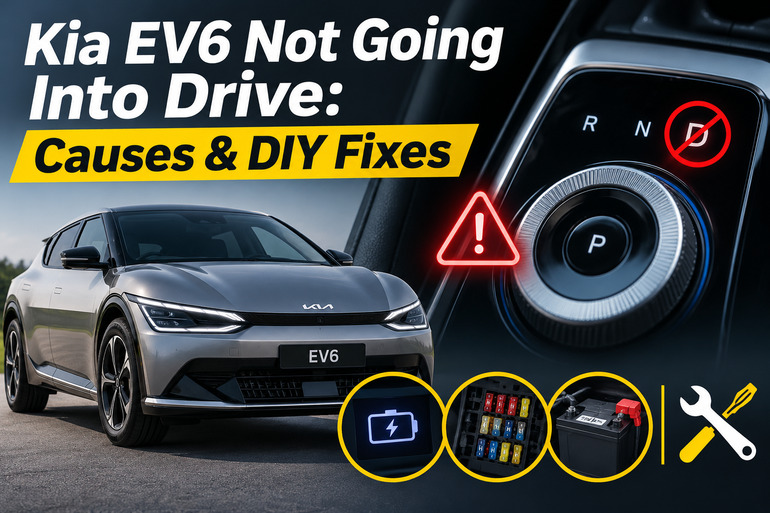
Why Your Kia EV6 Won’t Go Into Drive
The Kia EV6 uses an electronic gear selection system instead of a traditional mechanical transmission shifter. When you turn the rotary dial to Drive, the system sends an electronic request to the vehicle’s control units. These units check whether the required conditions are satisfied before allowing the gear change.
For normal driving, the vehicle must be in its DRIVE READY state, and you must press the brake pedal while selecting Drive. The system also prevents certain gear changes when the charging cable is connected or when specific operating modes are active. These safeguards help prevent unexpected vehicle movement.
When something interferes with this process, you might notice that the dashboard continues displaying P, the rotary selector doesn’t respond, or a warning appears when you attempt to change gears. In some cases, the vehicle’s screens and lights work normally even though the electric drive system hasn’t started.
It’s also useful to distinguish between a vehicle that won’t select Drive and one that displays D but refuses to move. The second situation may involve the electronic parking brake, reduced power, or a separate drivetrain fault. Both deserve attention, particularly when warning lights remain illuminated.
Kia EV6 Not Going Into Drive: Common Causes
Several conditions can prevent your Kia EV6 from engaging Drive, and they don’t all indicate a damaged component. The following five causes are worth considering based on the symptoms and warning messages your vehicle displays.
1. The Vehicle Hasn’t Entered DRIVE READY Mode
One possible explanation is that your EV6 hasn’t fully started. Unlike a gasoline vehicle, the EV6 doesn’t produce an engine sound to confirm that it’s running. Consequently, it’s possible to mistake an illuminated dashboard and functioning accessories for a vehicle that’s ready to drive.
Pressing the EV button without holding the brake pedal can turn on the vehicle’s electrical accessories without activating the electric drive system. You’ll see the screens illuminate and may be able to operate the climate controls, but the vehicle hasn’t necessarily entered its DRIVE READY state.
The important clue is the READY indicator on the instrument cluster. If it doesn’t appear after you’ve followed the normal starting procedure, the vehicle may not have completed its startup sequence. A missing READY indication can also occur with electrical or control system faults, so repeated startup failures require further diagnosis.
2. The Brake Pedal Signal Isn’t Being Recognized
Your Kia EV6 has a shift lock system that requires you to press the brake pedal before selecting Drive from Park. This prevents the vehicle from changing into a driving gear through an accidental movement of the selector.
However, pressing the brake pedal won’t always satisfy this requirement if the vehicle isn’t receiving the correct signal. A faulty brake pedal switch, a damaged electrical connection, or an associated circuit problem may interfere with brake detection.
You might see the message “Press brake pedal to change gear” even though your foot is firmly on the pedal. Brake lights that fail to illuminate when you press the pedal can provide another useful clue, although their operation alone cannot confirm that every brake signal is working correctly.
3. A Charging Cable Is Connected or Utility Mode Is Active
The EV6 includes safety restrictions that prevent driving under certain conditions. For example, it cannot shift out of Park while a charging cable remains connected. This applies even when the vehicle has already finished charging.
You may see an “Unplug vehicle to start” message if you attempt to drive before disconnecting the charging connector. Similarly, Utility Mode allows you to operate features such as the air conditioning and entertainment system while parked, but prevents the vehicle from entering a driving gear.
These situations are particularly easy to overlook because the vehicle’s electrical features continue working. In Utility Mode, the cluster displays UTIL instead of READY, which helps distinguish this condition from a starting or transmission fault.
4. A Weak 12V Battery or ICCU Problem
Although the EV6 has a large high voltage battery for propulsion, it also relies on a smaller 12V battery to support its electrical control systems. If this battery becomes discharged, the vehicle may fail to power its systems correctly or refuse to change gears.
A weak 12V battery can produce several clues. These include sluggish electrical operation, warning messages, difficulties starting the vehicle, or a dashboard that behaves unusually. The battery may also have enough power to illuminate some displays without providing reliable operation for the remaining systems.
Another concern involves the Integrated Charging Control Unit (ICCU), which helps maintain the 12V battery’s charge. Kia recalled certain 2022 through 2024 EV6 vehicles under recall SC327 because the ICCU could become damaged and stop charging the 12V battery. The resulting electrical problem could eventually cause reduced driving power or complete loss of propulsion. However, a discharged battery doesn’t automatically mean the ICCU has failed.
5. A Faulty Rotary Shifter or Park Control System
The rotary gear selector is another possible source of trouble. Because the EV6 uses electronic controls to interpret your gear selection, a failure involving the selector, its connections, or related control components can prevent the intended gear from engaging.
Some faults produce specific dashboard messages, including “Check shifter dial,” “Rotary shifter stuck,” or “Check P button.” A small object pressing against the selector or Park button can sometimes interfere with its operation. However, a persistent message may indicate an internal electrical problem.
A malfunction involving the Park mechanism can also affect gear selection. If the vehicle displays “PARK malfunction. Engage parking brake when parking vehicle,” Kia recommends immediate professional inspection. This warning should never be ignored because the vehicle may have difficulty securing the Park position.
Kia EV6 Not Going Into Drive: DIY Fixes
The appropriate fix depends on what is preventing your EV6 from selecting Drive. Begin with the simple checks below, but avoid forcing the rotary selector or attempting to bypass the vehicle’s safety systems.
1. Restart the EV6 Using the Correct Procedure
If your EV6 appears to be powered on but refuses to shift, first confirm that it has entered DRIVE READY mode. A normal restart can resolve an issue caused by an incomplete starting procedure.
Follow these steps while the vehicle is safely parked.
- Bring the vehicle to a complete stop and confirm that P is displayed.
- Apply the electronic parking brake.
- Press the EV button to turn the vehicle off.
- Keep your smart key inside the vehicle.
- Press and hold the brake pedal firmly.
- Press the EV button to start the vehicle.
- Confirm that the READY indicator appears.
- While continuing to hold the brake, turn the selector toward D.
If D appears on the dashboard and the vehicle operates normally without warnings, the problem may have been related to the startup procedure. You can then release the parking brake as appropriate and drive only after confirming the surrounding area is clear.
However, don’t keep repeating the starting procedure if the READY indicator remains absent or the vehicle displays an electric system warning. These symptoms suggest that the problem may involve the electrical supply or another control system.
A brief restart is useful for ruling out a simple operating error. Persistent failures require diagnosis rather than repeated attempts to make the vehicle engage Drive.
2. Disconnect the Charging Cable and Exit Utility Mode
If the vehicle was recently charging, check whether the charging connector is still attached. The EV6 won’t allow you to select a driving gear while the cable remains connected.
Stop the charging session using the appropriate charging controls, then unlock and disconnect the connector according to your owner’s manual. Once the cable is completely removed, close the charging door and restart the vehicle normally. Never pull forcibly on a connector that remains locked.
If the dashboard displays UTIL, your vehicle is in Utility Mode. Turn the EV6 off using the EV button, then restart it with the brake pedal pressed. The READY indicator should replace the Utility Mode indication. If the vehicle now accepts Drive, no mechanical repair was necessary.
3. Check the Brake Pedal and Brake Lights
Since the EV6 relies on a brake pedal signal to release the shift lock, checking this system can help you determine why the vehicle remains in Park.
First, sit in the driver’s seat and press the brake pedal firmly while attempting the normal gear selection procedure. Make sure nothing underneath the pedal, including a displaced floor mat or loose object, prevents you from pressing it properly.
Next, check the brake lights with the vehicle stationary. Ask another person to watch the rear brake lights while you press and release the pedal. Alternatively, you can observe their reflection against a nearby wall or garage door.
Pay attention to these observations.
- Brake lights illuminate normally: The basic brake light circuit is responding, although a separate brake signal fault may still exist.
- Brake lights remain off: A switch, fuse, wiring, or related electrical problem may be present.
- Brake lights remain illuminated: The brake pedal switch or its adjustment could require attention.
- The dashboard still requests brake application: The vehicle may not be receiving the required signal even though you’re pressing the pedal.
If the brake lights aren’t working properly, don’t drive the vehicle. A technician should inspect the brake switch and relevant circuits before replacing components.
Avoid trying to bypass the shift lock or bridge electrical connections to force the vehicle into Drive. These actions can create an unsafe condition without addressing the fault.
4. Inspect the Rotary Selector for Obstructions
If the EV6 displays a warning related to the shift dial, check the selector area for anything that might interfere with its movement.
With the vehicle parked and powered off, remove loose items from the center console. Look for coins, small accessories, or other objects resting against the dial or Park button. Gently check whether the selector is free of visible obstructions, without applying excessive force.
After clearing the area, start the vehicle normally and attempt to select Drive again. If the warning disappears and the gear changes correctly, the obstruction may have caused the problem.
However, if you still see “Check shifter dial,” “Rotary shifter stuck,” or a Park malfunction warning, stop troubleshooting the selector yourself. Internal electronic faults cannot be reliably identified by moving the dial repeatedly. A technician will need to examine the selector system and read the relevant fault codes.
5. Check for Signs of a Discharged 12V Battery
A discharged 12V battery can prevent the EV6 from starting or shifting, even when the main traction battery has plenty of charge.
Before assuming the battery has failed, look for signs of insufficient electrical power. These might include dim interior lights, unreliable dashboard operation, or difficulty entering DRIVE READY mode. Note whether the problem appeared after the vehicle had been parked for an extended period.
If the vehicle is completely unresponsive, a qualified roadside assistance technician can evaluate the 12V battery and perform a jump start when appropriate. Kia provides a model specific jump starting procedure in the owner’s manual, but incorrect cable connections can damage the vehicle and create a risk of injury.
After the 12V supply has been restored, check whether the EV6 enters READY mode and accepts Drive normally. If it does, the discharged battery was likely involved in the original problem.
However, restoring battery power doesn’t establish why it discharged. A battery that repeatedly loses charge may be deteriorating, or the vehicle may have a charging system fault.
Don’t continue driving if you receive a “Stop vehicle and check power supply” warning. Kia recommends stopping safely and arranging professional inspection and towing for this warning. The same applies when the dashboard indicates a serious electric vehicle system fault.
6. Check for Outstanding Recalls and Software Updates
If your EV6 has repeated electrical or starting problems, checking its recall status is a worthwhile next step. Certain faults involve components that require manufacturer approved repairs or software updates rather than ordinary owner maintenance.
For example, Kia’s SC327 recall covers certain 2022 through 2024 EV6 vehicles with possible ICCU damage. The authorized repair includes an ICCU software update, inspection, and replacement of the unit or its fuse when necessary. The recall remedy is provided free of charge for affected vehicles.
You can check your vehicle’s status through the National Highway Traffic Safety Administration (NHTSA) recall lookup by entering its 17 character Vehicle Identification Number (VIN). The VIN is usually visible near the lower corner of the windshield on the driver’s side or on your vehicle registration.
A few points are worth keeping in mind.
- Not every EV6 from the affected model years is necessarily included in the recall.
- A vehicle that received an earlier ICCU recall repair may still require the updated SC327 remedy.
- A vehicle can have a battery or gear selection fault without having an outstanding recall.
- Software updates and ICCU repairs should be performed by an authorized Kia technician.
Checking recall eligibility won’t directly repair your vehicle at home. However, it can help identify an established defect and prevent you from paying for a repair that Kia is responsible for performing.
7. Contact a Qualified Kia Technician
If your EV6 still refuses to select Drive after the basic checks, arrange an inspection at an authorized Kia dealership or a qualified electric vehicle repair facility.
Professional diagnosis is especially important when the vehicle displays repeated shift dial warnings, Park mechanism faults, brake system warnings, or power supply errors. The technician can use suitable diagnostic equipment to examine fault codes, monitor brake switch signals, and test the electronic gear selection system.
It’s useful to tell the technician exactly what happens when you attempt to select Drive. Explain whether the dashboard remains in P, whether READY appears, and whether the problem started after charging or a period of inactivity.
If the vehicle has difficulty securing Park, cannot release its electronic parking brake, or displays a serious electrical warning, arrange appropriate roadside assistance rather than attempting to drive it.
You should also avoid disconnecting electrical control modules, opening high voltage components, or attempting manual repairs inside the shift mechanism. These systems require appropriate training and safety equipment.
A proper diagnosis can identify the faulty component without unnecessary replacement of parts that are still functioning correctly.
Wrapping Up
When your Kia EV6 refuses to go into Drive, the cause may be as simple as an incomplete startup, an active operating mode, or a charging cable that hasn’t been disconnected. However, persistent problems can also involve the brake signal, 12V battery, or electronic gear selection system.
Start by observing the dashboard indicators and checking the basic operating conditions. These details often provide the clearest direction for further troubleshooting. If the problem remains or a serious warning appears, professional diagnosis is the safest way to restore reliable operation.