
When the 12V socket in your Kia Ceed stops working, the first clue may be a charger light that stays dark or a dash cam that keeps restarting. Those symptoms can look like the same fault, but a socket that has lost power and a plug that keeps losing contact call for different checks.
A working spare charger and your owner’s manual can help you narrow it down before you buy a fuse or a replacement socket.
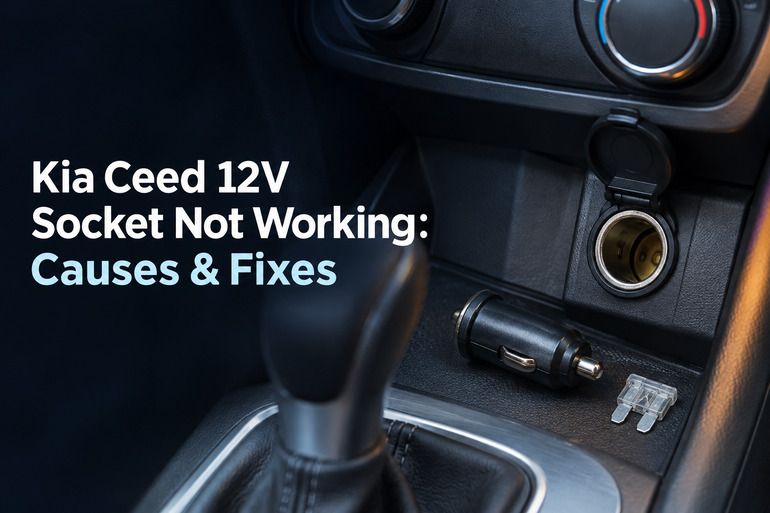
What a Dead 12V Socket Means for Your Kia Ceed
The round 12V socket supplies power to accessories such as phone adapters and dash cams. The tip of the accessory plug touches a contact at the bottom of the socket, and the contacts on the sides complete the circuit. If either connection is interrupted, your device can shut off. Some Ceeds also have a socket in the console or cargo area, depending on the body style and equipment.
Pay attention to when the power disappears. A charger that stays dark while the car is parked with the ignition off may work once the engine is running. Kia’s manual tells you to use the outlet with the engine running and to unplug accessories after use to avoid draining the battery. A charger that flickers while the engine is running gives you a different clue, especially if the plug feels loose.
If another round outlet still works, you can focus on the dead outlet and the fuse that serves it. Kia’s fuse diagrams show that the front and rear outlets can have separate protection. A working USB port offers less help. It’s a different connection, so a phone that charges there tells you little about whether the round socket has power.
If you smell burning plastic, see melting, or notice that the socket or plug is unusually hot, stop using the outlet and have it inspected before testing it again. If there’s smoke or fire while you’re driving, pull over as soon as it’s safe, shut the car off, get everyone out and away from traffic, and call emergency services.
Kia Ceed 12V Socket Not Working: Common Causes
The accessory, the socket, and the wiring that feeds it can all produce the same symptom. What happened just before the power cut out can help you decide where to look first.
1. A Faulty Charger, Cable, or Accessory Plug
If the charger’s light comes on but your phone shows no charging symbol, the socket is supplying at least some power. The USB cable, the adapter’s USB output, or the phone itself could still be the problem. Swapping the cable first is a simple way to see whether the fault follows it.
A plug with no light at all can be harder to judge. Some accessories have a small fuse inside the plug. If that fuse opens, the accessory stays dark even in a working socket. A charger that fails in two outlets you’ve already confirmed work points toward the charger or its plug.
2. A Blown Power Outlet Fuse
The fuse contains a thin metal strip that melts when too much current flows through it. That breaks the circuit and cuts power to the socket. Once the fuse opens, even a perfectly good charger will stay dark until the fuse is replaced.
Think about what was plugged in when the outlet stopped working. If it went dead as you switched on a tire inflator or a power inverter, check the device’s input rating. An accessory can physically fit the socket and still draw more current than Kia allows. A damaged accessory can also blow a fuse even if its stated rating is within the limit.
The fuse rating and the outlet’s accessory limit serve different purposes. For example, Kia’s 2024 manual shows a 20 amp fuse for the rear outlet on applicable versions, while the outlet instructions call for accessories that draw less than 10 amps. Use the outlet instructions to choose an accessory and your car’s fuse label to choose a replacement fuse.
3. Debris or Liquid Inside the Socket
A bit of debris at the bottom of the socket can keep the plug tip from reaching its contact. A metal object poses a greater risk. If it touches the center contact and the metal wall at the same time, it can create a short circuit and blow the fuse. That’s one reason Kia tells you to keep the cover closed when the socket is empty.
A spill around the console is another clue, particularly if problems started soon afterward. Check for visible residue, moisture, or discoloration from outside the opening. Even if the surface has dried, the timing of the spill is worth mentioning to a technician if the outlet still cuts out.
4. A Loose Plug or Worn Socket
A dash cam that restarts over bumps may be losing contact briefly. You might notice the same thing while parked if the charger light comes on as you seat the plug and goes out as soon as you let go. A plug that sits too shallow or fits loosely may struggle to maintain contact even when the socket has power.
The fit of one plug tells you about that particular pairing. If a second plug fits firmly and stays powered, focus on the first accessory. If several plugs that fit well elsewhere all wobble or cut out in the same outlet, the socket becomes a stronger suspect.
5. A Loose Connector, Damaged Wire, or Faulty Relay
There’s a connector behind the socket. If it comes loose, or if a wire loses its connection, a good fuse can sit in the panel while the outlet remains dead. Trouble can also occur on the ground side, which is the path current takes back through the circuit. A weak connection on either side can let an indicator light come on but struggle to run a device that draws more power.
Some Ceed fuse charts also show a power outlet relay. A relay is an electrically controlled switch that supplies power to the outlet circuit. If several outlets quit together, their shared power supply is worth checking, though the pattern alone can’t tell you whether the relay is faulty.
Kia Ceed 12V Socket Not Working: DIY Fixes
Start with a simple comparison using a charger you know works. If the fault stays with the same outlet, check the socket opening and use your Ceed’s fuse chart to find the fuse that serves it.
1. Retest With the Engine Running
Park outdoors, set the parking brake, and start the engine. With the car stationary, plug in a low power 12V accessory you’ve confirmed works, such as a phone charger with a working cable. If your Ceed is a plug-in hybrid, follow your model’s manual for the operating mode it specifies for outlet use.
Check whether the phone shows that it’s charging. If your first test was with the ignition off and the same setup now charges steadily, you may have been testing when the socket had no power. If it still fails, try that same setup in another round 12V outlet, if your Ceed has one, so you can compare both outlets under the same conditions.
2. Check the Accessory Before Replacing Car Parts
Try the original charger with a different cable and, if possible, try it in a confirmed working 12V outlet. Change one item at a time. If you swap both the cable and adapter together and your phone starts charging, you’ll still have to work out which part failed.
With the accessory unplugged, look at the plug for a cracked housing, a damaged tip, or signs of overheating. Replace a visibly damaged adapter. If the plug looks sound and the accessory maker’s instructions show a replaceable fuse, follow those instructions and use the exact type and rating specified for the plug.
If your spare adapter charges steadily in the suspect socket and the original fails in another working outlet, replacing the original adapter is a reasonable next step. Before connecting the replacement, check its input rating against the limit in your Kia manual.
3. Look Into the Socket With a Flashlight
Switch the car off, unplug the accessory, and shine a flashlight across the opening. Look for anything that would keep the plug from going all the way in, such as a coin, a broken plug tip, or residue from a spill. Check whether the rim looks warped or the socket body moves when you lift its cover.
If you see an object lodged inside, leave the outlet unused and have it cleared safely. Keep fingers, tweezers, and screwdrivers out of the opening, and avoid spraying cleaner into it. If the socket looks clear and undamaged, try seating a compatible plug firmly during your next test. A plug that needs pressure from your hand to keep working still has a contact problem.
4. Identify and Replace a Blown Outlet Fuse
Open the fuse section of your owner’s manual and match the dead outlet to the diagram on your car’s fuse panel cover. Look for its location as well as its name. A front outlet fuse may be in a different panel from the rear outlet fuse, and the label can vary with model year and equipment.
- Switch off the ignition and accessories, and unplug everything from the affected outlet.
- Use the fuse puller specified in your manual to pull the identified fuse straight out. A visible break in the metal strip inside shows that it has blown.
- Fit a replacement of the same type and amp rating. It should sit firmly in its slot. If it feels loose, have the fuse panel checked. Refit the panel cover before testing.
Never fit a higher rated fuse or bridge the slot with metal. If the new fuse blows with the socket empty, stop there and arrange an electrical diagnosis. That result points to a problem on the vehicle side of the circuit.
5. Check the Power Draw Before Reconnecting the Original Accessory
Once the outlet is working again, confirm that it can run a small charger steadily before reconnecting your inflator, inverter, or other accessory. Look on the accessory label or in its manual for the current it draws from the car. On an inverter, the advertised output rating describes what it can supply to another device. Use the inverter’s 12V input specification to judge whether it suits the socket.
If you use a splitter, count the draw of everything connected through it. All of those devices draw through the same car socket. If the total exceeds Kia’s limit for your outlet, use fewer devices at once or choose an accessory that draws less current.
If the outlet worked with a small charger but the fuse blew again as soon as you connected the original accessory, set that accessory aside. A fault in its plug or wiring remains possible even if the label gives a suitable rating. Have the circuit checked if the cause is unclear or the outlet cuts out again with other devices.
6. Contact an Auto Electrician or Kia Service Center
Arrange a diagnosis if a good accessory still fails after you’ve checked the correct fuse, if a replacement fuse blows again, or if the socket shows signs of heat damage. A qualified technician can check how the circuit behaves while it supplies power and trace the fault to the socket, its connector, the wiring, or the relay where fitted.
Tell the shop which outlets stopped working, what was plugged in at the time, and whether the fault happens over bumps or as soon as you switch on a device. If the fuse blew again, say whether the socket was empty. Those details give the technician a way to reproduce a fault that may come and go.
Wrapping Up
A steady charge from a spare adapter gives you a useful result, even if your usual charger is still dead. If every compatible plug fails in the same socket, the location of the fault matters more than how many accessories you try. Use the fuse information on your own Ceed to guide that next check.
Once the outlet works again, pay attention to how it behaves with the accessories you normally use. A repeat failure is worth tracing while you can still identify what was plugged in and when the power dropped.