
You press the button on your Nissan Juke key fob, and nothing happens. No comforting beep, no flash of lights, no unlocking doors. Just silence. It’s one of those moments that makes you question everything, especially when you’re running late or standing in the rain.
Here’s what you need to know: most key fob problems are simpler than they seem. Before you rush to the dealership and drop a few hundred dollars on a replacement, there are several fixes you can try yourself. Throughout this article, you’ll learn what’s causing your key fob to act up and exactly how to get it working again without breaking the bank.
Why Your Key Fob Stops Responding
Your Nissan Juke’s key fob is basically a small radio transmitter that talks to your car. When you press a button, it sends a coded signal that tells your vehicle to lock, unlock, or start. Pretty straightforward technology, but several things can interrupt this conversation between your fob and your car.
The most frustrating part is that key fobs often fail gradually. One day everything works fine, the next day you need to be three feet closer to your car, and eventually, nothing happens at all. Understanding what’s happening inside that little plastic device helps you figure out the right fix.
Physical damage plays a bigger role than most people realize. Maybe you’ve dropped your key fob a dozen times getting out of your car, or it’s taken a swim in your washing machine because you forgot to check your pockets. Even small amounts of moisture can corrode the internal components over time. The rubber buttons wear down, internal connections loosen, and the battery contacts get dirty.
Your car’s receiving system can also develop problems. The antenna that picks up your key fob’s signal sits somewhere in your Juke’s body, and if it gets damaged or if there’s electrical interference, your perfectly good key fob won’t do anything. This is less common but still happens, especially in older vehicles.
Nissan Juke Key Fob Not Working: Common Causes
Several factors can leave you stranded outside your Juke with a useless piece of plastic in your hand. Let’s look at what’s actually going wrong so you can pinpoint the issue faster.
1. Dead or Dying Battery
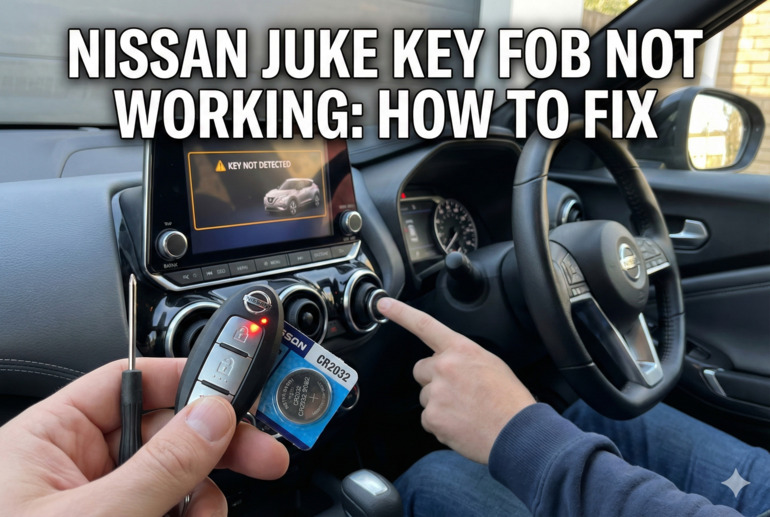
This is the number one reason your key fob stops working, and it’s also the easiest to fix. Your key fob runs on a small coin battery, typically a CR2025 or CR2032. These batteries usually last two to three years, but cold weather, frequent use, and even how you store your keys can drain them faster.
You’ll often get warning signs before total failure. The range decreases first. You used to unlock your Juke from across the parking lot, but now you need to be right next to it. Then the buttons become unreliable, working sometimes but not others.
Eventually, the battery gives up completely. Temperature extremes accelerate this process. If you live somewhere with harsh winters or scorching summers, your battery might not make it to the two-year mark.
2. Water Damage or Corrosion
Keys end up in water more often than you’d think. A quick dip in a puddle, exposure to rain, or that unfortunate trip through the wash cycle can spell trouble for your key fob’s delicate electronics. Water and circuits don’t mix well.
Even if your key fob seems to dry out fine, moisture can stay trapped inside, creating corrosion on the circuit board and battery contacts. This green or white crusty buildup acts like an insulator, blocking the electrical connections your key fob needs to function.
3. Broken Buttons or Worn Contacts
Every time you press a button on your key fob, a rubber pad pushes down on a contact point on the circuit board. After thousands of presses, that rubber wears down. The contact points can also get dirty or oxidized, making the connection weak or nonexistent.
You might notice this problem shows up inconsistently. Sometimes pressing harder works. Sometimes holding the button longer does the trick. These are telltale signs that your buttons or contacts are wearing out.
4. Programming Issues
Your key fob needs to be synced with your specific Juke. Sometimes this programming gets scrambled, especially if your car’s battery has been disconnected recently or if you’ve had electrical work done. The fob itself is fine, but your car doesn’t recognize it anymore.
This can also happen if you’ve tried programming a new key fob yourself and something went wrong. The car’s computer gets confused and stops accepting signals from any of your fobs.
5. Faulty Key Fob Receiver in Your Car
Less commonly, the problem isn’t your key fob at all. Your Juke has a receiver module that picks up the signal from your fob. If this module fails, gets damaged, or loses its connection, even a brand new key fob won’t work.
Electrical issues in your car, like a blown fuse or damaged wiring, can also knock out the receiver. This usually affects other electrical systems too, so if you’re having multiple electrical gremlins, this might be your culprit.
Nissan Juke Key Fob Not Working: How to Fix
Getting your key fob working again usually doesn’t require special tools or advanced mechanical knowledge. Most fixes take less than fifteen minutes and cost very little.
1. Replace the Battery
Start here because it solves about 80% of key fob problems. Pop open your key fob using the small release button or by carefully prying it apart with a flathead screwdriver wrapped in tape to avoid scratches. Take note of how the two halves fit together before you separate them completely.
Inside, you’ll see a small circular battery. Check the number on it (usually CR2025 or CR2032) and grab a replacement from any drugstore, supermarket, or gas station. They typically cost less than five dollars.
When installing the new battery, make sure the positive side (marked with a +) faces the right direction. Usually it faces up, but double-check against how the old one sat. Clean the battery contacts with a pencil eraser if you notice any corrosion. Snap the fob back together and test it. You should see immediate results.
2. Clean the Circuit Board and Contacts
If a new battery doesn’t fix the problem, moisture or dirt might be interfering with the electronics. Open your key fob again and remove the battery. Carefully take out the circuit board, noting how it sits so you can put it back correctly.
Look for any green or white corrosion on the board or battery contacts. Use a cotton swab dipped in rubbing alcohol to gently clean these areas. For stubborn corrosion, a pencil eraser works wonders. Just rub gently and blow away the residue.
Check the rubber button pad too. If it looks worn or dirty, clean it with alcohol. Let everything dry completely, at least 30 minutes, before reassembling. This gives any trapped moisture time to evaporate.
3. Reprogram Your Key Fob
Sometimes your Juke just needs to relearn your key fob. This process varies slightly by year, but here’s the general method. Sit in your driver’s seat and close all doors. Insert your key in the ignition and remove it six times within ten seconds. Your hazard lights should flash twice, confirming you’re in programming mode.
Insert the key and turn it to the accessory position (one click before starting). Press any button on your key fob. Your hazard lights will flash once. If you have multiple fobs, program them now by pressing a button on each one.
Turn the ignition off and remove the key. Test your fob outside the car. If this doesn’t work for your specific year, check your owner’s manual or search online for your exact model year’s programming sequence.
4. Check and Replace the Fuse
Your Juke’s key fob receiver runs on a fuse like other electrical components. If this fuse blows, your fob won’t communicate with your car. Find your fuse box, usually under the dashboard on the driver’s side or under the hood.
Your owner’s manual shows which fuse controls the keyless entry system. It might be labeled as “BCM,” “Keyless,” or something similar. Pull it out using the fuse puller tool in the fuse box. Hold it up to the light and look at the thin wire inside. If it’s broken, you need a new fuse.
Replace it with one of the exact same amperage. Never use a higher amp fuse as this can damage your electrical system. Once the new fuse is in, test your key fob. This fix works if the problem started suddenly after your car battery died or you had electrical work done.
5. Perform a Hard Reset on Your Car
Electronic glitches happen. Sometimes your Juke’s computer just needs a fresh start. Disconnect your car’s battery for about 15 minutes. Remove the negative cable first (the black one), then the positive.
Wait the full 15 minutes. This allows all the capacitors in your car’s electrical system to fully discharge. Reconnect the positive cable first, then the negative. Make sure connections are tight.
Start your car and let it idle for a few minutes. The computer is relearning all its settings. Then try your key fob. This reset can clear minor programming glitches that prevent your fob from working.
6. Contact a Professional Locksmith or Dealership
If you’ve tried everything above and your key fob still doesn’t work, it’s time to call in an expert. A professional automotive locksmith can diagnose whether you need a new key fob, if your car’s receiver is faulty, or if there’s a deeper electrical issue. Locksmiths often charge less than dealerships and can usually come to you, which saves the hassle of getting your car there without a working fob.
Wrapping Up
Your Nissan Juke key fob isn’t as complicated as it might seem when it stops working. Most problems come down to a worn-out battery, some moisture damage, or a simple programming hiccup that you can fix yourself in your driveway.
Start with the simplest solutions first. Swap the battery, clean the contacts, and try reprogramming. These three steps solve the vast majority of key fob problems without spending much money or time. If those don’t work, checking the fuse and doing a hard reset are your next best moves. Save the professional help for last, but don’t hesitate to reach out if you need it. Getting back into your car shouldn’t be a constant headache.