Running a fleet, managing delivery drivers, or simply protecting a single work vehicle puts a specific kind of pressure on your equipment choices. The wrong dash cam means blurry footage when you need it most, dead units in extreme heat, and apps that waste your drivers’ time. The right one quietly runs in the background, recording everything, and comes through exactly when it matters.
This guide covers five of the strongest options available right now for company vehicles of all kinds, from cars and SUVs to trucks, minivans, and rideshare vehicles. We tested and researched each one with real-world fleet use in mind, looking at video quality, durability, ease of installation, and the features that actually help businesses protect themselves.
Whether you manage a two-vehicle operation or a growing fleet, the picks below give you a clear path to better coverage and fewer headaches on the road.
How We Selected the Best Dash Cams for Company Vehicles
Our evaluation process went beyond spec sheets. We looked at how each dash cam performs in the conditions company vehicles actually face, including extreme temperatures, varied lighting, long recording sessions, and the need to pull footage quickly after an incident.
Here are the factors we focused on:
- Video resolution and clarity: License plate readability is non-negotiable for fleet use. We prioritized cams that deliver sharp, usable footage day and night.
- Night vision performance: Company vehicles often run early mornings and late evenings. We evaluated sensor quality and HDR capability in low-light conditions.
- Build durability and heat resistance: Fleet vehicles sit in parking lots all day. We checked for supercapacitor designs over batteries, which handle temperature extremes far better.
- Parking mode reliability: Vehicles parked overnight or in lots need protection around the clock. We looked at how each cam handles motion and collision detection when the engine is off.
- GPS and speed logging: For liability protection and route verification, built-in GPS that stamps location and speed data onto footage is a major advantage.
- App and footage management: Managers and drivers need to retrieve clips fast. We assessed WiFi speed, app usability, and how easy it is to download footage without removing the SD card.
- Coverage channels: For rideshare drivers, delivery personnel, and multi-purpose vehicles, we considered whether the cam covers the interior and rear in addition to the front.
Each product below earned its place because it addresses what matters most to businesses, not just individual drivers. Here is what we found.
Best Dash Cams for Company Vehicles (Expert Ranking & Review)
This lineup spans a range of budgets and use cases, from a value-packed front-and-rear combo to a fully integrated GPS navigator with built-in recording. Each pick serves a specific type of operator well. Read through to find the one that fits your fleet’s needs.
1. ROVE R2-4K DUAL: The Budget-Friendly Fleet Workhorse That Punches Well Above Its Price

If you need to outfit multiple company vehicles without overspending, the ROVE R2-4K DUAL is the kind of cam that makes the decision easy. It records 4K at 30fps up front and 1080p at the rear simultaneously, and it ships with a free 128GB microSD card included. For a fleet manager buying several units, that alone saves real money.
The front camera runs a Sony IMX675 STARVIS 2 sensor with an F1.5 aperture, which is wide enough to pull in significantly more light than average. The rear camera holds its own at F1.8. We found the night footage from the front camera genuinely impressive for a camera at this price point, with license plates staying readable in conditions where cheaper units fall apart.
The 5G WiFi tops out at 20MB per second for downloads, and the ROVE app works on both iOS and Android. Firmware updates happen over the air through the app, which is a practical advantage when you need to keep multiple units current without handling them individually.
What stands out from a fleet perspective is the built-in supercapacitor. Unlike battery-based designs that degrade in heat or cold, the supercapacitor holds up across a wide temperature range. Company vehicles sitting in sun-baked parking lots all afternoon will not kill this unit. The 24-hour parking mode offers three options: timelapse, motion detection, and collision detection, though a hardwire kit (sold separately) is required to use it.
Key Specs:
- Front Resolution: 4K 3840x2160P @30fps
- Rear Resolution: 1080P @30fps
- Front Field of View: 150°
- Rear Field of View: 140°
- WiFi: Dual-band 5GHz and 2.4GHz, up to 20MB/s
- Max Storage: Up to 1TB microSD
- GPS: Built-in
- Power: Supercapacitor
- 128GB card included out of the box
- Sony STARVIS 2 sensor delivers strong low-light performance
- Supercapacitor handles temperature extremes reliably
- OTA firmware updates simplify fleet-wide maintenance
- Hardwire kit required for parking mode (sold separately)
- Some users report occasional WiFi pairing delays with the app
The ROVE R2-4K DUAL makes a compelling case for fleets watching their budget, but if your team also needs navigation built right in, the next pick takes a completely different approach.
2. Garmin DriveCam 76: The All-in-One Navigator for Drivers Who Need Direction and Documentation

The Garmin DriveCam 76 is built for a specific kind of company vehicle operator: the driver who runs unfamiliar routes and needs GPS navigation and dash cam recording in a single mounted unit. Instead of a dedicated dash cam paired with a separate GPS device, you get both in one 7-inch package, which keeps the windshield cleaner and the setup simpler.
The dash cam portion handles continuous recording and automatically detects incidents. When something happens, the relevant video clip gets saved and automatically uploaded to the Garmin Vault, a secure online storage location you can access through the Garmin Drive app on your smartphone. For fleet managers, this is a meaningful feature because it keeps footage off the vehicle and in the cloud, accessible even if the device itself is damaged or stolen.
The 7-inch high-resolution screen earns genuine praise for visibility in truck cabs and larger commercial vehicles. Turn-by-turn directions come through clearly, and the Garmin voice assistant lets drivers call out destinations without ever touching the screen. Forward collision and lane departure warnings are built in as well, which adds a driver safety layer that straight dash cams simply do not offer.
We should note that the recording resolution is not on par with the dedicated dash cams in this guide. The DriveCam 76 comes preloaded with North America maps (covering the US, Canada, Mexico, Puerto Rico, and more), and connects to a smartphone for live traffic, fuel prices, and weather updates through the Garmin Drive app. For a sales rep, service technician, or delivery driver who covers a wide territory, that combination of navigation reliability and incident recording is genuinely hard to replicate with separate devices.
Key Specs:
- Screen Size: 7-inch (6.95″) IPS display
- Map Coverage: North America (US, Canada, Mexico, Puerto Rico, and more)
- Connectivity: Bluetooth and WiFi
- Incident Detection: Automatic, with Vault cloud upload
- Preloaded Storage: 16GB microSD included
- Mounting: Dashboard/windshield suction cup mount
- Power: Internal rechargeable battery (vehicle power cable included)
- Combined GPS navigator and dash cam in a single device
- Automatic cloud upload to Garmin Vault for secure footage storage
- Forward collision and lane departure warnings add active safety features
- Large 7-inch display is easy to read in any vehicle
- Recording resolution is lower than dedicated dash cam alternatives
- Preloaded 16GB card fills up faster than larger-capacity alternatives
For fleets that live and die by navigation, the DriveCam 76 solves two problems at once. If your priority is squeezing the absolute best video quality from every angle, the next option is worth your attention.
3. VIOFO A229 Pro: The Image Quality Standard-Bearer for Serious Fleet Documentation
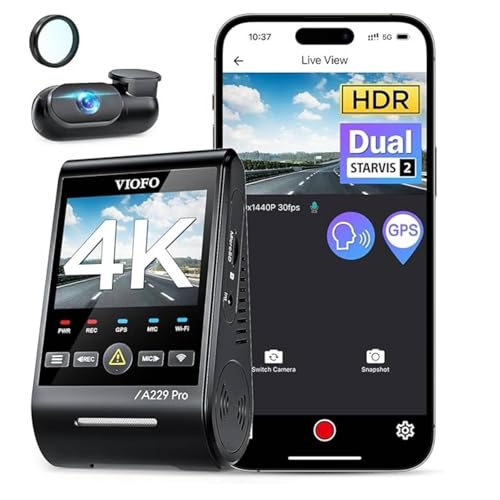
The VIOFO A229 Pro earns its spot in this guide by delivering the most capable sensor combination of any camera here. The front camera carries a Sony IMX678 STARVIS 2 sensor recording at true 4K, while the rear runs an IMX675 STARVIS 2 at 2K 1440P. Both channels use HDR, which means the dynamic range is wide enough to handle high-contrast lighting scenarios, like exiting a dark garage into bright sunlight, without blowing out the image on either end.
Its build is compact: 2.3 inches wide and 1.7 inches deep, with rotatable lenses so you can dial in the angle precisely after mounting. The 2.4-inch LCD screen is small but functional. A CPL (circular polarizing lens) filter is included in the box and pre-attached to the front lens, which cuts glare from dashboards and road surfaces. We found this to be a meaningful quality-of-life feature that most dash cams either skip entirely or charge extra for.
The quad-mode GPS supports four satellite positioning systems: GPS, BEIDOU, GALILEO, and GLONASS. That four-way coverage means faster satellite lock and more reliable position data, which matters when you need accurate speed and location stamps on incident footage for legal or insurance purposes. Voice control covers 12 commands, including locking video, toggling WiFi, and switching between camera views, all without taking hands off the wheel.
The 24-hour buffered parking mode stores 15 seconds of footage prior to a detected event and 30 seconds after. This pre-event buffer is genuinely valuable for fleet vehicles, because it captures the moments leading up to an incident rather than just what happened after the camera was triggered. The hardwire kit is not included and must be purchased separately.
Key Specs:
- Front Resolution: 4K 2160P @30fps (Sony IMX678 STARVIS 2)
- Rear Resolution: 2K 1440P @30fps (Sony IMX675 STARVIS 2)
- WiFi: 5GHz, up to 20MB/s download
- GPS: Quad-mode (GPS, BEIDOU, GALILEO, GLONASS)
- Max Storage: Up to 512GB microSD
- Parking Mode: Buffered (15s pre-event, 30s post-event)
- Included: CPL filter, 6M rear cable, car charger, trim tool
- Dual Sony STARVIS 2 sensors with HDR on both front and rear channels
- Quad-mode GPS delivers faster lock and more accurate data stamps
- CPL filter included, reducing glare without extra cost
- 15-second pre-event buffer captures the full lead-up to an incident
- No microSD card included
- App can be slow to respond for some users; WiFi may conflict with CarPlay
The VIOFO A229 Pro is the strongest pure recording option in this guide for two-channel coverage. If your drivers also need interior monitoring, the next pick adds that third channel in a purpose-built package.
4. Vantrue N2X: The Interior-Focused Dual Camera Built for Rideshare and Delivery Fleets

The Vantrue N2X takes a different approach to vehicle protection. Rather than pairing a front camera with a rear-facing one, it combines a front-facing lens with an interior cabin camera. This makes it the most logical choice for rideshare operators, taxi companies, and any business that regularly carries passengers or wants to document what happens inside the vehicle, not just outside it.
The front camera records at up to 1944P at 30fps with a 158-degree field of view, while the interior camera runs at 1080P with a 165-degree view and four built-in infrared LEDs for recording in complete darkness. The IR LEDs are a meaningful detail for night shifts and late-evening pickups, where passenger compartment visibility without visible light is essential. The interior lens is also rotatable by 45 degrees, so you can adjust the cabin coverage angle to suit the vehicle layout.
Both channels use STARVIS 2 technology and dual HDR, which balances the brightness difference between a lit cabin and dark exterior roads well. The 5G WiFi connects to the Vantrue app for quick video preview and downloads, and the GPS logger captures time, date, location, and speed with enough detail to generate mileage reports, which is a practical bonus for companies tracking driver activity.
The magnetic mount design is a smart choice for multi-vehicle operations. Drivers can remove and reattach the unit quickly between shifts without tools, and the mount holds steady even on rough roads. The supercapacitor design keeps it stable across a temperature range of negative 4°F to 158°F. Storage tops out at 512GB, which is lower than some competitors, but more than adequate for most daily fleet use cycles.
Key Specs:
- Front Resolution: 1944P+1080P @30fps; front also supports 1440P @60fps
- Front Field of View: 158°
- Interior Field of View: 165°
- Infrared LEDs: 4 (cabin camera)
- WiFi: 5GHz
- GPS: Built-in
- Max Storage: Up to 512GB
- Power: Supercapacitor
- Four IR LEDs enable clear cabin recording in total darkness
- Magnetic mount allows fast removal and reattachment between drivers
- GPS mileage reporting is useful for fleet tracking
- Front-and-inside design means no rear-facing coverage without an additional camera
- No microSD card included
The N2X is the most focused tool in this lineup for interior monitoring. If you need the front, rear, and interior all covered from one device, the final pick handles all three simultaneously.
5. Vantrue N4S: The Triple-Channel Fleet Cam That Covers Every Angle at Once

The Vantrue N4S (RC18) is the most complete coverage solution in this guide. Three STARVIS 2-powered sensors run simultaneously: a 2.7K front camera at 158 degrees, a 1440P interior camera at 165 degrees, and a 1440P rear camera at 160 degrees. Wide blind spots are not a concern here. Whether the incident happens in front of the vehicle, behind it, or inside the cabin, the N4S has it recorded.
What separates it from basic three-channel setups is the PlatePix technology. This is a dedicated mode that sharpens license plate detail by up to 2x, which we found genuinely useful in night driving conditions and situations where a vehicle passes at speed. Triple HDR across all three channels also keeps footage usable in high-contrast environments like tunnels, underground parking, and night roads lit only by headlights.
The rear camera on the RC18 model rotates a full 360 degrees, which gives fleet operators a choice that most cams do not: point it rearward for traffic coverage, or swing it inward to monitor cargo, luggage, or the back of a van interior. That flexibility makes the N4S unusually versatile for commercial use beyond standard passenger vehicles. Installation is tool-free using the magnetic GPS mount, static cling film, and included cable clips, and the 20-foot rear cable accommodates larger vehicles without stretching.
The four proprietary parking modes include buffered motion detection (10 seconds pre-event), collision auto-lock, low bitrate mode, and low framerate mode, giving fleet managers flexibility in how aggressively they monitor parked vehicles while conserving storage. The unit supports up to 1TB microSD cards, which is the highest capacity ceiling in this guide. OTA firmware updates keep the system current through the app without physical handling.
Key Specs:
- Front Resolution: 2.7K @30fps
- Interior Resolution: 1440P @30fps
- Rear Resolution: 1440P @30fps
- Rear Cable Length: 20 feet
- WiFi: 5GHz
- GPS: Quad-mode (GPS + BeiDou)
- Max Storage: Up to 1TB microSD
- Power: Supercapacitor (-4°F to 140°F)
- Front, rear, and interior all recorded simultaneously
- 360-degree rotating rear camera can monitor cargo or rear interior
- PlatePix technology sharpens license plate readability in low light
- Supports up to 1TB storage, the highest in this lineup
- Rear camera (RC18 model) is not waterproof
- Three-channel wiring takes more setup time than single or dual-channel units
Best Dash Cams for Company Vehicles: A Quick Rundown
- ROVE R2-4K DUAL: Best value for fleets, comes with a 128GB card included and strong 4K front recording
- Garmin DriveCam 76: Best for drivers who need GPS navigation and dash cam recording in one device, with cloud footage upload
- VIOFO A229 Pro: Best image quality, with dual Sony STARVIS 2 sensors, quad-mode GPS, and a CPL filter included
- Vantrue N2X: Best for rideshare and interior monitoring, with four IR LEDs for pitch-black cabin recording
- Vantrue N4S: Best full-coverage solution, recording front, rear, and interior simultaneously with 360-degree rear camera flexibility
Final Thoughts
Choosing a dash cam for company vehicles is not the same as choosing one for a personal car. The stakes are higher. Footage may end up in front of an insurance adjuster or a lawyer, and the cam has to perform reliably shift after shift, often in vehicles sitting in harsh weather. With that in mind, prioritize cameras with supercapacitor power systems over battery-based ones, and look for built-in GPS if location and speed data matter to your operation.
Think carefully about what coverage your specific vehicles actually need. A rideshare fleet has very different requirements from a delivery operation or a sales team. Match the camera type to the job, get the storage capacity right for your recording cycle, and make sure the app and footage retrieval process works for whoever will be managing it day to day. The right cam is the one that fits how your business actually runs.