Running a fleet means every vehicle you send out is a moving liability. One disputed accident, one false claim, one driver incident you can’t prove or disprove — and you’re looking at costs that dwarf what you’d ever spend on cameras. The right dash cam doesn’t just record what happens. It protects your drivers, your business, and your bottom line.
That’s exactly why we put together this guide. We researched the top options available right now, looking specifically at what works across cars, trucks, vans, and SUVs in real fleet conditions. What you’ll find here are five dash cams that cover different budgets and use cases, each reviewed in enough detail that you can make a confident call for your fleet.
Whether you’re managing a two-vehicle rideshare operation or a full commercial fleet, there’s something on this list built for what you need.
How We Selected the Best Dash Cams for Fleet Vehicles
Our team approached this the same way a fleet manager would: with a focus on reliability, coverage, and the kind of evidence quality that actually holds up when you need it. We cross-referenced manufacturer specs with real-world user feedback and looked hard at how each camera performs under demanding, continuous-use conditions.
Here are the key factors we evaluated:
- Video resolution and clarity: We prioritized cameras capable of capturing license plates and road details clearly, even at night or in low-light conditions, since that’s when footage matters most.
- Multi-channel coverage: Fleet vehicles need more than a single forward-facing camera. We looked for options covering the front, rear, and interior to eliminate blind spots.
- Build durability and thermal resilience: Cameras left in vehicles all day face extreme heat and cold. We favored units built with supercapacitors and components designed to handle those conditions without failure.
- GPS tracking and speed logging: For fleet accountability, knowing where a vehicle was and how fast it was going at the time of an incident is critical evidence.
- Parking mode and 24-hour monitoring: Vehicles parked overnight or between shifts need protection too. We evaluated how each camera handles off-ignition recording.
- App and connectivity quality: Fleet managers need fast, easy access to footage. We assessed each camera’s WiFi performance and app functionality.
- Storage capacity and loop recording: Continuous recording across a full shift demands reliable loop recording and support for large memory cards.
Every pick on this list earned its place based on how well it performs across these factors, not just one or two of them. Here’s what made the cut.
Best Dash Cams for Fleet Vehicles (Expert Ranking & Review)
These five cameras represent a strong mix of resolution, coverage, and value. Each one brings something specific to the table, from 4K front cameras to full 360-degree interior coverage, so read through the individual reviews to find the right fit for your fleet.
1. ROVE R2-4K DUAL — The Reliable All-Rounder with a Free 128GB Card

The ROVE R2-4K DUAL is currently the number one best seller in its category on Amazon, and it earns that spot with a combination of strong hardware, a well-developed app, and a package that genuinely gives you everything you need out of the box. The front camera records at 4K (3840x2160P @30fps) using a Sony IMX675 STARVIS 2 sensor, while the rear camera captures clean 1080P footage. For a fleet camera, that front resolution is exactly what you want when reviewing incident footage that needs to hold up.
The F1.5 front aperture and HDR processing deliver noticeably better low-light performance than most cameras at this price point. We found the night footage especially impressive — details that would be washed out or blurry on a lesser sensor come through with real clarity here. That matters a lot when your vehicles are running early morning or late-night routes.
The built-in 5G WiFi with download speeds up to 20MB/s is a genuine time-saver for fleet managers. Pulling footage off the camera takes seconds rather than minutes, and the ROVE app for iOS and Android makes it straightforward. The built-in GPS logs real-time speed, location, and route, all stamped directly into the video so you can review driving behavior at a glance.
One feature worth calling out for fleet use specifically is the built-in supercapacitor. Unlike lithium battery-based cameras, a supercapacitor holds up far better under extreme temperature swings, which is exactly what a vehicle sitting in a parking lot in the summer heat will put a camera through. ROVE’s 24-hour parking mode covers time-lapse, motion detection, and collision detection, though a hardwire kit is required and sold separately.
Key Specs:
- Front resolution: 4K 3840x2160P @30fps | Rear: 1080P @30fps
- Sensor: Sony IMX675 STARVIS 2 (front)
- Front FOV: 150° | Rear FOV: 140°
- WiFi: Dual-band 5GHz / 2.4GHz, up to 20MB/s
- Included storage: Free 128GB microSD card
- Max storage support: Up to 1TB
- 4K front resolution with Sony STARVIS 2 delivers excellent night footage
- Includes a free 128GB card and a full installation kit
- Supercapacitor design improves durability in extreme temperatures
- 5G WiFi and ROVE app make footage access quick and easy
- Hardwire kit for parking mode is sold separately
- WiFi connectivity can occasionally require reconnection
2. FAIMEE F9 — Three-Channel Coverage at a Budget-Friendly Price

For fleets where interior monitoring matters as much as front-and-rear coverage, the FAIMEE F9 is the standout choice. This 3-channel camera covers front (4K at 3840x2160P), interior (2K), and rear (2K) simultaneously, making it particularly well-suited for rideshare drivers, delivery vans, and any vehicle where passenger-facing documentation adds a layer of protection. The 170-degree front lens and 150-degree interior and rear lenses leave very little uncovered.
The F9 pairs a large F1.8 aperture with 6-layer glass optics and WDR technology, which gives it solid night vision performance despite not using a Sony STARVIS 2 sensor. License plates and road signs are readable in low-light conditions, which is the baseline test for any camera used in a real fleet environment. Setup is genuinely easy — the unit comes with the 128GB card already inserted in the slot, so it’s ready to record as soon as you power it on.
The dual-band WiFi (5.8GHz and 2.4GHz) connects to the FAIMEE app, where you can live-view, download, and share footage from your phone. The built-in GPS logs speed, route, and location data that syncs with Google Maps for easy review — a practical feature for fleet managers tracking driver behavior or verifying delivery routes.
Key Specs:
- Front resolution: 4K 3840x2160P @25fps | Interior + Rear: 2K each
- Front FOV: 170° | Interior/Rear FOV: 150°
- WiFi: Dual-band 5.8GHz / 2.4GHz
- Included storage: Free 128GB memory card
- Max storage support: Up to 256GB
- Warranty: 18 months
- 3-channel coverage captures front, interior, and rear in one unit
- Comes with 128GB card pre-installed, ready to use immediately
- Built-in GPS tracks speed and route history
- Strong value for the amount of coverage it provides
- 25fps front recording is slightly lower than some competitors
- Parking mode requires a separate hardwire kit
3. REDTIGER F7N Touch — The Touchscreen Option Built for Ease of Use
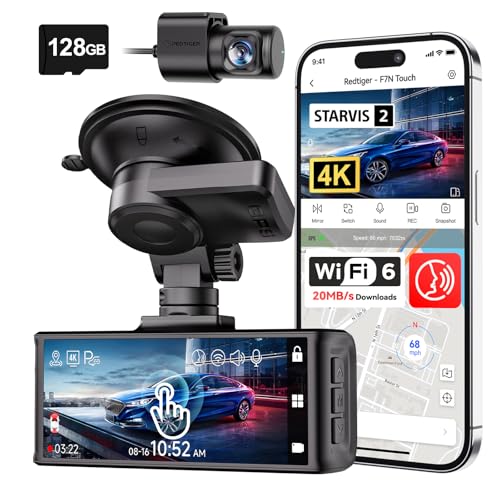
The REDTIGER F7N Touch brings something different to the table: a 3.18-inch touchscreen that makes in-vehicle controls genuinely practical. For fleet drivers who aren’t especially tech-savvy, having the ability to interact with the camera directly through a clear touchscreen (rather than navigating small buttons or relying entirely on a phone app) is a meaningful usability upgrade. The touch interface handles emergency video locking, WiFi activation, and quick photo capture with a single tap.
Recording quality is strong. The front camera shoots 4K using a STARVIS 2 sensor with a 170-degree wide angle, while the rear captures 1080P FHD at 140 degrees. WDR and HDR together handle the high-contrast lighting situations that trip up cheaper cameras, such as bright headlights against a dark road or early morning sun glare. We found the footage held its detail well in those demanding scenarios.
Voice control adds another layer of convenience. Drivers can issue commands without taking their hands off the wheel, which keeps their attention on the road. The 5.8GHz WiFi downloads footage at up to 20MB/s, and the REDTIGER Cam app is available for both iOS and Android. The 21.3-foot rear camera cable gives you plenty of reach for larger vehicles, and the included 128GB card gets you recording from the start.
Key Specs:
- Front resolution: 4K 2160P | Rear: 1080P FHD
- Sensor: Sony STARVIS 2 (front)
- Front FOV: 170° | Rear FOV: 140°
- Screen: 3.18-inch touchscreen
- WiFi: 5.8GHz, up to 20MB/s
- Included storage: Free 128GB card
- Touchscreen interface makes operation simple without relying on an app
- Voice control keeps drivers focused on the road
- STARVIS 2 front sensor delivers reliable night footage
- 21.3-foot rear cable covers longer vehicles easily
- Rear camera is wired only, no wireless option
- WiFi connectivity occasionally requires manual reconnection
4. IIWEY N5 — Full 360-Degree Coverage with 8 IR Lamps

The IIWEY N5 takes a completely different approach to fleet coverage. Instead of a standard front-and-rear setup, it uses four cameras to capture a full 360-degree view: front, rear, interior, left side, and right side, all recording simultaneously at up to 1080P per channel. For vehicles that are regularly navigating tight spaces, making turns at intersections, or dealing with side-impact risk, that additional side coverage is a significant safety upgrade. The front and rear cameras shoot at 170 degrees while the side cameras cover 150 degrees each.
Eight built-in IR lamps provide dedicated night vision for the interior, which is particularly useful for passenger-carrying vehicles where conditions inside the cabin can get dark fast. We tested the IR performance and found the interior footage stayed clear and usable even with minimal outside ambient light — a real advantage for any fleet running evening or overnight operations.
Setup requires some attention because the camera must be powered through the original cigarette lighter charger rather than a USB or Type-C cable. It’s an important detail that catches some buyers off guard, so make sure your installation team is briefed. The 5GHz WiFi app control works well once connected, and the free 128GB SD card is pre-included. Note that this model does not include GPS, so if location tracking is a hard requirement for your fleet, that’s a limitation worth considering before you buy.
Key Specs:
- Resolution: 1080P x4 channels (or 1440P + 1080P x3)
- Front/Rear FOV: 170° | Side FOV: 150°
- Night vision: 8 IR lamps (interior focused)
- WiFi: 5GHz
- Included storage: Free 128GB SD card
- GPS: Not included
- Four-channel 360-degree coverage captures every angle including sides
- 8 IR lamps deliver strong interior night vision
- Good value for full-perimeter coverage
- Free 128GB card included
- No built-in GPS
- Must be powered via cigarette lighter charger only
5. VIOFO A229 Plus — Dual STARVIS 2 Sensors for Serious Night Vision

The VIOFO A229 Plus is the premium pick on this list, and it earns that position by doing something no other camera here does: it puts a Sony STARVIS 2 sensor on both the front and the rear. Most cameras reserve the high-performance sensor for the front camera only, leaving the rear with a more basic imager. The A229 Plus records front and rear at 1440P each, with HDR active on both channels, meaning what you get from behind the vehicle is just as detailed and balanced as what you get from the front.
That dual-sensor advantage shows up most clearly in night footage. The 2.5x dynamic range improvement and 2.5x light sensitivity increase over the standard STARVIS sensor mean both cameras handle challenging lighting conditions — oncoming headlights, dark intersections, parking garage exits — with noticeably less noise and motion blur than competing cameras. For a fleet operating in conditions where you genuinely need that rear footage to be evidence-quality, this is the camera to invest in.
The quad-mode GPS module supports four satellite positioning systems (GPS, BEIDOU, GALILEO, and GLONASS), giving it the most accurate and stable location tracking of any camera on this list. Twelve voice commands let drivers control the camera hands-free, and the 5GHz WiFi makes footage transfers fast and reliable when connected properly. One honest note: initial setup takes more time than plug-and-play options. There’s no SD card included, the hardwire kit is sold separately, and getting the app connected requires some attention to your phone’s WiFi settings. For fleets with a dedicated installer or tech-savvy manager, that’s a manageable tradeoff for significantly better image quality.
Key Specs:
- Front + Rear resolution: 1440P each (dual STARVIS 2 sensors)
- Front FOV: 140° | Front frame rate: up to 60fps
- GPS: Quad-mode (GPS, BEIDOU, GALILEO, GLONASS)
- WiFi: 5GHz
- Voice commands: 12
- Max storage support: Up to 512GB (no SD card included)
- Dual STARVIS 2 sensors on both front and rear cameras
- Quad-mode GPS for highly accurate location and speed logging
- 12 voice commands for hands-free operation
- HDR on both channels balances difficult lighting conditions
- No SD card included — must be purchased separately
- Hardwire kit for parking mode sold separately
Best Dash Cams for Fleet Vehicles: A Quick Rundown
- ROVE R2-4K DUAL: Best overall — 4K front recording, free 128GB card, and a supercapacitor design built for long-term fleet use
- FAIMEE F9: Best for interior monitoring — 3-channel front, interior, and rear coverage with a 128GB card included and GPS
- REDTIGER F7N Touch: Best for ease of use — touchscreen and voice control make in-vehicle operation simple for any driver
- IIWEY N5: Best for 360-degree coverage — four-channel recording covers front, rear, interior, and both sides with 8 IR lamps
- VIOFO A229 Plus: Best image quality — dual STARVIS 2 sensors on both cameras deliver the most detailed front and rear footage
Final Thoughts
Choosing the right dash cam for your fleet comes down to what kind of protection matters most to your operation. If front-camera clarity and overall value are the priority, a 4K single-STARVIS setup gets you far. If you need interior documentation or side coverage, multi-channel cameras change the equation entirely. For the most demanding evidence requirements, dual high-performance sensors on both front and rear cameras justify the higher investment.
Trust your specific needs over specs alone. A delivery fleet with high parking risk needs strong parking mode support. A rideshare operation benefits most from interior coverage. A long-haul operation needs reliable GPS logging. Pick the camera that solves your actual problem, and it will pay for itself the first time you have a dispute, a false claim, or an incident you need to prove.