
Off-roading puts your vehicle through conditions that most dash cams were never built for. Dust, vibration, harsh sunlight, rough terrain, and remote locations without a phone signal can all expose the weak points of a camera that works fine on a city commute but falls apart the moment you hit a dirt trail. If you drive a truck, Jeep, SUV, or any vehicle you take off the pavement, you need a dash cam that can keep up.
That is exactly why we put together this guide. We researched and evaluated five of the most popular dash cams on the market right now, looking specifically at how well each one holds up when conditions get tough. From video clarity on bumpy trails to heat resistance in sun-baked climates, we looked at everything that matters to off-road drivers.
By the time you finish reading, you will know which dash cam best fits your rig, your budget, and your style of driving. Let us get into it.
How We Selected the Best Dash Cams for Off-Roading
Our team spent time digging into product specs, manufacturer claims, and real-world owner feedback to narrow down this list. Off-roading demands more from a dash cam than everyday driving does, so we held each product to a higher standard than usual.
Here is what we evaluated:
- Video resolution and clarity: Sharp, detailed footage is critical for capturing license plates, trail hazards, and incident evidence. We looked at both front and rear resolution under normal and low-light conditions.
- Heat and weather resistance: Off-road vehicles often sit in direct sunlight for extended periods. We paid close attention to how each camera handles temperature extremes, particularly whether it uses a supercapacitor instead of a lithium battery.
- Vibration tolerance and G-sensor sensitivity: Rough trails trigger constant jolts. A well-calibrated G-sensor protects critical footage without locking up every clip every time you hit a pothole.
- GPS accuracy and satellite systems: Knowing exactly where an incident happened matters off the beaten path. We looked at how many satellite systems each dash cam supports and how reliably they track location.
- Parking mode and 24-hour protection: Whether you park at a trailhead or a campsite, you want protection when you step away from your vehicle.
- App and Wi-Fi performance: Fast video transfer and a stable connection to your phone is important for reviewing footage on the road without needing a laptop.
- Build quality and mounting system: A mount that loosens up on vibrating trails is useless. We considered how each camera attaches and how secure it stays.
Every pick on this list earned its place through a combination of these factors. Here is what we found.
Best Dash Cams for Off-Roading (Expert Ranking & Review)
These five cameras represent the best options available for drivers who take their vehicles off the pavement. Each one has clear strengths, and we have matched them to the types of drivers who will benefit most.
1. ROVE R2-4K: Reliable 4K Recording for the Budget-Minded Trail Driver

The ROVE R2-4K is one of those dash cams that punches above its price point in a way that is hard to ignore. It records Ultra HD 2160P footage using a Sony IMX335 sensor paired with an F1.5 aperture and six-layer glass lens, which means it pulls in a strong amount of light even in tricky conditions. For off-road drivers who spend time on shaded forest paths or dusty desert roads at dawn, that light-gathering ability makes a real difference.
What makes this camera particularly appealing for trail use is the built-in supercapacitor. Unlike lithium batteries, supercapacitors handle high heat far better, which is critical if your truck or Jeep sits baking in the sun between runs. The camera also connects via Wi-Fi 6, letting you download recorded videos directly to your smartphone at speeds up to 6MB/s through the ROVE app.
The 150-degree wide-angle lens gives you a broad view of the road or trail ahead, and the built-in GPS accurately logs your location, speed, and route so you always have a record of exactly where something happened. Loop recording, G-sensor emergency lock, and parking mode round out the core features.
One thing to note is that the memory card is not included in the box, so budget for that separately. The 2.4-inch IPS screen is also on the smaller side, though in practice most drivers use the app for playback rather than the screen itself.
Key Specs:
- Video Resolution: 4K UHD 2160P at 30fps
- Field of View: 150 degrees
- Sensor: Sony IMX335
- Max Storage: 512GB (card not included)
- Connectivity: Wi-Fi 6, Built-in GPS
- Power: Supercapacitor
- Excellent low-light performance thanks to Sony sensor and F1.5 aperture
- Supercapacitor handles heat better than battery-based alternatives
- Built-in GPS with route and speed logging
- Strong value for a true 4K camera
- Memory card not included
- Wi-Fi download speeds slower than some competitors at 6MB/s
2. REDTIGER F7NP: The Front and Rear Workhorse That Covers Your Whole Rig

When you take your truck or SUV off-road, the risks do not only come from what is in front of you. Trail hazards, other vehicles, and tight spots on narrow paths mean you want eyes on both ends of your vehicle. That is where the REDTIGER F7NP earns its spot on this list. It shoots 4K at the front and 1080P at the rear, giving you solid dual-channel coverage right out of the box.
The STARVIS 2 sensor in this camera is a significant advantage. Combined with an F1.5 aperture, a 6-layer optical lens, WDR, and HDR technology, the F7NP produces footage that balances highlights and shadows well, making it much easier to read license plates and see detail in high-contrast lighting scenarios like a bright trail opening surrounded by shaded trees.
The front camera covers a 170-degree field of view and the rear covers 140 degrees, both of which are generous angles for off-road use. The 5.8GHz Wi-Fi connection runs at up to 20MB/s, which is among the fastest download speeds in this category. A free 128GB memory card is included, so you can start recording immediately.
We also found the supercapacitor to be a standout feature for off-road use specifically. Drivers in hot climates reported no issues with thermal shutdowns, which is a real problem with battery-based cameras parked in direct sunlight. The 18-month warranty and responsive customer support add to the overall confidence.
Key Specs:
- Video Resolution: 4K front, 1080P rear
- Field of View: 170 degrees front, 140 degrees rear
- Sensor: STARVIS 2
- Max Storage: 512GB (128GB card included)
- Connectivity: 5.8GHz Wi-Fi, Built-in GPS
- Power: Supercapacitor
- Free 128GB card included, ready to use from day one
- 5.8GHz Wi-Fi at 20MB/s for fast video transfers
- STARVIS 2 sensor delivers strong HDR night performance
- Supercapacitor is well-suited to heat-heavy off-road environments
- Parking mode requires a separate hardwire kit
- App connectivity can be inconsistent for some users
3. 70mai A800SE: The Smart Off-Roader’s Pick with ADAS and Flexible Rear Coverage
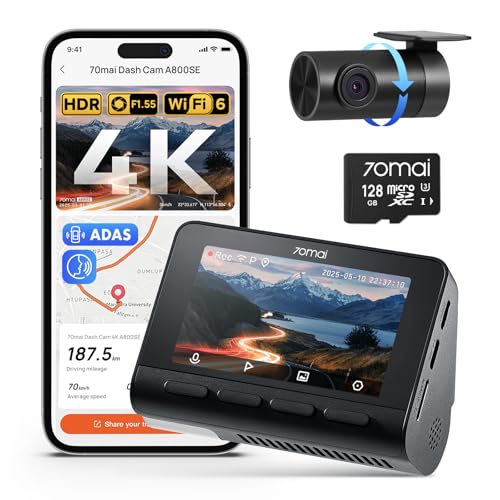
The 70mai A800SE brings a few features to the table that are genuinely useful for off-road drivers, and the price makes it one of the better deals on this list. Most impressive is the adjustable rear camera. The RC22 rear module can be aimed to capture the inside of your cab or the road and trail behind you, which gives you flexibility depending on what you need to document on any given day.
At 4K front resolution with an F1.55 aperture and 7-layer glass lens, the image quality holds up well in challenging light. The Dual HDR system works with the hardware to produce brighter, cleaner footage in tunnels, rain, and at night. We found the footage genuinely sharp, with good license plate legibility even at moderate speeds.
The built-in Advanced Driving Assistance System (ADAS) provides lane departure and forward collision warnings. On a rough trail this feature may trigger more often than you want, but on highway stretches between trails it is a practical bonus that other cameras in this range do not offer. The 70mai app connects over Wi-Fi 6 and provides quick access to footage without pulling the card.
One honest note is that the G-sensor sensitivity is set fairly high by default, which causes the camera to lock clips when going over bumps. That is easily adjusted in the settings. A free 128GB card is included, and the camera comes with a broad set of accessories including the wiring trim tool, making installation approachable for a first-time user.
Key Specs:
- Video Resolution: 4K front, 1080P rear
- Field of View: 140 degrees front, 130 degrees rear
- Aperture: F1.55
- Max Storage: 512GB (128GB card included)
- Connectivity: Wi-Fi 6, 5-system GPS
- Special Features: ADAS, voice control, adjustable rear camera
- Adjustable rear camera captures cabin or rear road depending on your preference
- ADAS provides lane departure and collision warnings
- Free 128GB card included
- 5-system GPS for precise location tracking
- G-sensor sensitivity is high out of the box and may over-trigger on rough terrain
- Parking mode requires a separately purchased hardwire kit
4. VIOFO A229 Pro: The Premium Choice for Serious Off-Road Documentation

If you want the best possible image quality on this list, the VIOFO A229 Pro is where the conversation starts. It uses dual Sony STARVIS 2 sensors, the IMX678 for the front at 4K and the IMX675 for the rear at 2K, which means both channels benefit from high-end hardware rather than the more common setup of pairing a premium front sensor with a basic rear one. For off-road drivers who need usable rear footage, that distinction matters.
The camera is built around a serious feature set. The quad-mode GPS module connects to four satellite systems (GPS, BEIDOU, GALILEO, and GLONASS), which gives it an edge in remote areas where a single-system GPS may struggle to lock on quickly. HDR on both the front and rear channels means the camera handles high-contrast lighting very well on both ends of the vehicle.
A CPL filter is included in the box, which cuts down on glare and reflections from your windshield. That is a thoughtful addition for off-road use where mid-morning and afternoon sun angles can wash out footage. The 6-meter rear cable is long enough for most trucks and SUVs. Voice control supports 12 commands, and the 5GHz Wi-Fi enables faster transfers through the VIOFO app.
The main trade-off here is price. The A229 Pro costs significantly more than the other options on this list, and it does not include a memory card. Some users have also reported that the app experience can be inconsistent, particularly around Wi-Fi stability during playback.
Key Specs:
- Video Resolution: 4K front (IMX678), 2K rear (IMX675)
- Field of View: 140 degrees front, 135 degrees rear
- Sensors: Dual Sony STARVIS 2
- Max Storage: 512GB (card not included)
- Connectivity: 5GHz Wi-Fi, Quad-Mode GPS
- Extras: CPL filter included, 6M rear cable, supercapacitor
- Dual Sony STARVIS 2 sensors on both front and rear channels
- Quad-mode GPS performs well in remote locations
- CPL filter included for glare reduction
- 24-hour buffered parking mode captures 15 seconds before and 30 seconds after an event
- Highest price on this list with no memory card included
- App and Wi-Fi connectivity can be inconsistent
5. Garmin Dash Cam 67W: The Most Discreet Option with Garmin’s Trusted Ecosystem

The Garmin Dash Cam 67W takes a different approach from the other cameras here, and it fits a specific type of off-road driver very well. If you want a camera that is virtually invisible on your windshield, connects to the Garmin ecosystem you may already use for navigation, and handles driver alerts out of the box, this is the one to consider.
The body is pocket-sized and weighs just 57 grams, so it tucks up behind your rearview mirror without blocking your view or drawing attention. Despite its compact size, it records 1440P HD video through an extra-wide 180-degree lens using Garmin Clarity HDR optics. That 180-degree coverage is genuinely impressive and captures far more of the surrounding environment than any of the other cameras on this list, including cross-traffic at intersections and wide trailside situations.
Voice control is built in and works without touching the camera, which is useful when your hands are on the wheel on a technical trail. Garmin’s Parking Guard feature monitors your vehicle while parked and sends an alert to your phone if an incident is detected, though it does require a Wi-Fi connection to function. The Vault feature automatically uploads saved clips to a secure online storage account when connected to Wi-Fi.
The 67W comes with a 16GB card in the box, which is quite small and will need to be upgraded for extended off-road use. The warranty is only one year, shorter than others on this list. For drivers already invested in Garmin devices, this camera integrates smoothly. For everyone else, the ecosystem lock-in and the front-camera-only design are worth weighing carefully before buying.
Key Specs:
- Video Resolution: 1440P at 60fps
- Field of View: 180 degrees
- Mounting: Low-profile magnetic mount
- Included Storage: 16GB (supports up to 512GB)
- Connectivity: Bluetooth, Wi-Fi
- Special Features: Voice control, Parking Guard, cloud Vault, driver alerts
- 180-degree field of view captures more of the environment than any other option here
- Extremely compact and discreet on the windshield
- Voice control works hands-free without physical interaction
- Integrates well with existing Garmin devices and navigation ecosystem
- Front camera only, no rear camera included
- Included 16GB card is too small for extended recording sessions
Best Dash Cams for Off-Roading: A Quick Rundown
- ROVE R2-4K: Best overall value for a 4K front cam with Sony sensor and heat-resistant supercapacitor
- REDTIGER F7NP: Best front and rear coverage with fast 20MB/s Wi-Fi and a free 128GB card
- 70mai A800SE: Best for smart features including ADAS alerts and a flexible adjustable rear camera
- VIOFO A229 Pro: Best image quality with dual Sony STARVIS 2 sensors on both channels
- Garmin Dash Cam 67W: Best for discretion and Garmin ecosystem integration with a 180-degree lens
Final Thoughts
Off-roading asks more of your gear than a daily commute ever will, and a dash cam is no exception. The cameras that hold up best in this environment share a few key traits: they use supercapacitors instead of batteries for heat resistance, they log your GPS location reliably even in remote areas, and they capture footage clear enough to be genuinely useful if something goes wrong on the trail.
Your ideal pick comes down to what you value most. If rear coverage matters, go for a dual-channel system. If raw image quality is the priority, look at what sensors are powering both cameras. If simplicity and discretion are what you are after, a compact, front-only option may serve you better than a fully loaded rig. Whatever you choose, make sure it is a camera you can rely on the moment it counts.