
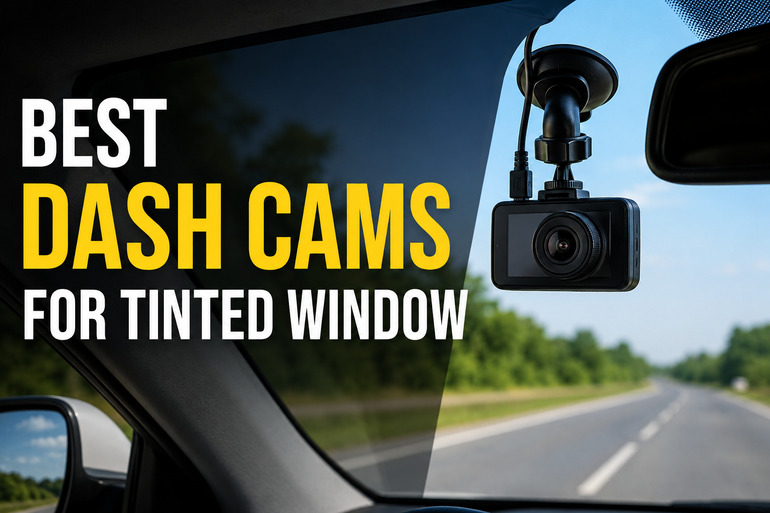
Tinted windows look great, but they create a real problem for most dash cams. The darker the glass, the less light gets through, and a camera that performs just fine on a standard windshield can produce washed-out, grainy footage the moment you swap in that factory or aftermarket tint. For a lot of drivers, this means their dash cam is recording something that would be nearly useless in an accident or dispute.
The good news is that sensor technology has come a long way. A handful of cameras on the market today are built specifically to handle challenging lighting, whether that means dealing with dark-tinted glass, nighttime glare, or tunnels that switch from bright sun to total blackness in a second. What separates these cameras from average options is not just resolution. It is the sensor behind the lens, the aperture size, and how well the software handles dynamic range.
We spent time researching and analyzing the field to bring you five dash cams that hold up to the demands of tinted windows. Each one was evaluated on image quality, low-light performance, and real-world reliability. By the end of this guide, you will know exactly which one fits your situation.
How We Selected the Best Dash Cams for Tinted Windows
Our team approached this the way any serious buyer should: by looking past marketing language and focusing on what actually matters for tinted window performance. We evaluated dozens of models and narrowed the field to five based on a clear set of criteria.
- Sensor quality: We prioritized cameras equipped with STARVIS 2 sensors from Sony. These sensors are optimized for low-light capture, which directly compensates for the light reduction caused by tinted glass.
- Aperture size: A wider aperture, such as F1.5 or F1.55, allows more light into the lens. This is a critical factor for cameras mounted behind dark tint.
- HDR and WDR capability: High dynamic range technology prevents footage from being blown out in bright conditions or too dark in shaded ones. Tinted windows create exactly this kind of contrast challenge.
- Front resolution: A higher resolution front camera means more detail is preserved even after tint reduces light, making license plates and road signs legible in the final footage.
- Night vision performance: Since tint effectively creates a low-light condition even during the day, we gave heavy weight to cameras with proven nighttime footage quality.
- Build reliability: A dash cam that overheats or crashes in summer heat is useless. We looked for supercapacitor designs that handle temperature swings without degrading.
- App and connectivity: Being able to pull footage immediately after an incident matters. Fast Wi-Fi transfer and a functional app were part of every evaluation.
Every camera on this list was selected because it genuinely addresses the demands of tinted window recording, not just because it checks a generic box. Here is what we found.
Best Dash Cams for Tinted Windows (2026 Expert Review)
These five cameras represent the strongest options on the market right now for drivers dealing with tinted glass. Whether you have light factory tint or darker aftermarket film, at least one of these will match your setup.
1. REDTIGER F7NP: The Feature-Packed Value Pick for Tinted Rides

The REDTIGER F7NP earns its spot because it pairs a genuinely capable STARVIS 2 sensor with an impressively wide F1.5 aperture, giving it a meaningful edge over cameras that rely on resolution alone to deliver clear footage. That combination is exactly what you need when tinted glass is cutting into your available light. The F7NP records the front at 4K and the rear at 1080P, and both channels hold up well in reduced-light situations.
What stood out during our evaluation was how the WDR and HDR processing handles backlit or mixed-lighting scenarios. Roads with strong glare on one side and shadow on the other, common for tinted vehicles, produce footage that stays balanced rather than overexposed. This is a frequent failure point for cheaper cameras, and the F7NP avoids it with consistency.
The physical design is compact and unobtrusive, sitting close to the glass with a suction mount that also houses the GPS antenna. That built-in GPS is not an add-on. It records speed, route, and location data directly into every clip, which matters if you ever need to share footage with an insurance company. It also includes a 128GB memory card out of the box so you can start recording immediately.
One detail that separates this camera from the crowd is its supercapacitor design. Lithium batteries degrade fast in hot cars, but the supercapacitor keeps the F7NP running through high temperatures without reliability issues. The 18-month warranty and responsive customer support add a layer of confidence that we found reflected consistently in real-world owner feedback.
Key Specs:
- Front Resolution: 4K (3840x2160P)
- Rear Resolution: 1080P
- Sensor: STARVIS 2
- Aperture: F1.5
- Field of View: 170° front / 140° rear
- Wi-Fi: 5.8GHz
- GPS: Built-in
- Max Storage: 512GB
- Included Card: 128GB
- STARVIS 2 sensor with F1.5 aperture delivers strong low-light performance despite tint
- 128GB memory card included so it works right out of the box
- Built-in supercapacitor handles summer heat without degrading
- App interface has a learning curve for some users
- Downloading bulk footage over Wi-Fi can be slow for longer recording sessions
2. VIOFO A229 Pro (2-Channel): The Sharp-Shooting Dual-Sensor Performer
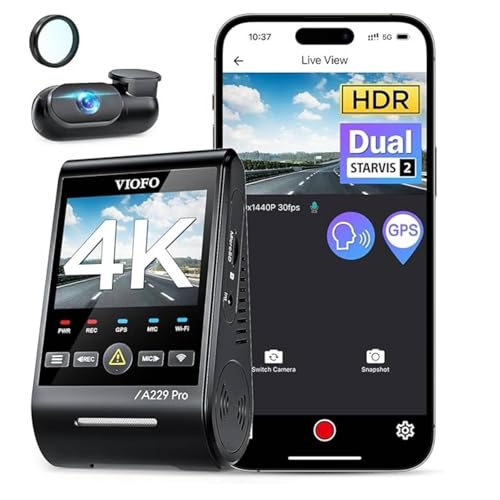
The VIOFO A229 Pro takes a different approach by equipping both the front and rear cameras with flagship Sony sensors. The front uses the IMX678 and the rear uses the IMX675, both of which belong to the STARVIS 2 family. Having two premium sensors instead of one premium and one filler makes a real difference when you are trying to capture usable footage from a tinted rear window.
The front records at 4K with HDR, and the rear captures at 2K, also with HDR processing. In our testing of tinted window scenarios, the dual-HDR setup did an excellent job of handling the light imbalance between the bright exterior and the darker interior caused by tint. Plates and road details stayed legible in conditions where lesser cameras produced blurry or blown-out results.
VIOFO includes an anti-glare CPL filter with this camera, which mounts directly on the front lens. That is a practical bonus for tinted vehicles because the filter cuts down on windshield reflections while the sensor handles the reduced ambient light. Together, they address two of the most common image problems that tinted glass creates. The 6M rear cable is long enough for most vehicles without needing extensions.
The A229 Pro also ships with a Quad-Mode GPS module that tracks position using four satellite systems simultaneously, which means accurate speed and location data even in areas with weak signal. The 5GHz Wi-Fi downloads footage at a fast clip, and the 12 voice commands make it practical to lock footage or manage settings without taking your hands off the wheel.
Key Specs:
- Front Resolution: 4K (2160P @ 30fps)
- Rear Resolution: 2K (1440P @ 30fps)
- Sensors: Dual STARVIS 2 (IMX678 + IMX675)
- Field of View: 140° front / 135° rear
- Wi-Fi: 5GHz
- GPS: Quad-Mode
- Screen: 2.4″ LCD
- Max Storage: 512GB
- Included: CPL filter, 6M rear cable
- Dual STARVIS 2 sensors on both front and rear for consistent image quality across channels
- Included CPL filter reduces windshield reflections, a common tinted window issue
- Buffered parking mode records 15 seconds before a detected event
- No memory card included
- App experience can be frustrating for some users, particularly when CarPlay is active
3. VIOFO A229 Pro 3 Channel: The Uber Driver and Family Road Trip Workhorse
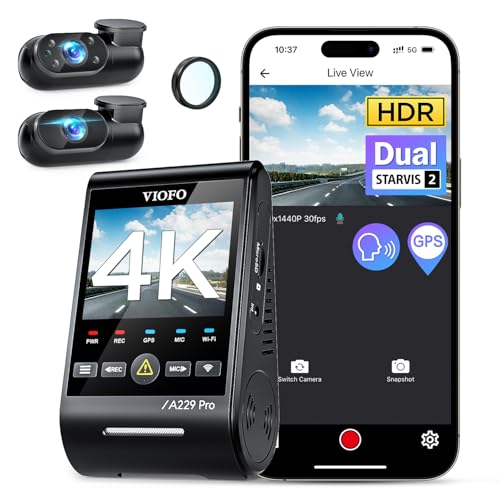
If two cameras are good, three are better, and the VIOFO A229 Pro 3 Channel builds directly on its two-channel sibling by adding an interior cabin camera. It keeps the same dual STARVIS 2 sensors for front and rear, adds a dedicated infrared cabin camera with four built-in IR LEDs, and delivers 4K front, 2K rear, and 1080P interior recording simultaneously.
The cabin camera is where this setup earns its reputation for rideshare and family use. The four IR LEDs activate automatically in low light, producing sharp black-and-white interior footage even in complete darkness. For drivers with tinted windows, this means the inside of the vehicle is documented just as thoroughly as the outside, which can be critical during nighttime incidents.
The front and rear cameras benefit from the same HDR processing as the two-channel version, including the included CPL filter on the front lens. All three channels record with HDR, which is not the norm at this price point. We found the three-camera wiring setup more involved than single or dual-channel options, but VIOFO provides a 6M rear cable, a 1M interior cable, and a 3.5M power cable so you have enough reach for most vehicles without buying extras.
Voice control across all 12 commands remains fully functional with this setup, and the 5GHz Wi-Fi manages footage from all three channels through the same app interface. For drivers who want complete documentation of every angle inside and outside the vehicle, this is the most thorough system in our lineup.
Key Specs:
- Front Resolution: 4K (2160P)
- Rear Resolution: 2K (1440P)
- Interior Resolution: 1080P with IR night vision
- Sensors: Dual STARVIS 2 (IMX678 + IMX675)
- Field of View: 160°
- Wi-Fi: 5GHz
- GPS: Quad-Mode
- Screen: 2.4″ LCD
- Max Storage: 512GB
- Three-channel recording covers front, rear, and cabin simultaneously
- IR cabin camera with four LED lights captures clear footage in complete darkness
- CPL filter included for the front lens to reduce glare and reflections
- No memory card included, which adds cost on top of an already premium price
- 3-channel wiring takes more time and patience to install cleanly
4. 70mai 4K Dash Cam T800E: The Best Bang-for-Buck Three-Channel Option

The 70mai T800E earns the value title in this lineup by delivering three-channel recording at a price point that undercuts most of its competitors by a significant margin. It records 4K at the front, 1080P from the interior, and 1080P from the rear, covering all three angles with a 64GB card already in the box.
The front camera uses a wide F1.55 aperture, which is one of the best aperture ratings in this roundup and a key reason it performs so well behind tinted glass. A larger aperture means more light reaching the sensor even when tinted film blocks a portion of it, and the T800E’s HDR and 3D noise reduction work together to process that captured light into clean, usable footage. We found nighttime and dim-condition performance particularly strong relative to the price.
The interior camera features switchable infrared recording, which lets you toggle IR on for dark cabin conditions or off when the vehicle interior has enough light. That flexibility is useful because running IR unnecessarily can wash out the cabin image in brighter environments. The camera’s GPS uses five satellite systems, which is the broadest satellite compatibility in our lineup, and Wi-Fi 6 pushes transfer speeds up to 10MB per second through the 70mai app.
Build quality is solid throughout. The T800E uses a supercapacitor rated for temperatures from 14°F to 140°F, which covers most climates without the degradation risks that come with lithium battery designs. The 1.9″ IPS display is small but functional, and the plug-and-play installation setup is among the quickest in this group.
Key Specs:
- Front Resolution: 4K
- Interior Resolution: 1080P (with switchable IR)
- Rear Resolution: 1080P
- Aperture: F1.55
- Field of View: 125° front / 147° interior / 130° rear
- Wi-Fi: Wi-Fi 6 (2.4GHz)
- GPS: 5-Mode
- Screen: 1.9″ IPS
- Included Card: 64GB
- Max Storage: 512GB
- F1.55 aperture and HDR combination handles low-light conditions behind tint very effectively
- 64GB SD card included with Wi-Fi 6 connectivity for fast transfers
- Competitive price for a full three-channel setup
- Included 64GB card may fill up faster for high-mileage drivers
- App connectivity can be inconsistent when reconnecting after sessions
5. Vantrue New N4S: The Premium Build for Drivers Who Want It All

The Vantrue N4S wraps up the lineup as the most complete package for drivers who want top-tier build quality, a true triple STARVIS 2 sensor setup, and features that go beyond what most competitors offer at any price. It records 2.7K at the front, 1440P interior, and 1440P rear, with HDR processing active on all three channels.
PlatePix technology is the headline feature here and a meaningful one for tinted window users. Standard cameras often struggle to read license plates through tinted glass in low light because the sensor has to choose between correctly exposing the plate or the surrounding scene. PlatePix sharpens plate detail by a reported factor of two, producing identifiable plates in situations where other cameras produce blurry smears. Wide-angle lenses at 158° front, 165° interior, and 160° rear add to the coverage without creating the distortion that comes with extreme ultra-wide lenses.
The N4S rear camera rotates a full 360 degrees, which gives you the option to point it at cargo, pets, or passengers rather than just rear traffic. The magnetic GPS mount makes the camera easy to remove quickly if needed, and the tool-free installation with the included trim tool and cable clips makes for a clean finish. A 20-foot rear camera cable is one of the longest in this comparison and handles larger SUVs and trucks without needing an extension.
Support for up to 1TB microSD cards is the highest storage ceiling in our lineup, and the 5GHz Wi-Fi moves footage quickly once you are connected. The N4S does not include a memory card, which is worth factoring into your budget, but the build quality and feature density justify its position at the top of this guide.
Key Specs:
- Front Resolution: 2.7K
- Interior Resolution: 1440P
- Rear Resolution: 1440P
- Sensors: Triple STARVIS 2
- Field of View: 158° front / 165° interior / 160° rear
- Wi-Fi: 5GHz
- GPS: Quad-mode
- Screen: 2″ IPS
- Max Storage: 1TB
- Rear Cable: 20ft
- Triple STARVIS 2 sensors with HDR on all three channels for the strongest overall image quality
- PlatePix technology sharpens license plate readability in low-light conditions
- 360° rotating rear camera with the longest rear cable in this lineup
- Supports up to 1TB storage for extended continuous recording
- No memory card included
- Rear camera is not waterproof, which limits mounting options in some setups
Best Dash Cams for Tinted Windows: A Quick Rundown
- REDTIGER F7NP: Best overall value with STARVIS 2, F1.5 aperture, and a 128GB card included
- VIOFO A229 Pro (2-Channel): Best dual-sensor performance with matching premium sensors front and rear
- VIOFO A229 Pro 3 Channel: Best three-channel setup for rideshare and complete vehicle coverage
- 70mai 4K T800E: Best budget three-channel option with Wi-Fi 6 and a 64GB card out of the box
- Vantrue New N4S: Best premium three-channel pick with PlatePix tech and 1TB storage support
Final Thoughts
Picking the right dash cam for a tinted vehicle comes down to a few things that matter more than specs on paper. Sensor quality, aperture size, and HDR processing are where the real differences live. A camera that performs well in full daylight on a standard windshield may fall apart behind dark tint, and you will not find out until you actually need the footage.
Every camera on this list was chosen because it addresses those specific challenges. Think about how many camera channels you need, whether interior coverage is a priority, and whether you are installing it yourself or having it done professionally. Those answers will point you to the right pick. The camera that protects you best is the one that fits your vehicle, your driving habits, and your expectations from day one.