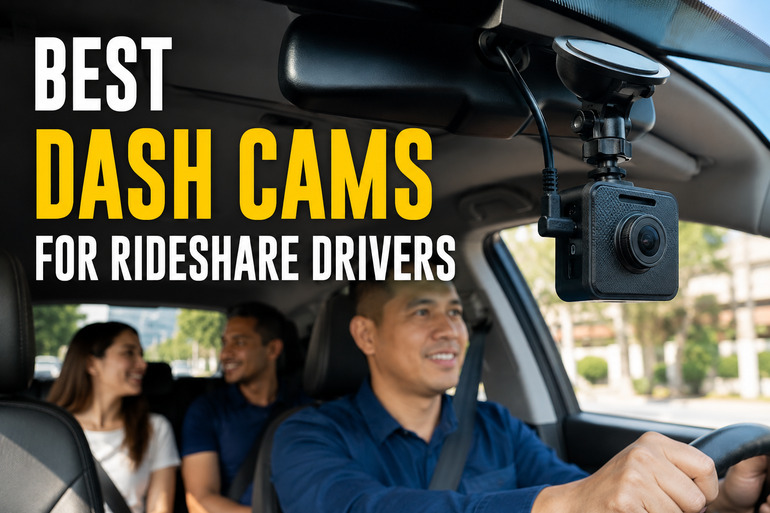
Driving for Uber or Lyft means your car is your office, and what happens inside and outside it can make or break you. One disputed incident, one false complaint, one hit-and-run in a parking lot while you’re on a trip — and suddenly you’re fighting a problem you have no footage to disprove. That’s a frustrating place to be.
A good dash cam changes the equation entirely. It gives you a silent, always-on witness that records everything from multiple angles, protects your income, and gives you the kind of confidence that makes every shift feel a little less risky. The right one works in the dark, doesn’t require babysitting, and keeps recording without you ever thinking about it.
We tested and researched the top options available to rideshare drivers right now, comparing them across coverage, video quality, night performance, ease of use, and real-world reliability. Here are the five that stood out.
How We Selected the Best Dash Cams for Rideshare Drivers
Our team spent time evaluating dozens of dash cam options specifically through the lens of rideshare use. That means we looked at more than just specs. We paid close attention to how each camera performs across the situations rideshare drivers actually face — long shifts, low-light pickups, passenger interactions, and overnight parking.
Here are the factors that shaped our picks:
- Camera coverage: We prioritized cameras with interior-facing lenses, since rideshare drivers need cabin footage just as much as road footage.
- Night vision quality: Most incidents happen in low light, so we looked hard at IR performance, HDR, and sensor technology.
- Video resolution: Footage that can actually identify license plates and road signs is far more useful than blurry recordings that prove nothing.
- Parking mode capability: Rideshare cars are often left in unfamiliar areas. A camera that keeps watch while parked is worth its weight.
- Ease of setup and daily use: If a cam requires constant fiddling, drivers won’t use it consistently. We favored options that just work from the moment the ignition turns.
- App and Wi-Fi access: Being able to pull footage to your phone quickly matters. We noted which cameras make that process easy and which make it a headache.
- Storage and loop recording: Cameras that come with a card included and loop seamlessly so no critical moment gets overwritten earned bonus points.
Every pick on this list passed our rideshare-specific test. These aren’t just good cameras in general — they’re the right tools for the job.
Best Dash Cams for Rideshare Drivers (Expert Ranking & Review)
These five cameras cover a wide range of budgets and use cases, from no-frills protection to full-featured surveillance systems. Each one brings something specific to the table, and we’ll walk you through exactly what that is.
1. IIWEY N6 360° Dash Cam — The Best All-Around Pick for Rideshare Drivers

The IIWEY N6 earns the top spot because it does something no two-channel or three-channel camera can: it surrounds your entire vehicle with recording coverage simultaneously. Four cameras — front, rear, driver side, and passenger side — capture everything at once, with ultra-wide field-of-view angles reaching 170 degrees in front and 150 degrees on the sides. For a rideshare driver, that means no angle is left unaccounted for, from the road ahead to the passenger climbing into the back seat.
The side cameras are one of this cam’s most underappreciated features. They’re adjustable, which means you can angle one inward to capture the cabin, giving you a full interior view on top of exterior coverage. That flexibility is exactly what rideshare drivers need, especially when managing both road documentation and passenger accountability on the same shift.
Night performance is handled by eight built-in infrared lights, and we found the footage to be consistently clear in low-light conditions. The exclusive Vision Enhance technology helps pull out detail like license plates and lane markings at intersections, which is where most critical moments happen.
Setup is genuinely painless. The N6 comes ready to go out of the box with a free 128GB card included, and the WiFi-6 connection at 5.8GHz transfers footage at speeds up to 20MB per second. Loop recording runs automatically, and the G-Sensor locks critical clips during hard braking or impact so nothing important gets overwritten.
Key Specs:
- Channels: 4 (front, rear, left, right)
- Resolution: 1080P x4
- Field of View: 170° front/rear, 150° sides
- WiFi: 5.8GHz WiFi-6
- Included Storage: 128GB (supports up to 256GB)
- Parking Mode: Yes (hardwire kit required, sold separately)
- Screen Size: 3.18-inch IPS
- True 360-degree coverage with four simultaneous recording angles
- Adjustable side cameras allow inward cabin monitoring
- Fast WiFi-6 file transfer with free app for iOS and Android
- Includes 128GB card, ready to use out of the box
- Parking mode requires a separate hardwire kit purchase
- No built-in battery; must stay connected to vehicle power
2. SUVCON J06 3-Channel Dash Cam — The Best Budget Option for New Rideshare Drivers

If you’re just getting started with rideshare driving and want solid coverage without spending a lot, the SUVCON J06 makes a strong case. It covers front, interior, and rear views through three cameras, giving you the essential angles that matter most in a dispute or incident. The front camera captures at 170 degrees and the cabin and rear lenses each reach 150 degrees, so you’re not leaving big blind spots in your recording.
The J06 is about as close to plug-and-play as you’ll find at this price. It comes with a 32GB card included, mounts to the dashboard or windshield without drama, and starts recording the moment your car turns on. The IPS display lets you check angles from any viewing position without the image washing out.
We appreciated the four infrared LEDs built into the interior-facing camera. They do a solid job of capturing cabin footage in low light, which is important for rideshare drivers working night shifts or early morning hours. The HDR technology also helps balance high-contrast scenes like driving toward bright headlights on a dark road.
One thing to keep in mind: the J06 doesn’t have built-in WiFi, so reviewing footage means either connecting a laptop or pulling the SD card. That’s a tradeoff you make at this price point, and for drivers who mainly need evidence storage rather than quick in-app access, it’s manageable.
Key Specs:
- Channels: 3 (front, interior, rear)
- Resolution: 1080P
- Field of View: 170° front, 150° interior and rear
- Screen Size: 3.47-inch IPS
- Included Storage: 32GB
- Parking Mode: Yes (with G-sensor activation)
- Connectivity: USB only (no WiFi)
- Affordable three-channel coverage for front, cabin, and rear
- HDR and infrared LEDs for solid low-light footage
- Easy plug-and-play setup with included SD card
- No built-in WiFi, requires manual SD card removal to review footage on a computer
- Some users report SD card formatting prompts requiring attention
3. REDTIGER F17 4K 3-Channel Dash Cam — Best for Crystal-Clear Evidence Quality

The REDTIGER F17 brings a meaningful step up in recording quality that rideshare drivers will notice the moment they review footage. The front camera runs on a STARVIS 2 IMX675 sensor, recording in true 4K at 2160P. That’s the kind of clarity that reads license plates cleanly, captures road signs without squinting, and holds up under scrutiny in an insurance claim or legal dispute. The interior and rear cameras each record at 1080P, rounding out solid three-channel protection.
What separates the F17 from cameras using older sensors is how it handles tough lighting situations. The STARVIS 2 sensor is built for higher light sensitivity and improved dynamic range, which means it doesn’t fall apart in the shift between bright headlights and dark road sections. WDR and HDR work together to keep the image balanced. We found footage from the F17’s front camera to be noticeably sharper than what most cameras in this price range produce.
The F17 also includes dual-mode recording flexibility. You can either run all three channels simultaneously, or switch off the interior camera to maximize front and rear resolution. For drivers who want peak road clarity on quieter shifts, that option is a useful one.
Build-wise, the F17 is compact and mounts cleanly on the windshield with an adhesive GPS mount. The 5.8GHz WiFi connects to the REDTIGER app, where you can pull footage directly to your phone. GPS logs speed and route data with every clip, which adds a credible layer of evidence to any recording. It comes with a 64GB card included.
Key Specs:
- Channels: 3 (front, interior, rear)
- Resolution: 4K (2160P) front, 1080P interior and rear
- Front Sensor: STARVIS 2 IMX675
- Field of View: 150° front, 160° cabin, 155° rear
- WiFi: 5.8GHz
- Included Storage: 64GB (supports up to 512GB)
- Screen Size: 3-inch LCD
- Parking Mode: Yes (hardwire kit required, sold separately)
- 4K front camera with STARVIS 2 sensor for exceptional detail
- Dual recording modes let you prioritize resolution or coverage
- Built-in GPS logs speed and route with every clip
- 18-month warranty with responsive customer support
- Parking mode requires a separately purchased hardwire kit
- WiFi connectivity can occasionally require reconnecting
4. FAIMEE F9 4K+2K+2K 3-Channel Dash Cam — Best for Drivers Who Want High Resolution Across All Three Cameras

Most three-channel dash cams give you a strong front camera and noticeably weaker interior and rear feeds. The FAIMEE F9 breaks from that pattern. It records at 4K (3840x2160P) up front and steps up to 2K (2304×1296) for both the interior and rear cameras. That’s a meaningful difference when you need to read a passenger’s face or identify a vehicle that clipped your bumper.
The F9 uses an F1.8 large-aperture lens paired with six-layer glass optics, and the combination works well in low-light situations. WDR technology balances exposure across the frame, so footage doesn’t blow out in high-contrast lighting. We found night performance across all three lenses to be genuinely good, not just passable. The front camera in particular handles dark roads and headlight glare cleanly.
What we especially liked in our testing is how little the F9 asks of you day-to-day. It powers on and starts recording automatically every time the car starts. No app required to get going, no account to create. If you want to review footage, you can pull the SD card, connect via the built-in WiFi to the FAIMEE app, or check it right on the 3-inch IPS screen. The dual-band WiFi (5.8G and 2.4G) gives you connection options depending on your environment.
The F9 ships with a 128GB high-endurance card already installed, which is the largest included storage on this list. Built-in GPS logs speed and location with every recording, and the G-sensor locks footage during impacts so nothing critical gets erased by loop recording.
Key Specs:
- Channels: 3 (front, interior, rear)
- Resolution: 4K front, 2K interior, 2K rear
- Field of View: 170° front, 150° interior and rear
- WiFi: Dual-band 5.8G/2.4G
- Included Storage: 128GB (supports up to 256GB)
- Screen Size: 3-inch IPS
- Parking Mode: Yes (hardwire kit required, sold separately)
- Lens Aperture: F1.8
- 2K resolution on interior and rear cameras, not just the front
- Large F1.8 aperture lens with 6-layer glass optics for strong night performance
- 128GB high-endurance card included, ready to use immediately
- Dual-band WiFi and straightforward app access
- Parking mode requires a separate hardwire kit
- Frame rate is 25fps, slightly below the 30fps of some competitors
5. Vantrue New N4S 3-Channel Dash Cam — Best Premium Option for Serious Rideshare Professionals

The Vantrue N4S is the camera for drivers who do this full-time and want the best all-around system they can get. It uses three STARVIS 2-powered sensors across all channels, recording at 2.7K front, 1440P interior, and 1440P rear. Every lens is backed by HDR, and Vantrue’s proprietary PlatePix technology sharpens license plate readability in real-world conditions, not just ideal ones.
Night Vision 4.0 is where the N4S really earns its price. The combination of STARVIS 2 sensitivity, triple HDR, and PlatePix produces footage that holds detail in tunnels, underground garages, and dark residential streets. In our review, footage from the N4S at night was consistently more usable than anything from cameras at half the price. That clarity is not a luxury for rideshare drivers. It’s evidence.
The rear camera on the N4S deserves special mention. It rotates a full 360 degrees, so you can aim it at rear traffic for road coverage or pivot it inward to watch cargo, pets, or passengers. That kind of versatility in a single unit is rare. The parking mode offers four separate protection options: motion detection with pre-event buffering, collision detection, low bitrate continuous recording, and low frame rate recording. You can pick the mode that fits how and where you park.
One important note: this model’s rear camera (RC18) is not waterproof, so exterior mounting needs some care. The N4S also supports up to 1TB of storage, the highest capacity on this list, which is useful for drivers who do long shifts and don’t want to manage storage constantly. No card is included, so budget for that separately.
Key Specs:
- Channels: 3 (front, interior, rear)
- Resolution: 2.7K front, 1440P interior, 1440P rear
- Sensors: Triple STARVIS 2
- Field of View: 158° front, 165° cabin, 160° rear
- WiFi: 5GHz
- Included Storage: None (supports up to 1TB)
- Parking Mode: 4 modes (hardwire kit required for 24/7 use)
- Screen Size: 2-inch IPS
- Triple STARVIS 2 sensors with PlatePix for superior night plate readability
- 360-degree rotating rear camera for flexible coverage
- Four parking modes for customizable parked-vehicle protection
- Supports up to 1TB storage for long uninterrupted recording
- No microSD card included, adding to the total setup cost
- RC18 rear camera is not waterproof, requiring careful installation
Best Dash Cams for Rideshare Drivers: A Quick Rundown
- IIWEY N6: Best overall — true 360-degree four-channel coverage with adjustable side cameras and fast WiFi-6 transfer
- SUVCON J06: Best budget pick — affordable three-channel protection with IR night vision and plug-and-play setup
- REDTIGER F17: Best for evidence quality — 4K front camera with STARVIS 2 sensor and dual recording modes
- FAIMEE F9: Best for balanced resolution — 2K on all three channels plus a large F1.8 aperture and 128GB card included
- Vantrue N4S: Best premium option — triple STARVIS 2 sensors, PlatePix night clarity, and four-mode parking protection
Final Thoughts
Choosing the right dash cam for rideshare driving comes down to three things: coverage, night performance, and reliability. Coverage means you have the cabin covered, not just the road in front. Night performance means footage is actually usable after dark, not just technically recording. And reliability means the camera does its job on every single trip without asking you to think about it.
Your budget will shape which of these fits best, but don’t treat the cheapest option as the right one by default. Consider how many hours you drive, how often you drive at night, and whether you need interior footage to protect yourself from passenger disputes. The camera that matches those needs is the one worth buying, not just the one that costs less today.