If you spend any real time behind the wheel, you already know how much can happen in a single drive. A near-miss at an intersection, a breathtaking stretch of highway, a stranger doing something completely unhinged in traffic. Vloggers and everyday drivers alike are catching on to a simple truth: a quality dash cam does more than protect you from bad drivers. It tells your story.
The problem is the market is flooded with options that look impressive in spec sheets but fall apart in real-world use. We spent serious time comparing cameras across video quality, night performance, app experience, ease of setup, and raw value. The result is a shortlist you can actually trust.
Whether you want cinematic 4K footage for your channel or just rock-solid front-and-rear coverage for peace of mind, there is something here for you. Here is what we found.
How We Selected the Best Dash Cams for Vlogging
We approached this the same way a driver would: by thinking about what actually matters when the camera is mounted and rolling. We evaluated dozens of options before landing on five that genuinely impressed us.
- Video Resolution: Higher resolution means more detail in your footage, which matters both for vlogging content quality and for capturing license plates in incident scenarios.
- Night Vision Performance: A dash cam that goes blurry after dark is only half useful. We prioritized cameras with proven low-light capability backed by strong sensors and aperture specs.
- App and WiFi Experience: Downloading and sharing footage should not feel like a chore. We looked at connectivity speed, app reliability, and how quickly clips can get from the camera to your phone.
- Channel Coverage: Single-channel cameras leave blind spots. We paid close attention to whether front, rear, and interior coverage was available and how well each channel performed.
- Build Quality and Heat Resistance: Dash cams live on hot windshields. Cameras with supercapacitors instead of lithium batteries handle extreme temperatures far better and last significantly longer.
- Ease of Installation: Setup should be straightforward enough that you do not need to call a technician. Clear instructions, included accessories, and intuitive mounting systems all factor in here.
- Value for Money: A great dash cam does not have to break the bank. We weighed what each camera delivers against what it costs, rewarding options that punch above their price.
These criteria shaped every review below, so you will see them referenced throughout. Trust what you are about to read because it reflects real evaluation, not marketing copy.
Best Dash Cams for Vlogging (Expert Ranking & Review)
Five cameras, five different strengths. From budget-friendly single-channel recorders to premium dual-sensor setups built for serious content creators, this lineup covers every driver’s situation. Here is the full breakdown.
1. ROVE R2-4K: The Reliable Solo Shooter That Earns Its Keep

The ROVE R2-4K has been one of the most popular dash cams on the market for years, and it is not hard to see why. It records in true 4K Ultra HD at 2160P using a Sony IMX335 sensor paired with an F1.5 aperture, one of the widest in the category. That combination pulls in more light than most competing cameras at this price point, making your footage look noticeably sharper and more usable in low-light conditions.
What sets this camera apart beyond raw specs is its built-in WiFi 6, which allows downloads of up to 6MB/s directly to your phone through the ROVE app. For vloggers who want to pull clips quickly and get them posted, that speed is genuinely useful. The app also supports over-the-air firmware updates, which means ROVE keeps improving the camera long after you buy it.
The physical build is compact, with a 2.4-inch IPS screen and a 150-degree wide-angle lens. It uses a built-in supercapacitor instead of a lithium battery, which means better performance in hot weather and a longer overall lifespan. Loop recording, G-sensor crash detection, parking mode, and a time-lapse feature round out a spec list that is hard to argue with at this price.
We found the camera easy to operate directly through the buttons without ever needing the app, which is a real advantage over cams that force you into their software for basic functions. It can also be silenced completely, a detail vloggers who prefer a clean audio track will appreciate.
Key Specs:
- Resolution: 2160P (4K) at 30fps
- Sensor: Sony IMX335, F1.5 aperture
- Connectivity: WiFi 6, app control
- Screen: 2.4-inch IPS
- Storage: Supports up to 512GB (card not included)
- GPS: Built-in
- Outstanding 4K clarity with Sony sensor and large aperture
- Full button control without requiring the app
- WiFi 6 for fast clip downloads
- Supercapacitor handles heat well
- Memory card sold separately
- Front-facing only, no rear camera
2. REDTIGER F7NP: The Front-and-Rear Workhorse Built for Evidence and Content

The REDTIGER F7NP earns its place in this lineup by doing two things extremely well: capturing 4K front footage and backing it up with a capable 1080P rear camera. It uses the STARVIS 2 sensor with an F1.5 aperture and a six-layer optical lens, and the result is footage that holds up in traffic, at night, and on fast-moving highway runs where license plates matter.
WDR and HDR technology work together to balance highlights and shadows so that bright headlights or harsh sunlight do not blow out your footage. We tested it across varying lighting conditions and consistently got clean, watchable recordings from both cameras. The 170-degree front angle and 140-degree rear angle cover a wide field that most vloggers will find sufficient for capturing the full picture of any drive.
The included 5.8GHz WiFi delivers downloads at up to 20MB/s, which is three times faster than the ROVE above and one of the quickest in this category. That is a meaningful edge if you are pulling a lot of clips regularly. The free 128GB memory card means you can start recording the moment it is installed.
The camera also carries an 18-month warranty and an active customer support team that has a track record of replacing units when things go wrong. REDTIGER includes a supercapacitor for heat resistance and supports loop recording, parking mode (with hardwire kit sold separately), and automatic incident locking via the G-sensor.
Key Specs:
- Resolution: 4K front, 1080P rear
- Sensor: STARVIS 2, F1.5 aperture
- Connectivity: 5.8GHz WiFi, app control
- Screen: 3.16-inch LCD
- Storage: 128GB included, supports up to 512GB
- GPS: Built-in
- 20MB/s WiFi download speed
- 128GB card included out of the box
- Strong WDR and HDR night performance
- Reliable supercapacitor build
- Parking mode requires separate hardwire kit purchase
- App experience reported as inconsistent by some users
3. ZMOPO D435: The 360-Degree Option for Drivers Who Want It All on Camera

Not every vlogger is focused on one direction. If your content captures the full driving experience, including what is happening beside you and inside the cabin, the ZMOPO D435 is the camera to consider. It runs four Full HD 1080P cameras simultaneously, covering the front, rear, left side, and right side of your vehicle in one compact unit. For delivery drivers, rideshare operators, and content creators who want comprehensive coverage, this is genuinely difficult to match at this price.
The design is dashboard-mounted and houses all four lenses in a single unit with a 3-inch LCD screen. The 160-degree wide-angle coverage per lens and eight infrared lights mean solid night vision across all angles, and WDR technology handles mixed-light situations on the fly. Time-lapse recording compresses 60 minutes of footage into a single minute in parking mode, which saves significant storage space without losing situational awareness.
The 5GHz WiFi allows quick footage sharing through a companion app for both iOS and Android. GPS tracking is available through an optional separate logger (sold separately), and the supercapacitor ensures performance holds up in high-temperature environments. A 128GB card is included and the camera supports up to 256GB.
We found the installation process straightforward for the front unit. Routing the side and rear cables takes more effort, but the included cable clips and trim tool help keep things tidy. The two-year support period and active customer service team add peace of mind that is worth noting at this price.
Key Specs:
- Resolution: 4x Full HD 1080P (front, rear, left, right)
- Coverage: 160-degree per lens, 360-degree total
- Connectivity: 5GHz WiFi, app control
- Screen: 3-inch LCD
- Storage: 128GB included, supports up to 256GB
- Night Vision: 8 infrared lights plus WDR
- Complete 360-degree coverage in one unit
- 128GB card included
- Excellent value for four-channel recording
- 24-month support period
- GPS logger sold separately
- Lower max storage cap (256GB) compared to competitors
4. VIOFO A229 Pro: The Premium Dual-Sensor Pick for Serious Content Creators
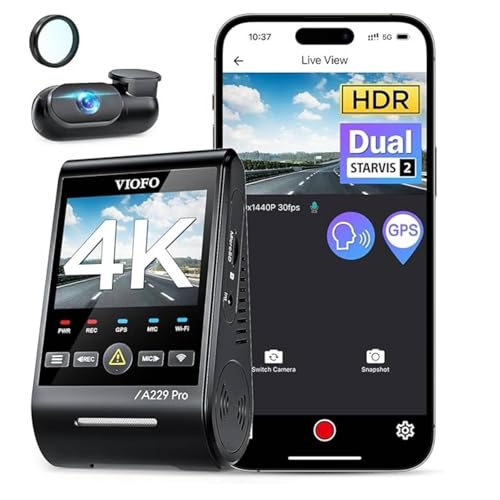
If you want the best image quality in this lineup and are willing to pay for it, the VIOFO A229 Pro is the one to beat. It uses dual Sony STARVIS 2 sensors, the IMX678 up front for 4K recording and the IMX675 in the rear for 2K, giving you crisp, cinema-quality footage from both ends of your vehicle. Most cameras in this category offer 4K front and 1080P rear. The A229 Pro gives you 4K front and 2K rear, which is a meaningful step up for creators who plan to use that rear footage in their content.
The HDR processing on both channels is among the best we have seen. It handles the kind of tricky lighting conditions that typically cause cheaper cameras to struggle, like driving from a dark tunnel into bright sunlight, or filming at night with oncoming headlights. The footage comes out balanced and detailed rather than washed out or muddy.
Twelve voice commands let you operate the camera without touching it, and the 5GHz WiFi connects to the VIOFO app for fast transfers and clip review. A CPL filter is included in the box to cut down on windshield glare, which is a thoughtful addition that most brands charge extra for. Three parking modes give you flexibility in how you monitor your vehicle when it is stationary, and the quad-mode GPS logs your precise route, speed, and location.
The A229 Pro has a dedicated following among serious dash cam enthusiasts, and based on our experience with the footage quality, that reputation is earned. The app has its quirks, and no memory card is included, but for vloggers who want a genuine visual upgrade, this delivers it.
Key Specs:
- Resolution: 4K (IMX678) front, 2K (IMX675) rear
- Connectivity: 5GHz WiFi, voice control, app control
- Screen: 2.4-inch LCD
- Storage: Supports up to 512GB (card not included)
- GPS: Quad-mode built-in
- Extras: CPL filter included, 3 parking modes
- Dual STARVIS 2 sensors for both channels
- 2K rear camera is a major step above 1080P competitors
- Included CPL filter reduces glare
- Precise quad-mode GPS
- No memory card included
- App can be slow and occasionally unreliable
5. 70mai T800E: The Three-Channel All-Rounder Built for Complete Coverage

The 70mai T800E is the most fully featured camera in this lineup when it comes to channel coverage. It captures 4K from the front, 1080P from the rear, and 1080P from inside the cabin, all in a single setup that comes with a 64GB card right out of the box. That interior camera with switchable infrared makes this the standout choice for rideshare drivers and road trip vloggers who want to document every dimension of the journey.
The front lens carries an F1.55 aperture and records with HDR plus 3D noise reduction, delivering footage that stays sharp and clean in conditions where lesser cameras produce grainy or washed-out results. Night performance is genuinely strong across all three channels, and the interior infrared kicks in automatically in darkness so cabin footage stays usable regardless of lighting conditions.
Built-in five-mode GPS is one of the most precise positioning systems in this category, pulling from five satellite networks simultaneously. WiFi 6 connects to the 70mai app and transfers files at up to 10MB/s, which is fast enough to pull clips without waiting around. Voice control handles the most common commands hands-free, and the supercapacitor keeps performance stable across the full temperature range from 14°F to 140°F.
The app works well for most users but has shown occasional connectivity hiccups, which seems to be a minor growing pain for a newer model. Outside of that, we found the camera to be one of the more polished and user-friendly options in this group, with clear menus, solid build quality, and footage that matches its spec sheet.
Key Specs:
- Resolution: 4K front, 1080P interior, 1080P rear
- Connectivity: WiFi 6, voice control, app control
- Screen: 1.9-inch IPS
- Storage: 64GB included, supports up to 512GB
- GPS: 5-mode built-in
- Warranty: 18 months
- 3-channel coverage including switchable IR interior camera
- 64GB card included
- Five-mode GPS is among the most precise available
- Strong HDR and 3D noise reduction
- App connectivity can be inconsistent
- Parking mode requires a separately purchased hardwire kit
Best Dash Cams for Vlogging: A Quick Rundown
- ROVE R2-4K: Best single-channel 4K cam for straightforward, reliable front recording
- REDTIGER F7NP: Best front-and-rear value with fast WiFi downloads and included memory card
- ZMOPO D435: Best 360-degree coverage for drivers who want all-angle recording in one unit
- VIOFO A229 Pro: Best image quality overall, with dual STARVIS 2 sensors and a 2K rear camera
- 70mai T800E: Best three-channel setup for complete front, cabin, and rear coverage
Final Thoughts
Choosing a dash cam for vlogging comes down to what you actually need from your footage. Think about whether you are shooting for an audience or primarily for protection. Consider how many angles matter to you and whether interior coverage adds value to your specific situation. Night performance, download speed, and long-term build reliability should all factor in, because a camera that works perfectly in good conditions but struggles in the rain or heat is only doing part of the job.
Every camera in this list earned its spot for a real reason. Pick the one that fits how you drive, what you create, and what you want to protect. The right choice is the one you will actually use every single day.