
An F2 message on your Kia portable charger can leave you with a car that won’t charge and little explanation beyond a warning light. However, the code gives you a useful starting point. In several Kia owner manuals, F2 identifies a grounding problem at the electrical outlet.
Before buying another charging cable or assuming the battery needs repair, focus on the charging setup. A few careful checks can help you identify the next step without opening electrical equipment or attempting unsafe repairs.
What the Kia Charger F2 Error Means
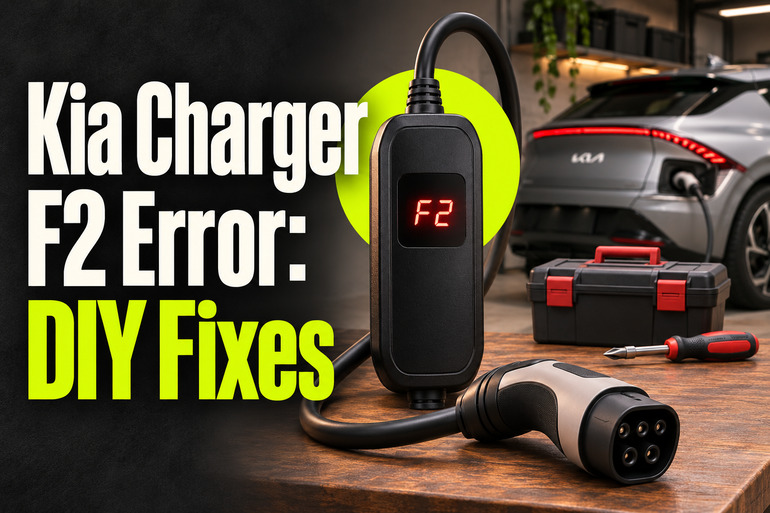
Kia lists F2 as “Ground Monitoring/Interrupt,” with poor outlet grounding as the stated cause on the portable chargers covered by its fault chart. This guidance applies to the charging cable’s control box, often called the ICCB. If your code appears on a different charger, confirm its meaning in that charger’s manual first.
Grounding provides a protective electrical path if certain faults occur. When the charger detects an unacceptable grounding condition, its safety system can prevent charging. Therefore, an outlet that supplies power to another appliance may still be unsuitable for your charging equipment.
Keep F2 separate from other charging warnings. Kia’s chart assigns different codes to current leakage, overheating, and voltage faults. A slow charging session, an interrupted session, and an F2 warning don’t automatically have the same cause. Recording the exact code helps you avoid following advice for an unrelated problem.
Stop using the equipment immediately if you notice a burning smell, excessive heat, cracked parts, or exposed wires. Those signs require attention before further testing. Kia specifically warns against using damaged charging equipment and recommends a licensed electrician when the household outlet’s condition is uncertain.
Kia Charger F2 Error: Common Causes
The outlet’s grounding is the first concern when the applicable Kia fault chart identifies F2. However, the connection between the outlet and charger also deserves attention before you decide which part needs professional inspection.
1. Missing or Faulty Outlet Grounding
A grounding problem can exist behind an outlet that looks normal from the outside. The presence of three openings doesn’t prove that the protective ground connection is intact or correctly installed. Likewise, successfully powering a lamp doesn’t establish that the outlet is suitable for vehicle charging.
For this reason, an F2 warning that appears consistently at one location gives an electrician a useful starting point. It suggests that the supply at that location needs checking, although the code alone cannot identify the exact wiring defect.
Avoid removing the outlet cover or trying to tighten connections yourself. Kia requires a grounded outlet for its portable charger and directs owners to qualified help when grounding is absent. The repair depends on the actual installation, rather than a universal adjustment at the receptacle.
2. A Worn Outlet or Damaged Plug
A plug that sits loosely, an outlet with visible damage, or a damaged grounding pin raises concern about the electrical connection. These observations don’t confirm the precise reason for F2, but they give you a clear reason to stop using that setup.
Pay attention to the equipment’s history as well. A cable that has been pulled sharply, trapped under something heavy, or repeatedly strained deserves careful visual examination. Kia warns against pulling, twisting, or stepping on the cable and prohibits use when the charger, connector, or case is damaged.
3. Extension Cords and Unapproved Adapters
If your charger reaches the vehicle through an extension cord, power strip, or plug adapter, the setup includes extra connections that need to be removed from the troubleshooting process. Kia’s portable charging precautions prohibit extension cords and adapters. Some manuals also explicitly prohibit splitters and surge protectors.
An added accessory isn’t proof of the F2 cause. However, continuing to test through it makes the result harder to interpret. You need a charging arrangement that follows the equipment instructions before judging whether the outlet or charger is responsible.
Keep this distinction clear if your charger has a detachable supply lead supplied for that model. A manufacturer specified input lead is different from an accessory added to make an unsuitable outlet fit. Follow the manual for the exact charging unit, including its approved lead and connection procedure.
4. A Charger That Needs Professional Assessment
When F2 continues on a supply that an electrician has verified as suitable, the portable charging equipment becomes a reasonable subject for further investigation. This is a troubleshooting inference, rather than confirmation that a particular internal component has failed.
Don’t open the control box to investigate its electronics or grounding circuit. Kia prohibits repairing or disassembling the portable charger. A dealer or the equipment manufacturer should assess persistent faults and determine whether the unit needs service or replacement.
Kia Charger F2 Error: DIY Fixes
Begin with information gathering and external checks, then use controlled comparisons where the equipment and supply are safe. Your aim is to identify what needs attention without trying to override the charger’s protection.
1. Confirm the Code and Charger Model
Take a clear photo of the display and the charger’s identification label. Record whether F2 appears as soon as you connect the wall plug, after you connect the vehicle, or after charging begins. This timing gives the person handling the fault more useful information than a general report that charging stopped.
Next, find the instructions for that particular charging unit. Kia notes that portable charger types can vary by region, and its manuals describe different equipment arrangements. Check the charger label alongside your vehicle’s model year rather than assuming every Kia branded cable uses identical controls.
Confirm that the display actually reads F2. If another code appears during the same attempt, photograph that too. Keep a short record of each result so you can describe the fault accurately instead of relying on memory during a service call.
2. Examine the Disconnected Equipment
Stop charging through the vehicle’s normal controls. Follow the manual’s release procedure, disconnect the vehicle connector, and then unplug the supply plug. Kia’s guidance specifies disconnecting the vehicle first and warns against unplugging the wall connection while charging. Hold the plug itself rather than pulling its cable.
With everything disconnected, look for cracked plastic, damaged pins, cuts, crushed cable sections, discoloration, or signs of water entry. Keep your hands away from electrical contacts and don’t insert tools into connectors. If anything looks damaged, leave the equipment out of use and arrange an assessment instead of reconnecting it to see whether it still works.
3. Remove Added Accessories and Check the Connection
If you were using an extension cord, splitter, or plug converter, remove it from the arrangement. Position the vehicle where the charger’s own cable can reach a suitable outlet without being stretched. If that isn’t possible, use another approved charging location rather than adding cable length.
Before reconnecting, consider the outlet’s condition. A plug that cannot remain securely seated needs professional attention. Don’t hold it in place with tape or wedge something against it. Similarly, don’t bend a grounding pin to improve its fit or modify a plug to match another outlet.
Only reconnect when the equipment is undamaged and the supply is suitable. Follow the manufacturer’s instructions for the connection sequence and keep the cable protected from damage. The Electrical Safety Foundation also recommends inspecting charging cables before use and prohibits extension cords and multiplug adapters for EV charging.
4. Compare Results at a Verified Suitable Outlet
A different outlet can help narrow the problem, provided it is known to be properly grounded and suitable for the charger. An electrician verified charging outlet is a better comparison than another untested socket nearby. Check that its voltage and plug arrangement match the equipment label.
Use the same undamaged charger and follow its normal connection procedure. If F2 disappears and the vehicle charges normally, that result supports investigating the original supply. It doesn’t identify the exact defect or establish that every outlet on the original property is unsafe.
If F2 returns, record the result and stop repeating the attempt. Several untested outlets don’t provide the same evidence as a verified supply. Avoid buying replacement equipment based solely on repeated failures at sockets whose grounding condition remains unknown.
5. Use an Outlet Tester Only Within Its Limits
For a compatible, undamaged household receptacle, a basic plug in tester may provide useful information without exposing wiring. Follow the tester’s instructions and read its indicator chart carefully. If it reports an open ground or another wiring fault, stop using the outlet and give that result to an electrician.
However, a normal indication cannot settle every grounding concern. Klein Tools states that its basic receptacle testers don’t indicate ground quality and may miss certain combinations of wiring defects. Therefore, a normal tester result doesn’t overrule a recurring F2 warning or replace an electrical assessment.
6. Contact an Electrician or Kia Service Department
Choose the professional according to the evidence. If the problem occurs at one outlet, or the outlet is loose or damaged, contact a licensed electrician. Explain that the portable charger reports a grounding fault and ask for an assessment of the outlet and circuit’s suitability for vehicle charging. ESFI recommends qualified electricians for EV charging site assessments.
If the supply has been verified and F2 persists, contact Kia or the charger manufacturer with your photos and comparison results. Another compatible, normally functioning charger can also help distinguish a charging equipment problem from a vehicle concern. Kia advises contacting the charger manufacturer if the vehicle charges normally with another working charger.
If the vehicle also fails to charge with another normally working charger, arrange a Kia inspection. Seek dealer assistance sooner if charging fails alongside a vehicle service warning light. Kia specifically identifies both situations as reasons for professional inspection, so further outlet experiments would offer little value at that point.
Wrapping Up
A Kia portable charger’s F2 warning deserves a focused response. Confirm the code, examine the disconnected equipment, and establish whether the electrical supply is suitable before considering replacement parts. Clear observations make the next decision easier and help prevent spending money on a repair that hasn’t been supported by testing.
If the warning returns, keep the affected setup out of use until it has been assessed. An electrician can address supply concerns, while Kia or the charger manufacturer can investigate equipment faults. Use your recorded results to arrange the right help.