
An airbag warning light deserves prompt attention, even if your Kia starts, steers, and drives normally. When a scan reveals B1346, the problem concerns the electrical circuit for the driver’s airbag, so normal driving performance doesn’t tell you whether that airbag will work correctly.
Understanding this code helps you make sensible repair decisions without replacing parts by guesswork. Your safest starting point is to confirm the fault, preserve useful diagnostic information, and arrange the right inspection before touching any airbag components.
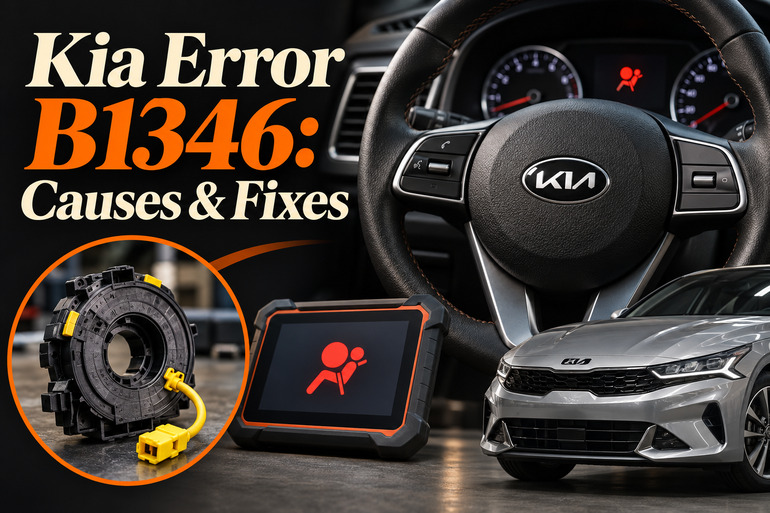
What Kia Error B1346 Means
Kia identifies B1346 as excessive resistance in the driver airbag’s first stage circuit. Some diagnostic tools display it as B134600. Resistance describes how much a circuit opposes electrical current. An interrupted connection or damaged component can push resistance beyond the acceptable limit, causing the airbag control module to record the fault. The code identifies a circuit problem rather than proving that the airbag itself needs replacement.
The circuit includes the airbag control module, wiring, connectors, clock spring, and the driver airbag’s ignition circuit. The clock spring maintains the electrical connection between the stationary steering column and the rotating steering wheel. On applicable systems, the driver airbag has separate deployment stages. B1346 concerns the first stage, while B1481 identifies excessive resistance in the second stage.
The most noticeable symptom is usually the airbag warning light. Kia owner documentation describes a brief startup check, commonly lasting about six seconds. A light that stays on, appears while driving, blinks, or fails to illuminate during its check needs professional attention. Check your model’s manual for its exact behavior. Don’t assume that every airbag is disabled, or that the driver airbag remains fully functional, based on the light alone.
Arrange an inspection promptly and ask the repair facility whether the vehicle should be transported. Airbag work isn’t suitable for ordinary home troubleshooting. Kia warns against disconnecting or altering SRS wiring because improper handling can cause accidental deployment or leave the system inoperative. Don’t remove the steering wheel airbag, unplug its connectors, or probe its terminals.
Kia Error B1346: Common Causes
Several faults can create excessive resistance in the same circuit. The following causes explain why a technician must narrow down the problem before choosing a repair.
1. A Faulty Clock Spring
The clock spring is a documented source of B1346 on certain Kia vehicles. It provides an electrical path through a rotating connection behind the steering wheel. If that path becomes damaged or interrupted, the airbag control module can detect excessive resistance.
Kia issued bulletin ELE218 for some 2012 and 2013 Rio models and some 2014 and 2015 Forte and Forte Koup models with B1346 or B1481. The bulletin directs technicians to replace the clock spring on affected vehicles under the applicable procedure. That makes the vehicle’s model, production date, and identification number useful diagnostic details.
However, a repair bulletin doesn’t make every B1346 fault a clock spring failure. A vehicle outside the listed range still needs diagnosis, and a vehicle within it needs its eligibility and symptoms checked. Avoid ordering a part simply because another Kia owner fixed the same code with one.
2. Loose or Damaged Electrical Connectors
A connector must hold its terminals securely together to carry current reliably. Loose connections, bent terminals, corrosion, contamination, or damaged locking features can interfere with that contact. Kia’s published diagnostic procedure specifically includes these conditions during terminal and connector inspection.
Recent steering wheel, column, or airbag work is useful background information because the technician needs to know which connections may have been disturbed. If the warning first appeared immediately after a repair, tell the shop exactly what was done. The timing provides a starting point, although it doesn’t establish that the previous work caused the fault.
3. Damaged Wiring in the Driver Airbag Circuit
A broken conductor can interrupt the circuit completely. Other damage may leave an unreliable connection that works at one moment and fails at another. The relevant wiring connects the airbag control module, clock spring, and driver airbag, so the problem doesn’t have to be inside the steering wheel.
Kia’s Sorento diagnostic information includes repair or replacement of the harness or connector between the control module and clock spring when testing identifies a fault there. This is why replacing the clock spring without checking the rest of the circuit can leave B1346 unresolved.
Previous collision repairs or work around the steering column should be disclosed before testing begins. Supply repair invoices if available. Don’t pull back covers or move airbag wiring to find damage yourself, since the inspection requires the correct precautions and vehicle information.
4. A Fault Within the Driver Airbag Module
The driver airbag module contains the parts that inflate the airbag when deployment is commanded. A fault within its first stage ignition circuit is another possible source of excessive resistance. Nevertheless, B1346 alone cannot distinguish an internal airbag fault from a problem elsewhere along its electrical path.
Kia’s diagnostic procedures use approved test equipment to separate the airbag module from the remaining circuit during diagnosis. They also warn against directly measuring airbag resistance with a meter because the measuring current may cause deployment. Airbag replacement should follow a confirmed diagnosis, with all testing left to a qualified technician.
Kia Error B1346: DIY Fixes
The safe steps you can take involve observing symptoms, confirming information, and checking repair coverage. Physical repairs to the airbag circuit belong with a qualified technician, so use these steps to support a prompt and accurate diagnosis.
1. Record the Warning Light’s Behavior
With the vehicle parked, note what the airbag warning light does during a normal startup. Record whether it illuminates briefly and goes out, stays on, or behaves differently from the description in your owner’s manual. A short video can help show an intermittent warning.
Also write down when you first noticed the problem and whether it followed other work on the vehicle. Include any other warning lights or steering wheel functions that stopped working around the same time. These details give the technician context without requiring you to touch the system.
A warning that disappears doesn’t prove the underlying fault has been repaired. Kia directs owners to obtain an inspection when the airbag light comes on during operation, even if the vehicle otherwise appears normal. Don’t keep driving simply to see whether the warning returns.
2. Confirm the Code With a Compatible Scanner
If you already have a scanner, check that it supports the SRS or airbag system for your Kia’s exact model and year. Engine code reading capability alone doesn’t establish that a tool can access the airbag control module. Follow the scanner’s instructions and use a reading function only.
Save the complete report before anything is erased. Useful details include the exact code, its description, any status information, and other SRS faults found during the scan. If your tool can’t access the system, let the repair shop perform this step rather than buying equipment solely to clear the light.
Pay attention to similar codes. Kia distinguishes B1346 from B1347, which concerns resistance that is too low, and B1481, which concerns excessive resistance in the second stage. Giving the shop the full report helps prevent an incomplete or mistaken description of the problem.
3. Check Recall and Warranty Coverage
Before paying for parts, collect your VIN and contact a Kia dealer. Ask whether any open recall, warranty extension, or applicable service bulletin concerns the driver airbag clock spring. Give the service adviser the exact code and ask for confirmation of eligibility before authorizing the repair.
There are documented programs worth checking. Kia’s revised ELE108 bulletin describes a clock spring warranty extension for qualifying 2011 through 2015 Sorento vehicles. It states coverage of 15 years with unlimited mileage from the first service date, subject to the specified vehicle range. ELE218 also references warranty extension WTY017 for certain Rio and Forte vehicles. Current eligibility requires dealer verification.
You can also use NHTSA’s recall lookup for open safety recalls. However, NHTSA explains that its VIN results don’t include manufacturer customer service or other campaigns outside safety recalls. A result showing no open recall therefore doesn’t settle whether a warranty extension applies.
4. Have the Confirmed Circuit Fault Repaired
Once testing identifies the faulty section, the repair should address that specific problem. Depending on the findings, this may involve a connector, wiring, the clock spring, or the driver airbag module. Ask the shop to explain what test result supports its recommendation.
For a confirmed clock spring fault, the technician must select the correct replacement and follow Kia’s installation procedure. Kia’s Sorento bulletin stresses maintaining the new clock spring’s alignment during installation. This is another reason to leave replacement to someone equipped to handle the airbag and steering wheel safely.
Don’t attempt a temporary repair by bridging terminals, fitting a resistor to hide the fault, or altering airbag wiring. Such changes can conceal a warning while leaving the protection system compromised. Kia explicitly warns against modifications to SRS components and wiring because they can affect system performance and cause injury.
5. Verify the Result After Repair
Before collecting the vehicle, ask whether the technician completed the applicable checks, cleared the diagnostic codes after repair, and rescanned the SRS. Request a repair invoice that identifies the diagnosed fault and the work performed. This gives you a useful record if the warning returns.
Then observe the warning light during the next normal startup and compare it with your owner’s manual. A light that stays off is useful evidence, but it should accompany the shop’s verification. If the warning returns, contact the repair facility promptly and provide the new scan report if one is available.
6. Contact a Qualified Kia or SRS Technician
Professional diagnosis is necessary as soon as B1346 is confirmed. A Kia dealer is especially useful for checking manufacturer coverage and current service information. If you choose an independent shop, confirm that it handles Kia SRS diagnosis and has access to the correct procedures and equipment.
Provide the model year, VIN, complete scan report, warning light observations, and relevant repair history. Ask whether the quoted amount covers diagnosis only or includes a confirmed repair. Also clarify whether further approval will be needed if testing reveals a different component fault.
If there is visible airbag damage, a deployed airbag, or unresolved collision damage, stop using the vehicle and arrange qualified assistance. Don’t attempt to make the warning disappear before seeking help. Kia advises professional replacement after deployment and warns that improper SRS handling can cause serious injury.
Wrapping Up
Kia error B1346 points to a problem in a safety system that needs dependable electrical connections. The useful next step is a confirmed diagnosis, supported by your vehicle details, a complete scan report, and a clear account of when the warning appeared.
Keep your own checks limited to observation and information gathering. Then have a qualified technician identify the faulty part and verify the repair. Checking available coverage before authorizing work can also help you avoid paying for a repair that an applicable Kia program may cover.