
An ABS warning on your Kia Sonet deserves attention, even if the brake pedal still feels normal. The light can point to a voltage problem, a missing wheel speed signal, or another fault that needs proper testing.
However, the warning alone doesn’t identify a failed part. Understanding when it appears, which other lights accompany it, and how your brakes feel will help you decide which checks are safe and when your Sonet needs professional attention.
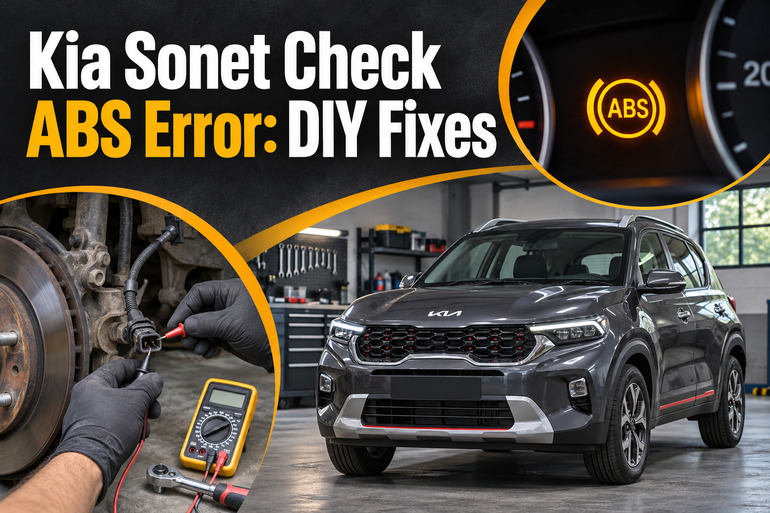
What the ABS Warning Means on Your Kia Sonet
Your Sonet’s antilock braking system, or ABS, helps prevent the wheels from locking during braking. It monitors wheel speeds and adjusts brake pressure when necessary, helping you retain steering control during a hard stop. It still requires adequate following distance, especially on rough or slippery roads.
The ABS light normally appears for approximately three seconds when you switch the ignition on, then goes out. A light that stays on indicates a problem requiring inspection. Kia explains that normal braking remains available during an ABS malfunction, but without antilock assistance. A normal pedal therefore doesn’t prove that every braking function is working.
Pay particular attention to a red brake warning alongside the ABS light. Kia warns that this combination can mean the braking system isn’t operating normally. Pull over safely and arrange assistance if the red warning remains after releasing the parking brake. Stop driving if the pedal feels soft, braking weakens, or you notice a fluid leak.
The exact display wording and fitted equipment can vary by model year and market. Treat a “Check ABS” message as a request for diagnosis rather than a specific part replacement instruction. Also, a brief click as the vehicle first moves can be a normal ABS check, so a sound by itself doesn’t establish a fault.
Kia Sonet Check ABS Error: Common Causes
Several faults can switch on the same ABS warning, although the clues around its appearance may differ. The following are established possibilities rather than confirmed diagnoses for every Sonet.
1. Low Battery Voltage
A warning that appears after a difficult start or a jump start makes battery condition worth checking. Kia specifically notes that low voltage following a drained battery can illuminate the ABS warning without necessarily indicating an ABS component failure.
On Sonet versions equipped with automatic engine stop and restart, Kia also describes brief warning lights during an automatic restart because of low battery voltage. That explanation applies to lights that appear briefly, rather than a warning that remains on throughout the journey.
The useful distinction is whether the warning follows a clear starting problem and then disappears, or continues despite reliable starting. A battery and charging system test can help establish whether poor electrical supply needs attention before ABS parts are considered.
2. A Faulty Wheel Speed Sensor
Wheel speed sensors provide information used by ABS and other systems, including electronic stability control where fitted. If a sensor stops supplying a usable signal, the vehicle may illuminate warning lights because those functions no longer have the information they need.
However, a warning or a fault code naming a particular wheel doesn’t automatically prove that its sensor has failed. The signal also depends on the wiring and the rotating target that the sensor reads. Those parts need checking before you approve a replacement.
3. Damaged Wiring or Poor Connections
The sensor may still work while its electrical connection fails. Broken wiring, damaged connectors, or contamination around connections can interrupt the signal traveling between a wheel sensor and the ABS controller. Delphi includes wiring and connector checks in its ABS diagnostic guidance.
If the warning first appeared after work near a wheel, tell the technician exactly what was done. That timing gives the workshop a useful starting point for checking cable routing and connections, although it doesn’t establish that the recent work caused the fault.
A warning that comes and goes also needs investigation. Its disappearance doesn’t prove that a damaged wire has repaired itself. Record when it returns instead of repeatedly clearing it, so the technician can connect the symptoms with the stored fault information.
4. A Damaged Encoder or Wheel Bearing Problem
The wheel sensor reads a rotating target, sometimes called an impulse ring or encoder. Depending on the assembly, a magnetic encoder can be incorporated into the wheel bearing seal. Damage to that target can interfere with the signal even when the sensor itself is sound.
Bearing installation also matters on designs that use a magnetic encoder. If the warning begins after a bearing replacement, the workshop should verify the correct part, installation, and sensor relationship for your Sonet. Replacing another sensor without checking the assembly may leave the original problem unresolved.
5. A Power Supply or Internal ABS Fault
An ABS warning can also involve the system’s electrical supply, controller, or hydraulic unit. The hydraulic unit contains valves that control brake pressure, while the electronic controller monitors the system and stores information about detected faults.
These possibilities need targeted testing. A warning light alone doesn’t justify replacing the ABS module. Before recommending an expensive assembly, the workshop should establish whether the fault concerns its power supply, wiring, connected components, or internal operation.
Kia Sonet Check ABS Error: DIY Fixes
Start with checks that gather useful information without disturbing the braking system. Your aim is to identify a simple contributing condition and recognize when further work requires a qualified technician.
1. Confirm the Warning and Record the Symptoms
Park somewhere safe and look closely at the instrument cluster. Note whether you have an ABS light alone, an additional stability control warning, or a red brake warning. Take a photo while stationary, including any written message.
Also record when it happened. Useful details include whether the engine struggled to start, the battery recently went flat, or a workshop recently replaced a tire or wheel bearing. Note any change in pedal feel or braking performance.
If the red brake light stays on with the parking brake released, or braking feels abnormal, stop troubleshooting and arrange assistance. Don’t perform a hard stop to test whether ABS works. The warning and your observations already provide enough reason for inspection.
2. Restart Once Under Safe Conditions
If only the ABS warning is present and there are no braking symptoms, switch the engine off while safely parked, then restart once. Watch whether the light completes its normal startup check and goes out.
Kia describes a specific situation in which continuous ABS operation on a road with poor traction can bring on the warning. Its guidance is to stop safely and restart. If the warning remains, professional inspection is required. This isn’t a universal reset procedure for every ABS fault.
If the light disappears, keep a record of the event and arrange inspection if it returns. Avoid repeated restarts or battery disconnection as a way to suppress the message. Neither action identifies why the warning appeared.
3. Address a Recent Battery Problem
If the ABS warning followed a flat battery, arrange a battery condition and charging system test. Explain whether the vehicle needed a jump start, cranked slowly, or had repeated starting trouble. These details help the technician assess the electrical supply.
Kia advises having a drained battery recharged before driving in the situation it describes. Simply getting the engine running doesn’t establish that the battery has recovered or that the charging system is healthy. Use the charging procedure and battery requirements specified for your vehicle.
After the electrical issue has been addressed, check whether the ABS warning remains. If it does, continue with diagnosis rather than assuming the battery explains everything. A charging warning that stays on while the engine runs also requires prompt attention.
4. Check Tire Pressures and Recent Tire Changes
A tire check is a sensible supporting step, particularly if the warning appeared after a tire replacement or puncture repair. ABS diagnostic guidance includes checking tire sizes, pressures, and condition. However, an ABS warning alone doesn’t prove that tire pressure caused the fault.
With the vehicle parked safely, use a tire pressure gauge and follow these steps.
- Find the recommended pressures on the vehicle’s tire information label.
- Measure each tire when cold.
- Adjust the pressures to the values specified for your Sonet and load.
- Compare the fitted tire sizes with the approved sizes in your manual.
- Tell the workshop if a temporary spare or a different size tire was fitted when the warning appeared.
Kia defines cold tires as those on a vehicle parked for at least three hours or driven no more than about one mile. Use the vehicle label rather than a general pressure figure found online. Correcting pressure supports safe operation, but a persistent ABS warning still needs investigation.
5. Read ABS Fault Codes With a Compatible Scanner
If you already have a diagnostic scanner, confirm that it supports the ABS system on your exact Sonet model and year. A tool’s ability to read engine fault codes doesn’t establish that it can access the braking controller. ABS coverage is a separate capability that varies between tools and vehicles.
Follow the scanner’s instructions while parked. Record the complete codes, their descriptions, and whether they are current or stored before clearing anything. If the tool cannot communicate with ABS, that result alone doesn’t prove that the ABS module has failed.
Treat the results as clues for the workshop. A wheel speed code needs further checks of the relevant signal path. Don’t run pump tests, change coding, or attempt brake bleeding through the scanner. Those functions go beyond a safe basic owner check.
6. Contact a Qualified Automotive Technician
Arrange professional diagnosis if the warning stays on, returns after disappearing, or accompanies other faults. Seek assistance immediately if braking changes or a red brake warning remains on. You don’t need to complete every earlier check before getting help.
Give the technician your photos, symptom notes, and any saved codes. Ask for a diagnosis that includes the electrical supply and relevant wheel speed signals before parts are replaced. Comparing sensor readings can help locate a signal problem, while physical checks can establish whether the sensor, wiring, encoder, or bearing needs attention.
Leave sensor removal, wiring repairs, bearing replacement, and hydraulic ABS work to qualified personnel. After repair, the workshop should verify the result using the appropriate diagnostic checks and a controlled road test. A light that has simply been cleared isn’t sufficient evidence that the underlying fault is resolved.
Wrapping Up
A Kia Sonet ABS warning gives you a reason to investigate, but it doesn’t name the failed component. The most useful first steps are to identify the accompanying lights, record when the warning appears, and check for a recent battery or tire issue without disturbing brake components.
If the warning persists, take those observations to a qualified technician instead of buying parts on a guess. If braking changes or a red brake warning remains on, stop driving and arrange assistance. A clear diagnosis gives you a sound basis for the repair.