
A “Mechanism Error” message on your Kia Optima’s stereo can leave you with a silent CD player, a trapped disc, or clicking sounds behind the dashboard. The message points to trouble within the audio unit, but it doesn’t identify the exact failed part.
Before replacing the stereo, a few careful checks can help separate a disc problem from a loading fault. Your model year and installed audio system determine which controls and reset instructions apply.
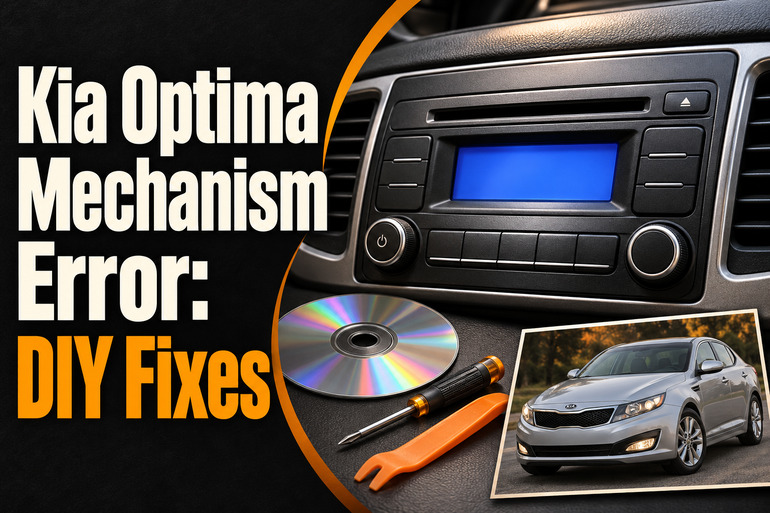
What a Kia Optima Mechanism Error Means
When this message appears on the stereo during CD operation, the player is reporting a problem with its disc mechanism. This is the assembly that accepts, positions, and ejects your CD. Kia audio documentation distinguishes mechanism faults from loading and disc errors, although the wording differs between audio units.
Normally, the player draws in a disc, positions it for playback, and reads its recorded information. If something prevents that sequence from finishing, the unit may stop and display an error. You might hear repeated clicking, find that the eject button does nothing, or see the message whenever the stereo starts.
The timing provides useful clues. An error involving one particular CD suggests a different starting point from a player that refuses every disc. Likewise, a stereo with working FM radio but a trapped CD gives you a reason to focus first on the disc player.
These checks apply to an error on the audio display. A separate warning in the instrument cluster needs its own diagnosis. Also, stop using the stereo if you notice smoke, a burning smell, or unusual heat around the unit. Those symptoms require professional attention before further testing.
Kia Optima Mechanism Error: Common Causes
Several problems can interrupt CD operation, and some produce similar symptoms. The following possibilities deserve attention, but the message alone cannot confirm which one affects your Optima.
1. A Trapped Disc or Obstructed Loading Path
A disc that cannot move properly can prevent the player from completing its loading or ejecting sequence. A lifting paper label, an unsuitable disc shape, or a foreign object inside the slot can interfere with that movement. Kia warns that labeled discs can jam and that inserting foreign objects can damage the player.
You may hear the mechanism trying to work while the disc stays inside. Sometimes the edge appears briefly before moving back into the slot. These observations suggest a movement problem, although they don’t establish whether the disc or an internal part is responsible.
An occupied slot is another detail to consider. If you’re unsure whether a CD is already inside, don’t push another one in to test it. Forcing a second disc into a single disc player can make the original problem harder to repair.
2. A Dirty, Damaged, or Unsupported CD
Fingerprints and scratches can interfere with playback. A homemade CD may also fail because of its recording method or an unsupported format. Kia’s Optima manuals describe compatibility differences between discs and audio systems, so a disc that works elsewhere may still be unsuitable for your installed player.
However, a reading problem and a mechanism problem aren’t interchangeable diagnoses. If your CD loads and ejects normally but won’t play, the disc deserves attention first. If it stays trapped inside, cleaning its recorded surface cannot address the immediate fault. This distinction helps you avoid treating every CD error as evidence of a failed stereo.
3. Extreme Cabin Temperatures or Condensation
An audio system may behave abnormally in extreme heat or cold. Kia’s UVO documentation also identifies moisture forming on the optical lens as a possible operating problem. This lens helps the player read the disc, so moisture can interrupt playback even when the loading mechanism still moves.
A fault that appears after the car sits in strong sunlight, or during damp weather, makes operating conditions worth considering. Still, temperature or moisture should remain a possibility rather than an assumed explanation for a mechanism error. If the same fault continues after the cabin returns to a comfortable temperature, further diagnosis is needed.
4. A Temporary Audio System Malfunction
Sometimes the stereo’s controls stop responding correctly even though no permanent mechanical failure has been established. A frozen display, delayed button responses, or several audio features failing together can make a temporary system malfunction worth checking.
Kia provides reset procedures for certain Optima audio systems, including some UVO units. That makes a documented reset a reasonable troubleshooting step on an applicable unit. It doesn’t establish that software caused your error, and a reset cannot remove a physical obstruction or repair a damaged component.
5. An Internal Mechanism Fault
If the player repeatedly fails to load or eject discs, an internal mechanical or control fault becomes a stronger possibility. The assembly may be unable to move the disc correctly or complete its operating sequence. Identifying the specific component requires examination of the audio unit.
Repeated clicking can support that suspicion, but sound alone cannot identify a failed motor, damaged moving part, or control problem. Similarly, an error appearing with an apparently empty slot doesn’t prove the mechanism is clear. A disc or object may be hidden farther inside.
This is where the limits of external troubleshooting matter. Kia directs owners to seek service for CD player malfunctions and warns against disassembling the player themselves. Opening the unit to adjust parts or clean its internal components goes beyond a safe owner check.
Kia Optima Mechanism Error: DIY Fixes
Start with checks that help identify the fault without disturbing the mechanism. If a disc won’t move normally, avoid forcing it and continue only with the controls and procedures approved for your audio unit.
1. Confirm the Message and Check Other Audio Sources
Park the car, apply the parking brake, and photograph the exact message. Note whether it appears immediately at startup, after selecting CD mode, or only when you press eject. Also, record any clicking or repeated loading sounds.
Next, select FM radio and check another available source, such as Bluetooth or AUX. Working sound from those sources suggests that at least some shared audio functions remain operational. If every source fails or the entire display freezes, the technician will need that information too.
Match your stereo to the illustrations in your owner’s manual or separate audio manual. Include the vehicle’s model year and whether the unit is factory installed when looking for instructions. A procedure for a different Kia stereo may use similar buttons while performing a different function.
2. Try the Normal Eject Procedure
With the audio system powered as its manual requires, press the eject button normally and allow the mechanism to finish responding. If the disc comes out freely, remove it by its edges. Stop if it remains caught or requires pulling force.
Don’t insert a credit card, knife, tweezers, adhesive strip, or second CD into the slot. Kia specifically warns against foreign objects and multiple discs. Also, don’t assume that a small opening on the stereo is an emergency eject hole. Identify it in the manual before inserting anything.
3. Check the Removed Disc and Test a Suitable Replacement
If ejection succeeds, examine the disc under good light. Look for fingerprints, deep scratches, cracks, distortion, or a peeling label. Clean light surface dirt with a soft cloth, wiping from the center outward. Kia recommends this direction and warns against solvents and ordinary household cleaners on CDs.
Once you’ve confirmed that the slot is empty and the player accepts discs normally, try an undamaged, commercially produced music CD that meets your unit’s requirements. Insert it with the label facing the direction specified in the manual. If that CD plays, the original disc becomes the stronger suspect. If the replacement also fails, stop feeding discs into the player and move to the next applicable check.
4. Let the Audio System Return to Normal Conditions
If the problem began in a very hot cabin, switch the audio off and ventilate the interior before testing again. Kia’s Optima manual recommends opening the windows to release excessive cabin heat before using the audio system. You can also use the vehicle’s climate controls under normal, safe operating conditions.
For a problem associated with damp conditions or a rapid temperature change, give the interior time to stabilize. There isn’t a verified waiting period that applies to every Optima audio unit. Avoid using a hair dryer, spraying liquid into the slot, or attempting to dry internal parts.
After conditions improve, try the normal controls again. Successful operation suggests that conditions may have contributed, but it doesn’t confirm the cause. Note whether the problem returns during similar weather or also occurs under ordinary conditions. That pattern will help if service becomes necessary.
5. Restart the Stereo and Use Its Documented Reset
Turn the stereo off using its normal power control. Then shut the vehicle down normally and allow the audio display to switch off before starting another session. Keep this check brief so you don’t leave the system operating for a long period with the engine off.
If the error remains, consult the manual for your exact unit before resetting it. Some Optima systems have a recessed RESET control, but its location and operating instructions vary. Follow the illustrated procedure and the stated press duration. Don’t substitute an online button combination intended for another model.
Review the effects before proceeding. Certain resets restore settings, and a factory initialization may erase phone pairings or other saved preferences. After the system restarts, check whether the controls respond and whether normal ejection works. A message that returns immediately, especially with continued clicking, needs further investigation.
6. Contact a Car Audio Specialist or Kia Service Department
Arrange professional diagnosis if the disc remains trapped, several suitable CDs fail, or the error returns after the applicable checks. A qualified car audio technician or Kia service department can determine whether the problem involves the mechanism, its controls, or the audio unit’s power supply. Persistent faults are a reason to seek service rather than continue resetting the stereo.
Bring your photo of the message and a short description of when it occurs. Explain whether other audio sources work, whether a disc is inside, and which checks you completed. If the fault began after battery service or stereo installation, mention that history without assuming it caused the failure.
Ask for a diagnosis and estimate before authorizing replacement. Depending on the unit and available parts, repair or replacement may be appropriate. Any replacement needs to suit your vehicle’s audio equipment and connected features. If your main concern is recovering a trapped disc, tell the shop before it begins work.
Wrapping Up
A Kia Optima mechanism error deserves a careful check of the CD player, especially when a disc won’t eject or the unit keeps clicking. The most useful clues are when the message appears, whether other audio sources work, and whether the fault follows one disc or several.
Begin with the normal controls and the instructions for your installed stereo. If those checks don’t restore reliable operation, leave the mechanism undisturbed and arrange diagnosis. Clear observations can help a technician identify the problem without replacing parts based on the message alone.