
A Hyundai Elantra trunk that refuses to open can leave your groceries, tools, or other belongings trapped inside the car. Sometimes, pressing the key fob produces no response. In other cases, you hear a clicking sound, but the trunk lid remains firmly closed. These symptoms can point to different problems, including a weak key fob battery, an electrical fault, or a damaged latch mechanism.
The right repair depends on how the trunk behaves when you try to open it. A few simple checks can help you identify the likely cause and determine whether you can fix it yourself or need a mechanic.
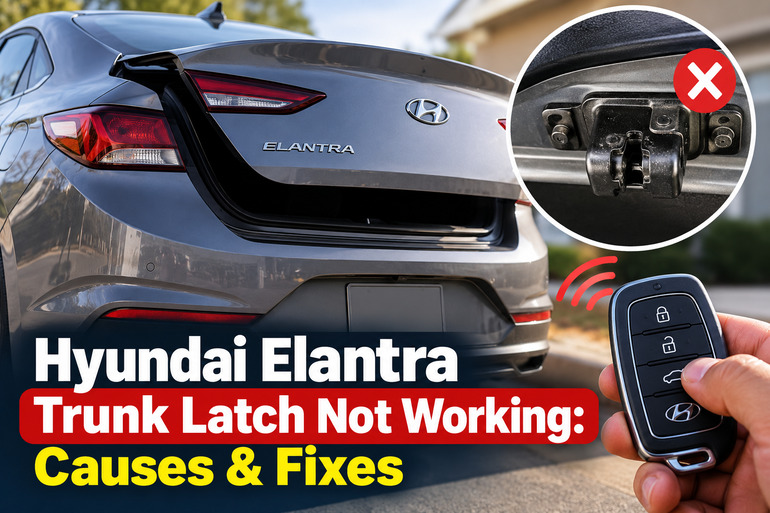
What Happens When the Hyundai Elantra Trunk Latch Stops Working?
The trunk latch keeps the lid securely closed while allowing it to open when you activate the release mechanism. Depending on your Elantra’s model year and equipment, you may be able to release the trunk using the key fob, an exterior trunk switch, an interior release lever or button, or a combination of these controls. The exact arrangement varies by model.
When you activate the release, an electrical actuator or mechanical linkage operates the latch so the trunk lid can lift. If a switch fails, electrical power is interrupted, or the latch becomes stuck, the release mechanism may not work as intended.
The symptoms provide useful diagnostic clues. A trunk that opens with the interior release but not the key fob suggests a problem with the remote or its signal. A faint click without the lid opening may indicate that the actuator is receiving power but the latch remains jammed or under pressure. If none of the available release controls works, an electrical supply problem, faulty actuator, damaged latch, or mechanical obstruction becomes more likely.
Avoid forcing the lid upward or repeatedly slamming it. Excessive force can damage the latch, striker, paintwork, or surrounding body panels. If the trunk is stuck closed, begin with the controls and checks that do not require access to the latch itself.
Hyundai Elantra Trunk Latch Not Working: Likely Causes
Several faults can produce similar symptoms, so the first sign of trouble does not automatically identify the failed part. These are five common areas to investigate, starting with the simpler possibilities and moving towards problems that may require repairs.
1. A Weak Key Fob Battery or Faulty Remote
If the trunk refuses to open when you press the key fob button, the remote may have a weak battery. The battery supplies the power needed to transmit a signal to the vehicle. As it loses capacity, the remote may work inconsistently or stop communicating at a distance.
You might also notice that the door locks respond unreliably or that you need to stand closer to the car for the remote to work. If the door locks operate normally but the trunk button does not, a damaged button or a fault in the remote’s circuitry could be responsible.
A failed trunk button does not necessarily mean that the entire smart key has stopped working. Testing another available trunk release control helps distinguish a remote problem from a fault elsewhere in the vehicle.
2. A Blown Fuse or Vehicle Battery Problem
The trunk release system may depend on electrical power supplied by the vehicle’s battery through a fuse and associated wiring. If a relevant fuse blows, the release mechanism may stop responding even though the rest of the car appears to function normally.
A weak or discharged vehicle battery can also interfere with electrical systems. This becomes more likely if the engine cranks slowly, the interior lights look unusually dim, or several electrical features begin behaving erratically around the same time.
However, a trunk latch that has stopped working by itself does not prove that the battery or fuse is faulty. The specific fuse allocation varies by model year and equipment, so the correct fuse diagram is essential before attempting any replacement.
3. A Faulty Trunk Release Switch or Damaged Wiring
The trunk release switch can wear out after repeated use. Its internal contacts may fail to complete the electrical circuit, preventing the release command from reaching the actuator.
The symptoms depend on which control has failed. If the trunk opens using the key fob but not the switch on the trunk lid, the exterior switch or its wiring becomes a reasonable suspect. If one interior control fails while the others continue working, the fault may be limited to that control.
Wiring can also become damaged, loosen at a connector, or develop corrosion. Moisture around the trunk lid, previous collision repairs, and repeated movement of wiring through hinged areas can contribute to electrical problems. These faults often require electrical testing to identify the exact failure point.
4. A Failed Trunk Latch Actuator or Damaged Latch Assembly
The actuator operates the release mechanism when it receives a suitable command. If its motor or internal components fail, the trunk may remain locked even when the key fob, switches, and electrical supply are working correctly.
Listen carefully when you activate the release. A complete absence of sound could indicate a failed actuator, although a lack of power or a faulty switch can produce the same symptom. A clicking or buzzing sound without the latch releasing may suggest a weak actuator, a jammed mechanism, or pressure preventing the latch from disengaging.
The latch itself can also wear, deform, or become damaged. Hyundai issued a US safety recall, Recall 256, covering certain 2015 and 2016 Elantra vehicles because high temperatures could cause the trunk latch pawl to contract and become damaged during release attempts. The affected latch could also prevent the emergency trunk release from working correctly. Owners of potentially affected vehicles should check their vehicle identification number (VIN) for recall applicability.
5. Latch Misalignment, Dirt, Corrosion, or Freezing
Sometimes, the electrical system works correctly, but the trunk still refuses to open because the mechanism cannot release freely. Dirt, corrosion, damaged latch components, or a misaligned striker can interfere with the latch’s movement.
The striker is the metal loop or fitting that the latch grips when the trunk closes. If the trunk lid has shifted following a collision or an impact, the striker may place excessive pressure on the latch. You may notice that the lid sits unevenly, requires extra force to close, or fails to open even though the release mechanism clicks.
Moisture can also freeze around the trunk lock or latch in cold conditions. If the fault began after a freezing night or a period of wet weather, ice may be contributing to the problem.
Hyundai Elantra Trunk Latch Not Working: How to Fix
Start with the simplest checks before replacing any parts. The following methods can help restore operation when the problem is caused by a weak remote battery, an electrical supply issue, or minor mechanical interference.
1. Test Every Available Trunk Release Method
Begin by determining whether the fault affects one control or the entire release system. Depending on your Elantra’s model year and configuration, try the trunk button on the key fob, the exterior trunk release switch, and the interior release control.
Follow the opening instructions in your owner’s manual. Some models require the doors to be unlocked, while others allow trunk release with the smart key nearby. Put the transmission in Park for an automatic model and apply the parking brake before carrying out the checks.
Pay attention to what happens each time. If one control works consistently while another does not, concentrate on the control that fails. If none works, move on to the remote battery and vehicle electrical supply before assuming the latch itself needs replacement.
2. Replace the Key Fob Battery
A weak remote battery is one of the simplest possibilities to eliminate when the trunk does not respond to key fob commands.
Check your owner’s manual for the correct battery type and replacement procedure. Open the key fob carefully using the recommended method, noting the battery’s orientation before removing it. Fit a fresh battery of the specified type and reassemble the remote without forcing its plastic case or damaging the internal contacts.
Test the trunk release from a reasonable distance. If the doors and trunk now respond consistently, the old battery was likely contributing to the fault. If the door locks work but the trunk still ignores the remote, test the other release controls to determine whether the problem is isolated to the trunk function.
3. Check the Vehicle Battery and Relevant Fuse
If several electrical features are malfunctioning, inspect the vehicle’s battery condition first. Look for obvious signs of a discharged battery, such as dim lights or slow engine cranking. If you have a suitable battery tester, use it according to the manufacturer’s instructions. A mechanic or roadside technician can test the battery and charging system if the results are uncertain.
Next, consult the fuse diagram in the owner’s manual for your exact model year and equipment. Locate the fuse associated with the trunk release, trunk lock, or relevant body control system, using the labels specified for that vehicle.
If the relevant fuse is visibly damaged, replace it only with a fuse of the same specified rating. Never install a higher-rated fuse or bridge the fuse terminals. If the replacement fuse blows again, stop replacing it and arrange professional diagnosis because an underlying electrical fault may be present.
Keep in mind that a working battery does not rule out a local electrical fault, and the absence of other electrical symptoms does not exclude a blown fuse.
4. Inspect the Trunk Opening and Latch When the Lid Is Open
If you can open the trunk using an alternative control, inspect the accessible latch and striker for obvious damage, dirt, or signs of misalignment. Remove loose debris with a soft brush or clean cloth, keeping fingers away from pinch points in the mechanism.
Look for a bent striker, broken plastic components, loose visible fasteners, or corrosion. The trunk lid should normally close without excessive force and sit evenly with the surrounding body panels. If it requires slamming or sits unusually high on one side, the alignment may need adjustment.
For a latch that moves freely but appears dry, use only a lubricant suitable for automotive locks or latches and permitted by the vehicle manufacturer’s maintenance guidance. Apply it sparingly and keep it away from painted surfaces, electrical connectors, and interior trim. Do not dismantle the latch or adjust the striker without the appropriate service instructions, since incorrect adjustment can prevent the trunk from securing properly.
5. Address Minor Weather-Related Sticking
If the trunk stopped working after exposure to freezing temperatures, ice or frozen moisture may be obstructing the release mechanism. Move the vehicle to a warmer, sheltered area when possible and allow the affected area to thaw gradually.
Avoid pouring boiling water over the lock or trunk lid. Sudden temperature changes can damage surfaces, and additional water may freeze again when conditions remain cold. Do not use an open flame, high heat, or forceful pulling to free the lid.
After the mechanism has thawed, operate the normal release control and observe whether the latch functions consistently. If the trunk remains stuck, or the same problem returns despite warmer conditions, arrange an inspection for corrosion, damaged parts, or an electrical problem rather than repeatedly forcing the lid.
6. Contact a Qualified Automotive Technician
Professional diagnosis is the appropriate next step if the remote battery is good, the vehicle’s electrical supply appears normal, and the trunk still will not open. A technician can test for power at the actuator, verify switch operation, inspect wiring and connectors, and determine whether the latch mechanism needs repair or replacement.
A jammed trunk may require careful access to the latch from inside the vehicle. Avoid prying the lid open with screwdrivers or metal tools, cutting wires, or removing panels blindly. These attempts can cause additional damage and may make the eventual repair more expensive.
The technician should also check for outstanding safety recalls using the vehicle’s VIN. Certain 2015 and 2016 Elantra vehicles may be covered by Hyundai’s Recall 256, which calls for replacement of the affected trunk latch base. Contact an authorized Hyundai dealer to confirm whether your specific vehicle is eligible for recall repairs.
Do not continue using a vehicle if its trunk cannot latch securely. An improperly secured trunk can open while driving or allow exhaust gases to enter the passenger compartment. Have the fault corrected before returning the vehicle to normal use.
Wrap-Up
A Hyundai Elantra trunk latch that stops working can have several causes, from a weak key fob battery to a faulty actuator, damaged wiring, or a misaligned latch. Testing each available release control is a useful first step because it helps narrow down which part of the system may be at fault.
Begin with the simple checks, follow the instructions for your exact model, and avoid forcing a stuck trunk. If the latch remains unresponsive or shows signs of physical damage, professional diagnosis is the safest way to identify the fault and restore reliable operation.