
Arizona drivers face a challenge most people outside the Southwest never think about. Temperatures inside a parked car can hit 160°F on a summer afternoon in Phoenix, Tucson, or Scottsdale. That kind of heat doesn’t just make your steering wheel uncomfortable to touch. It destroys electronics. It fries batteries. It turns an average dash cam into a paperweight before the summer is even halfway through.
Finding a dash cam that can genuinely handle Arizona heat means looking past the specs on the box and understanding how a camera actually manages thermal stress. Not every dash cam is built for it, and the difference between one that survives and one that doesn’t often comes down to a few key engineering choices. That’s exactly why we put together this guide.
We compared five of the most capable dash cams on the market with a specific focus on how they perform in high-temperature environments. By the time you’re done reading, you’ll know which one fits your car, your driving habits, and your budget.
How We Selected the Best Dash Cams for Arizona Heat
Our team spent time evaluating dozens of models, narrowing the field down to options that could actually hold up in extreme heat while still delivering the features Arizona drivers need day to day.
- Thermal management design: We looked at whether each camera uses a supercapacitor instead of a lithium battery, since supercapacitors tolerate high temperatures far better and don’t swell or fail the way batteries do.
- Video quality in bright conditions: Arizona sunlight is intense, and a camera that looks great in cloudy Seattle can blow out entirely in desert glare. Wide Dynamic Range (WDR) and HDR performance under direct sun were key factors.
- Night vision capability: Many Arizona drivers park in unlit desert lots, driveways, or rural areas. Low-light performance had to be strong.
- Build quality and mounting stability: A camera that falls off your windshield in summer heat is useless. We assessed the adhesive systems and mounting hardware on each option.
- App and connectivity reliability: We favored cameras with stable Wi-Fi apps that let you pull footage without touching a hot device or removing the SD card in a baking car.
- Parking mode effectiveness: With so many cars parked outside in Arizona sun, parking mode coverage and how it handles heat-induced shutoffs mattered.
- Storage and loop recording: Extended storage support gives you more recording time without constant card management, which is especially useful for road trips through the desert.
Every pick on this list passed our standard for build quality, sensor performance, and thermal durability. These are cameras we’d put in our own vehicles driving through Arizona in July.
Best Dash Cams for Arizona Heat (Expert Ranking & Review)
The five cameras below represent the best options available for drivers dealing with extreme desert heat. Each one has real strengths, and the right choice depends on what matters most to you.
1. ROVE R2-4K: The Budget-Friendly 4K Workhorse That Handles the Heat

The ROVE R2-4K earns its place on this list right at the top of the budget tier. It records in true 4K Ultra HD at 2160P with 30fps, and the image quality is noticeably sharper than what most cameras in its price range deliver. The combination of a six-glass lens, F1.5 aperture (the widest available in its class), and a Sony IMX335 sensor means the camera pulls in a lot of light, which pays off big when you’re driving into the Arizona sun late in the afternoon.
What makes this camera work in extreme heat is the built-in supercapacitor. ROVE made the decision to skip a lithium-ion battery entirely, which is exactly the right call for hot climates. Lithium batteries swell, drain faster at high temperatures, and eventually fail. A supercapacitor doesn’t have that problem. It charges and discharges quickly, handles the heat without degrading, and keeps the camera operational even when the car’s interior is cooking.
The 150-degree wide-angle lens gives you strong coverage across multiple lanes, and the 2.4-inch IPS screen is bright enough to see clearly in direct sunlight. Built-in Wi-Fi 6 lets you connect to the ROVE app and download footage at up to 6MB per second without ever touching the SD card. The GPS feature logs your speed and route, which can be critical if you’re dealing with an insurance claim on a desert highway where you need to prove where you were and how fast you were going.
One thing to keep in mind: some users in very hot environments have reported the camera shutting off when temperatures get extreme, particularly with the hardwire kit running the camera continuously. For most daily drivers in Arizona, this won’t be an issue since the camera turns off with the ignition. If you’re planning to use parking mode all day in direct sun, factor that in.
Key Specs:
- Resolution: 4K UHD (2160P) at 30fps
- Lens: 150° wide angle, F1.5 aperture
- Sensor: Sony IMX335
- Connectivity: Wi-Fi 6, built-in GPS
- Power: Built-in supercapacitor
- Storage: Up to 512GB microSD (not included)
- Supercapacitor design handles Arizona heat well
- Widest aperture (F1.5) in its class for excellent light capture
- True 4K video at a budget-friendly price point
- Front camera only, no rear coverage included
- Memory card not included
2. 70mai A810S: The Smart Dual-Camera System With Serious Night Chops

The 70mai A810S is a front-and-rear system that brings a level of intelligence to dash cam recording that most cameras in this price range simply don’t offer. The front camera uses a Sony STARVIS 2 IMX678 sensor recording in true 4K at 2160P, while the rear uses a Sony IMX662 sensor at 1080P. That combination covers you from both ends of the car with footage sharp enough to read license plates under Arizona’s glaring midday sun or on a dark desert road at midnight.
70mai’s Lumi Vision full-color night technology combined with their Night Owl Vision algorithm and a large F1.7 aperture means this camera produces color footage in conditions where most cameras give you muddy, grainy noise. We found the low-light performance genuinely impressive, especially in the kind of dark parking lots and unlit highways that stretch across rural Arizona.
The A810S also has 4G LTE support through an optional hardwire kit, which opens up real-time remote viewing, live location tracking, and instant push notifications when your parked car is bumped or has motion detected. For Arizona drivers who frequently leave their vehicles in outdoor lots during the workday, that kind of remote access is genuinely useful. The 5-mode GPS positioning (covering GPS, BDS, GALILEO, GLONASS, and QZSS) locks on fast and tracks accurately even in areas where signal can be spotty.
Like the ROVE, the A810S runs on a supercapacitor, which is a deliberate and smart choice for heat tolerance. The camera comes with a 128GB card included, which is a nice bonus that the ROVE doesn’t provide. Installation is beginner-friendly, though routing the rear camera cable takes a bit more patience. The 70mai app has a timeline-based interface for reviewing footage that several reviewers called the most intuitive they’d used across multiple brands.
Key Specs:
- Resolution: 4K front (2160P) + 1080P rear
- Aperture: F1.7 (front), F1.7 (rear)
- Sensors: Sony STARVIS 2 IMX678 (front), IMX662 (rear)
- Connectivity: Wi-Fi 6, 5-mode GPS, optional 4G LTE
- Storage: Up to 512GB, includes 128GB card
- Field of View: 146° front, 130° rear
- Excellent full-color night vision on both cameras
- 4G LTE remote access capability (with optional kit)
- 128GB card included out of the box
- Outstanding timeline-based app interface
- 4G remote access requires separately purchased hardwire kit
- Rear camera only records at 1080P, not 4K
3. Vantrue E1 Pro: The Coin-Sized Camera That Punches Way Above Its Weight

If you want a dash cam that disappears behind your rearview mirror and never draws attention, the Vantrue E1 Pro is the one. The body is roughly the size of a silver dollar, yet it packs an 8-megapixel Sony STARVIS 2 IMX678 sensor that captures footage at 4K resolution with 30fps. That’s a serious imaging chip inside an almost comically compact housing.
Vantrue’s PlatePix software does something that’s genuinely useful for Arizona drivers: it improves license plate readability by around 50% over standard 4K HDR processing. At highway speeds on the freeway, where cars are moving fast and there’s glare coming off asphalt in every direction, PlatePix helps the camera hold onto plate details that a standard algorithm would lose. Testing showed it can capture plates at night at speeds up to 31mph, which covers most parking lot and neighborhood scenarios where you’d actually need that kind of evidence.
The E1 Pro runs on a supercapacitor, not a battery. Vantrue specifically calls out that the camera is built to handle the kind of heat found in California, Texas, Florida, and Arizona summers, and the metal casing helps conduct and dissipate heat rather than trapping it. The 158-degree wide-angle lens and included CPL filter are a thoughtful pairing: the polarizing filter cuts windshield glare, which is especially helpful when you’re dealing with Arizona’s intense reflections off light-colored concrete and sand.
Vantrue’s 5G Wi-Fi transfers footage to your phone at 8MB per second, and the app works cleanly for both iOS and Android. The magnetic adhesive mount makes it easy to pop the camera off before a trip and take it with you. Storage goes up to 1TB, giving you more headroom than most cameras on this list.
Key Specs:
- Resolution: 4K (3840×2160) at 30fps
- Sensor: Sony STARVIS 2 IMX678 (8MP)
- Field of View: 158°
- Connectivity: 5G Wi-Fi, built-in GPS
- Power: Built-in supercapacitor
- Storage: Up to 1TB microSD (not included)
- Screen: 1.54″ IPS
- Extremely compact, virtually invisible behind mirror
- PlatePix technology delivers superior plate recognition
- Metal casing actively helps with heat management
- CPL filter included to cut Arizona windshield glare
- Front camera only, no rear coverage
- Parking mode requires a separately purchased hardwire kit
4. Vantrue N4S: The Three-Channel Beast for Rideshare Drivers and Full Coverage Fans

Not every Arizona driver just wants front coverage. If you drive for a rideshare service, carry valuables in your car, or simply want to know that every angle around your vehicle is protected, the Vantrue N4S is the most complete system on this list. It runs three cameras simultaneously: a 2.7K front camera at 158 degrees, a 1440P interior cabin camera at 165 degrees, and a 1440P rear camera at 160 degrees. That adds up to full 360-degree coverage with no meaningful blind spots.
Every one of those cameras uses a Sony STARVIS 2 sensor, and Vantrue’s triple HDR processing handles the harsh Arizona contrast between blinding sunlight and deep shade far better than cameras using older sensor technology. The PlatePix software runs on all three channels, so plate recognition is enhanced regardless of which camera catches the incident. We were particularly impressed by how the cabin camera’s infrared night vision mode performs in Arizona’s pitch-dark parking environments, where interior light can drop to zero.
The N4S is rated to operate in temperatures from negative 4°F to 140°F, which covers even the most extreme Phoenix summer conditions. The supercapacitor design is standard across the lineup, and several reviewers specifically mentioned the camera running without issues in hot summers and cold winters. The 360-degree rotating rear camera is a smart design touch: you can swing it inward to monitor cargo, a pet, or your back seat instead of just pointing it out the rear window.
Installation takes more patience than a single-channel camera because you’re routing cables for three separate units. Vantrue includes everything you need, including a crowbar tool for tucking wires behind trim panels and a generous 20-foot rear camera cable. Once installed, the system just runs. The 5GHz Wi-Fi app makes reviewing footage from any of the three cameras quick and straightforward.
Key Specs:
- Resolution: 2.7K front + 1440P cabin + 1440P rear
- Sensors: Triple Sony STARVIS 2
- Field of View: 158° front, 165° cabin, 160° rear
- Connectivity: 5GHz Wi-Fi, quad-mode GPS
- Power: Built-in supercapacitor (rated to 140°F)
- Storage: Up to 1TB microSD (not included)
- Triple-channel coverage eliminates all blind spots
- Supercapacitor rated for 140°F, purpose-built for desert heat
- 360-degree rotating rear camera for flexible monitoring
- PlatePix enhancement runs on all three cameras
- Parking mode requires a separately purchased hardwire kit
- Installation is more involved than single or dual-channel cameras
5. BlackVue DR770X-2CH II: The Premium Cloud-Connected System for Drivers Who Want Professional-Grade Reliability
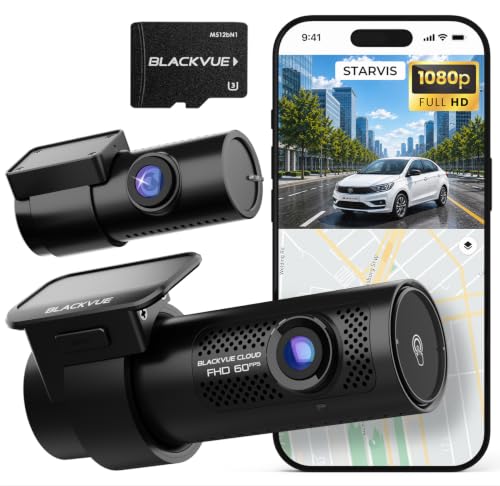
BlackVue has been making premium dash cams for over a decade, and the DR770X-2CH II reflects that experience. It’s the most polished hardware on this list. The front camera records Full HD at 60fps, giving you noticeably smoother footage than the standard 30fps most competitors offer at this resolution. The rear records at Full HD and 30fps. Both cameras use Sony STARVIS sensors, and the H.264 encoding delivers efficient, high-quality files that don’t eat through storage unnecessarily.
What sets BlackVue apart from the rest of this list is the cloud ecosystem. Through the BlackVue app and their cloud platform, you can remotely view live footage, get push notifications when the camera detects motion or an impact, track your vehicle’s GPS location, and access event recordings from anywhere with a cell signal. This works via a Wi-Fi hotspot on your phone or through the optional CM100G LTE module. For Arizona drivers who frequently leave vehicles in outdoor lots, having that remote monitoring capability is a meaningful upgrade over cameras that only record locally.
The DR770X-2CH II boots fast, which matters in Arizona because a slow-booting camera is useless if you get hit in the first 30 seconds after starting your car. The USB-C power connection makes cable management clean and straightforward. BlackVue’s mount system is tight and stable, and several long-term owners note their units have run without incident for four to six years, which speaks to the build quality. The supercapacitor handles power interruptions and heat without the reliability concerns of a battery-based design.
The main tradeoff here is resolution. At Full HD rather than 4K, the DR770X-2CH II delivers slightly less detail than the other cameras on this list. For most real-world situations that detail gap is minimal, but if maximum resolution is a priority, that’s worth knowing.
Key Specs:
- Resolution: Full HD 1080P at 60fps (front), 1080P at 30fps (rear)
- Sensors: Sony STARVIS (front and rear)
- Field of View: 120°
- Connectivity: Wi-Fi, built-in GPS, optional 4G LTE module
- Power: Built-in supercapacitor
- Storage: Up to 1TB microSD (not included)
- BlackVue Cloud enables true remote live view and push alerts
- Smooth 60fps front recording for clear footage at highway speeds
- Premium long-term reliability backed by years of proven performance
- Full HD only, not 4K like the other cameras on this list
- Cloud features and LTE access require additional hardware or subscription
Best Dash Cams for Arizona Heat: A Quick Rundown
- ROVE R2-4K: Best budget pick with true 4K video and supercapacitor heat tolerance
- 70mai A810S: Best dual-camera system with outstanding night vision and optional 4G remote access
- Vantrue E1 Pro: Best compact option with industry-leading plate recognition in a coin-sized body
- Vantrue N4S: Best for full coverage with three cameras covering every angle inside and outside the car
- BlackVue DR770X-2CH II: Best for cloud connectivity and long-term reliability from a proven premium brand
Final Thoughts
Buying a dash cam for Arizona is not the same as buying one for Seattle or Chicago. The heat is a real engineering constraint, and cameras that ignore it will let you down when you need them most. Every option on this list uses a supercapacitor instead of a lithium battery, which is the single most important specification for desert climates. Beyond that, the right choice comes down to how much coverage you need, how important remote access is to your situation, and what your budget allows.
Think about how your car is used before you decide. A rideshare driver needs cabin coverage. A driver who parks outside all day might prioritize remote monitoring. Someone who just wants simple, solid front protection doesn’t need to spend at the top of the range. Pick the camera that fits your actual driving life, and you’ll have footage that holds up whether it’s a fender bender on the freeway or a scammer in a parking lot trying to blame you for something you didn’t do.