Driving at night carries risks that don’t show up in daylight. Poor visibility, unpredictable drivers, and the simple fact that most accidents are harder to document after dark make a reliable dash cam one of the smartest things you can put in your car. The problem is that not every dash cam handles low light well. Some produce grainy, washed-out footage that’s useless when you actually need it.
That’s where night vision technology separates the good from the forgettable. We spent time researching the market, comparing sensor specs, testing real-world performance claims, and evaluating what drivers say after weeks of use. This guide covers five dash cams that genuinely deliver in the dark.
By the time you finish reading, you’ll know exactly which option fits your driving habits, your car setup, and your budget.
 `
`
How We Selected the Best Dash Cams for Night Vision
Our team approached this the same way we approach any product that has to perform under pressure: we started with the specs, then went deep into real-world driver feedback, and filtered out anything that looked good on paper but fell apart in practice.
- Sensor quality: The image sensor is the single biggest factor in night vision performance. We prioritized models using Sony STARVIS 2 technology, which captures significantly more light than older sensors.
- Dynamic range and HDR support: Night driving involves constant contrast between bright headlights and dark surroundings. We looked for dash cams with HDR or WDR processing that handles those extremes without blowing out highlights.
- Resolution front and rear: A clear front image means nothing if the rear camera is fuzzy. We evaluated overall resolution consistency across all channels.
- Aperture size: A wider aperture (lower f-number) lets in more light. We paid close attention to this spec when comparing low-light performance.
- Parking mode capability: Night incidents don’t only happen while driving. We considered how well each unit monitors your vehicle when it’s parked and unattended.
- Connectivity and ease of use: Footage is only useful if you can access it quickly. We factored in WiFi speed, app reliability, and general setup experience.
- Build quality and temperature tolerance: A dash cam that overheats or fails in winter is a liability. We looked for supercapacitor designs that hold up in extreme conditions.
Every pick on this list passed these filters. They’re not just spec-sheet winners. They’re the cameras that drivers keep recommending after months on the road.
Best Dash Cams for Night Vision (2026 Expert Review)
Five cameras made the cut. Each one brings something distinct to the table, from compact front-only options to full three-channel systems that cover every angle. Here’s a detailed breakdown of all five.
1. REDTIGER F7N Touch: The Everyday Night Driver’s Best Friend
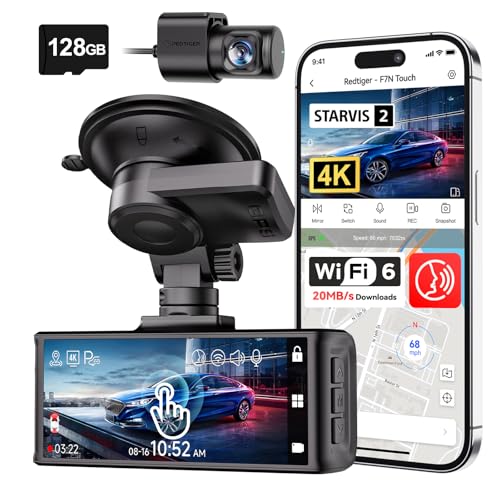
The REDTIGER F7N Touch is built around a Sony STARVIS 2 sensor paired with HDR and WDR processing, and the combination produces what REDTIGER calls “evidence-grade” footage. That’s a bold claim, but the results back it up. The front camera records in 4K at 2160p and handles headlight glare remarkably well, keeping license plates legible even during heavy rain at night.
The 3.18-inch touch screen makes this feel less like a driving gadget and more like a modern device. Navigation through menus is quick and intuitive, similar to using a smartphone. Hands-free voice control lets you lock emergency videos or toggle WiFi without taking your hands off the wheel, which is a genuine safety advantage.
Connectivity runs on 5.8GHz WiFi with transfer speeds up to 20MB per second. That matters when you want to pull a clip off the camera quickly. The included 128GB card means you can start recording immediately, with loop recording and the G-sensor working together to protect footage from being overwritten after an incident.
The F7N Touch also includes 24-hour parking protection via time-lapse and G-sensor modes, an adhesive suction mount with a built-in GPS module, and a supercapacitor for reliable performance in extreme heat. Installation is a straightforward DIY job, and the included pry tool makes hiding wires clean and professional-looking.
Key Specs:
- Front resolution: 4K (3840x2160p) / Rear: 1080P FHD
- Sensor: Sony STARVIS 2
- Screen: 3.18-inch touch screen
- WiFi: 5.8GHz (20MB/s transfer speed)
- Storage: 128GB card included, supports up to 512GB
- Aperture: f/1.8
- Sony STARVIS 2 sensor delivers sharp, clear night footage with strong license plate visibility
- Responsive touch screen and voice control make in-car operation genuinely hands-free
- Comes with a 128GB card and no subscription fees required
- Suction mount can lose grip on rough roads or in high heat
- Parking mode requires a separate hardwire kit purchase for 24/7 use
2. REDTIGER F17: The Triple-Angle Solution for Total Coverage

For drivers who want more than just front and rear coverage, the REDTIGER F17 adds a third camera inside the cabin. The front camera uses a STARVIS 2 IMX675 sensor with a 150-degree field of view, capturing 4K footage with strong dynamic range and low-light clarity. The interior and rear cameras each record in 1080p, giving you simultaneous coverage across 360 degrees of your vehicle.
What makes the F17 stand out at night is how the interior infrared illumination works alongside the front sensor. The four built-in IR lights mean the cabin camera stays useful even in complete darkness, which is a significant advantage for rideshare drivers or anyone who carries passengers regularly. The front camera’s STARVIS 2 sensor brings the same improved brightness and reduced motion blur you’d expect from the top-tier lineup.
The F17 supports two recording modes. You can run all three channels at once, or switch to a 4K front and 1080P rear setup if you don’t need the interior view, maximizing resolution detail when cabin coverage isn’t a priority. We found this flexibility genuinely useful rather than a gimmick.
Setup is clean and practical. The adhesive mount with built-in GPS holds firmly without suction issues, and the 5.8GHz WiFi connects quickly to the REDTIGER app for fast video transfers. The included 64GB card gets you started, though upgrading to a larger card is worth considering for longer trips.
Key Specs:
- Front resolution: 4K (2160p) / Interior and Rear: 1080P each
- Sensor: Sony STARVIS 2 IMX675 (front)
- Fields of view: 150° front, 160° cabin, 155° rear
- WiFi: 5.8GHz
- Storage: 64GB card included, supports up to 512GB
- Aperture: f/1.5
- Three-channel coverage gives complete front, interior, and rear visibility
- Four IR lights keep cabin footage clear even in full darkness
- Dual recording modes let you prioritize resolution when needed
- App WiFi connection can be inconsistent for some users
- 64GB included card fills quickly with three simultaneous channels recording
3. Vantrue E1 Pro: The Tiny Camera That Punches Well Above Its Size

The Vantrue E1 Pro is roughly the size of a one-dollar coin, and that compact design is one of its biggest selling points. Tucked behind the rearview mirror, it’s nearly invisible from the driver’s seat and completely unobtrusive while driving. Small size doesn’t mean compromised quality here: the E1 Pro uses an IMX678 sensor (8MP) with an f/1.8 aperture and a 158-degree lens to record in 4K at 30 frames per second.
Night vision performance is where this camera earns serious attention. The combination of STARVIS 2, PlatePix software, and HDR processing delivers footage that’s described by Vantrue as 50% clearer than standard 4K HDR. We found it particularly effective for license plate recognition at night, with the camera reportedly able to capture plates clearly at speeds up to 31mph in the dark. That’s a real differentiator if your main concern is capturing incident evidence after dark.
The E1 Pro also includes a buffered parking mode that records 15 seconds before and 30 seconds after motion is detected. Four parking mode options give you flexibility in how you protect the car when you step away. Starlight Night Vision technology specifically brightens and clarifies footage captured during parked monitoring, which is a thoughtful addition.
One thing to note: this is a front-only camera. There’s no rear lens. If you need rear coverage, the E1 Pro pairs well with a second unit or a separate rear camera, but that adds cost and complexity. The camera also runs warm during extended use, which is common with compact units of this class.
Key Specs:
- Front resolution: 4K (3840×2160) / 30FPS
- Sensor: Sony STARVIS 2 IMX678 (8MP)
- Screen: 1.54-inch IPS
- WiFi: 5GHz
- Storage: No card included, supports up to 1TB
- Aperture: f/1.8
- Coin-sized body hides easily behind the mirror with no view obstruction
- PlatePix technology significantly sharpens license plate capture at night
- Buffered parking mode records events before and after motion detection
- Front-only camera with no rear coverage included
- Can overheat during prolonged use in hot climates
4. VIOFO A229 Pro: The Premium Choice for Serious Night Recording
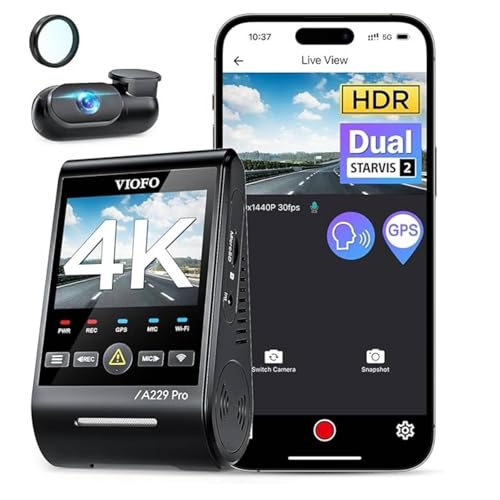
The VIOFO A229 Pro is the most technically ambitious dual-channel camera in this lineup. It uses two separate Sony STARVIS 2 sensors: an IMX678 for the front at 4K and an IMX675 for the rear at 2K. Both channels benefit from HDR processing, which is what VIOFO calls Night Vision 2.0. The result is that license plate recognition and detail retention stay strong front and rear, not just on the side facing traffic.
The Quad-Mode GPS module is another standout feature. It connects to four satellite systems simultaneously (GPS, BEIDOU, GALILEO, and GLONASS), giving you notably more accurate location and speed data than single-system alternatives. That precision matters in insurance disputes or legal situations where exact positioning and timing need to be verified.
Build quality is clearly a priority here. The supercapacitor handles temperatures from 5°F to 149°F, and the CPL filter included in the box reduces windshield glare from the front lens. The 6-meter rear cable is longer than what most competitors provide, which helps with clean installations in larger vehicles like SUVs or trucks. We also appreciate that the USB-C fast transfer capability lets you download footage directly from the camera without relying on WiFi alone.
The VIOFO A229 Pro does ask more of the buyer. No SD card is included, the app has a learning curve, and the price point is the highest in this lineup. It also does not include a three-way interior camera. But for drivers who prioritize dual-channel night vision quality above everything else, this camera sets the standard in its class.
Key Specs:
- Front resolution: 4K (2160p) / Rear: 2K (1440p)
- Sensors: Dual STARVIS 2 (IMX678 front, IMX675 rear)
- Screen: 2.4-inch LCD
- WiFi: 5GHz
- Storage: No card included, supports up to 512GB
- Aperture: Not specified (CMOS, 1/2.3″ sensor size)
- Dual STARVIS 2 sensors deliver HDR night vision for both front and rear channels
- Quad-Mode GPS provides precise location, speed, and route data
- CPL filter and 6-meter rear cable included for cleaner installation
- No SD card included, adding to the total purchase cost
- App interface has received mixed feedback from users
5. 70mai T800E: The Best Value for Three-Channel Night Coverage

The 70mai T800E brings three-channel recording at a price that undercuts most of its competition by a significant margin. The front camera shoots in 4K using an f/1.55 aperture, which is the widest in this entire lineup, letting in more light per frame than any other camera reviewed here. HDR imaging and 3D noise reduction handle contrast and clarity in low-light conditions, while the front lens covers a 125-degree field of view for a wide, usable image.
The interior camera is a genuine highlight. It features switchable infrared recording, so you can flip the IR on for dark cabin environments and off when you don’t need it. For rideshare drivers or parents who frequently transport passengers, this flexibility is practical and not just a checkbox feature. The rear camera records in 1080p and adds a third layer of coverage that rounds out the system.
WiFi 6 is the connectivity standard here, and it makes a noticeable difference in transfer speeds. The 70mai app pulls footage at up to 10MB per second, which is fast enough to grab a clip and review it in seconds after an incident. The built-in 5-mode GPS covers five satellite systems for accurate speed and route tracking. Voice control lets you manage recording commands without touching the unit.
The 70mai T800E comes with a 64GB card, a supercapacitor rated for use between 14°F and 140°F, and a rear camera cable all included in the box. The main limitation is that the parking mode requires a separately purchased hardwire kit, and the app has received mixed marks for connection stability. For the price, though, the overall package is hard to beat.
Key Specs:
- Front resolution: 4K / Interior: 1080P / Rear: 1080P
- Screen: 1.9-inch IPS
- Aperture: f/1.55 (widest in this lineup)
- WiFi: Wi-Fi 6
- Storage: 64GB card included, supports up to 512GB
- GPS: 5-mode satellite system
- f/1.55 aperture captures more light at night than any other camera in this group
- Switchable IR interior camera is perfect for rideshare and family drivers
- Wi-Fi 6 enables fast footage transfer through the 70mai app
- Parking mode requires a hardwire kit sold separately
- App connectivity can be inconsistent during active use
Best Dash Cams for Night Vision: A Quick Rundown
- REDTIGER F7N Touch: Best overall for night vision with a touch screen and voice control
- REDTIGER F17: Best for full 360-degree coverage with IR cabin recording
- Vantrue E1 Pro: Best compact front-only camera with PlatePix night clarity
- VIOFO A229 Pro: Best dual-channel system for premium front and rear night recording
- 70mai T800E: Best value three-channel option with the widest aperture in the group
Final Thoughts
Night vision in a dash cam comes down to three things: sensor quality, aperture, and how the camera processes difficult lighting. The best cameras on this list combine Sony STARVIS 2 sensors with HDR or 3D noise reduction to produce footage that holds up in court, on an insurance claim, or in a dispute with another driver. If you’re shopping based purely on what your camera will see after dark, those are the specs to prioritize.
Your choice should ultimately depend on what kind of coverage you need and how much you’re willing to invest. A rideshare driver needs interior coverage. A commuter in a large SUV benefits from a long rear cable and dual strong sensors. Someone who parks in unsecured areas at night needs a reliable parking mode. Match the camera to your life, pick the one that checks your boxes, and drive with more confidence knowing you’re covered.