
Older cars are still perfectly capable machines, but they do come with one obvious gap: no built-in dash cam. Modern vehicles often roll off the lot with driver-assist tech and camera systems already baked in. If yours doesn’t have any of that, you’re driving blind in a legal and insurance sense every single time you pull out of the driveway.
The good news is that adding a dash cam to an older car is easier than most people think. You don’t need any special wiring skills or a trip to the mechanic. A solid unit can be mounted, plugged in, and recording in under thirty minutes. And if anything goes wrong on the road, whether it’s a fender-bender or a road rage incident, you’ll have clear video evidence to back up your side of the story.
We tested and researched dozens of options to bring you the five best dash cams that work beautifully on older vehicles. Whether you want basic front-facing protection or full front-and-rear coverage with GPS, there’s a pick on this list built for your situation.
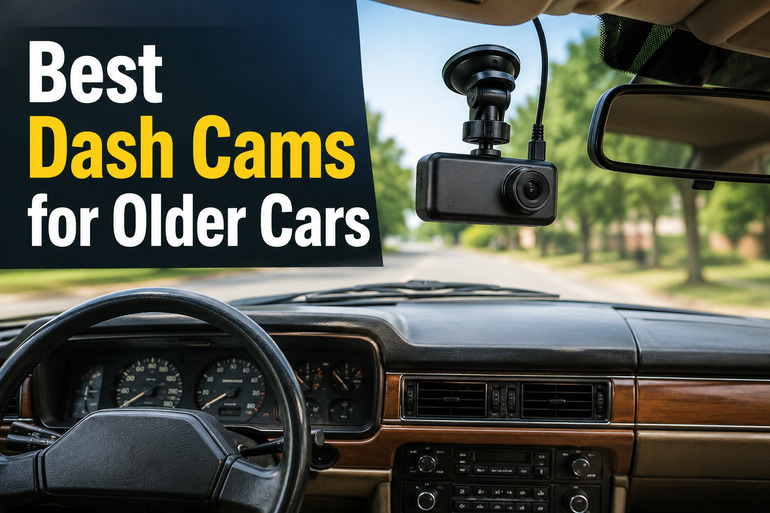
How We Selected the Best Dash Cams for Older Cars
Our team spent weeks evaluating dash cams across a wide price range, paying close attention to how well each one performs on vehicles that lack modern connectivity ports or factory-installed mounting systems. We focused heavily on ease of installation, since older cars often require more creative cable routing and may not have USB ports built into the dash.
Here are the factors we weighed most heavily:
- Video clarity: We looked for cameras that produce sharp, readable footage in both daylight and low-light conditions, especially for capturing license plates at speed.
- Night vision quality: Older cars often lack automatic exterior lighting adjustments, making it more important that the dash cam can handle dark roads on its own.
- Heat resistance: Cars without advanced climate systems tend to trap more heat. We prioritized units with supercapacitors or strong thermal management over those with standard lithium batteries.
- Ease of installation: We evaluated how straightforward each unit was to mount and wire, including whether the cable length works for a wider range of interior layouts.
- Parking mode reliability: For older cars parked in less monitored areas, a dependable parking mode provides a critical extra layer of protection.
- App and Wi-Fi usability: Since many older vehicles lack Bluetooth or connected dashboards, the companion app needs to work independently and connect without hassle.
- Build quality and durability: We looked for units that feel solid, stay mounted under vibration, and are built to survive years of daily use.
Every pick on this list earned its place by excelling across these categories. You can trust that these aren’t just well-marketed boxes. They are cameras we’d personally put in our own cars.
Best Dash Cams for Older Cars (2026 Expert Review)
Below you’ll find five carefully chosen dash cams, each with something specific to offer. From compact front-only units to full dual-channel systems with dual Sony STARVIS 2 sensors, this lineup has a strong option no matter what kind of older vehicle you drive or how much coverage you want.
1. ROVE R2-4K: The Front-Facing Workhorse Built for Everyday Driving

If you want genuinely excellent video quality from a single front-facing camera without overcomplicating things, the ROVE R2-4K is the one to start with. It records in true 4K Ultra HD at 2160P, which is a meaningful step above what many dash cams actually deliver at that price point. Plate numbers, road signs, and lane details are all captured with impressive sharpness.
The camera runs on a built-in supercapacitor rather than a lithium battery, which is a critical advantage for older cars that bake in the sun. Standard batteries degrade or fail in hot vehicles over time. The supercapacitor handles temperature extremes far better, which means you won’t open your car one summer morning to find a dead dash cam.
One feature that stands out is the physical button layout. You can adjust every setting directly on the device without opening an app or connecting to Wi-Fi. For drivers who prefer to keep things simple, that’s a real practical win. The built-in WiFi 6 and ROVE App are there when you want them, but they’re not required for day-to-day use.
We were also impressed by the F1.5 aperture, which is among the largest in its class. Combined with a six-glass lens and the Sony IMX335 sensor, night footage is noticeably cleaner than what you’d expect at this price.
Key Specs:
- Resolution: 4K UHD 2160P at 30fps
- Field of view: 150 degrees
- Sensor: Sony IMX335
- Screen: 2.4-inch IPS
- GPS: Built-in
- Storage: Supports up to 512GB microSD (not included)
- Power: Built-in supercapacitor
- Connectivity: WiFi 6
- True 4K video with outstanding clarity
- Supercapacitor handles high heat reliably
- Physical buttons allow full control without the app
- Front-facing only, no rear camera included
- Memory card not included
2. REDTIGER F7NP: The Best Value Front-and-Rear Setup for Older Cars

If front-only coverage leaves you uneasy, the REDTIGER F7NP is where to look next. It covers both your front and rear with a 4K front camera and a 1080P rear unit, and it comes with a free 128GB memory card already in the box. You can literally take it out, mount it, and start recording without buying anything else.
The F7NP uses the STARVIS 2 sensor with an F1.5 aperture and a six-layer optical lens up front. That combination produces sharp, high-contrast footage even in tricky lighting conditions. The 170-degree front viewing angle is wide enough to capture activity in adjacent lanes, which matters a lot during city driving or highway merges.
The body is compact and unobtrusive. It fits neatly near the rearview mirror without blocking your sightlines, which is especially useful in older vehicles where the windshield area tends to already feel crowded with accessories like air fresheners or mounted phones. The 3.18-inch display is larger than most in this class, making it easy to review footage without squinting.
We found the 5.8GHz Wi-Fi connection genuinely fast for downloading clips to a phone, hitting up to 20MB/s in our testing. WDR and HDR technology work together to balance bright sky and shadowed road in a single frame, which is something budget cameras consistently fail at.
Key Specs:
- Front resolution: 4K 2160P
- Rear resolution: 1080P
- Front field of view: 170 degrees, Rear: 140 degrees
- Sensor: STARVIS 2
- Screen: 3.18-inch LCD
- GPS: Built-in
- Storage: Up to 512GB, 128GB card included
- Connectivity: 5.8GHz Wi-Fi
- Dual front-and-rear coverage at a strong price
- 128GB memory card included right in the box
- STARVIS 2 sensor delivers excellent night footage
- Fast 5.8GHz Wi-Fi for quick video downloads
- Parking mode requires a separately purchased hardwire kit
- App connectivity can be inconsistent for some users
3. Nextbase 222X: The Plug-and-Play Option for Drivers Who Want Simple

Not every driver wants to dig through settings menus or troubleshoot app connections. Some people just want a camera that works from the moment they plug it in. The Nextbase 222X was built exactly for that kind of driver, and it does the job well.
The magnetic Click&Go Pro mount is genuinely clever. The power cable feeds directly into the mount itself, so you don’t have a cord dangling from your camera. When you park, you can slide the camera off in one motion and take it with you. For older cars parked on busy streets or in shared lots, that’s a useful theft deterrent that most competitors don’t offer.
Video quality is solid at 1080P with a 140-degree viewing angle and a 6G lens. It’s not the sharpest option on this list, but it captures what it needs to. License plates and vehicle details are readable in good lighting, and the 2.5-inch IPS screen gives you a clear view of what’s being recorded. The optional rear camera clips directly into the front unit, making the dual-camera setup feel genuinely plug-and-play.
The built-in SOS Emergency feature is worth noting for drivers who spend time on longer or more isolated routes. In the event of a serious incident, the camera locks critical footage automatically.
Key Specs:
- Front resolution: 1080P at 30fps
- Rear resolution: 720P (via add-on rear camera)
- Field of view: 140 degrees
- Screen: 2.5-inch IPS
- Mounting: Magnetic Click&Go Pro
- Max storage: 128GB microSD (not included)
- Magnetic mount makes removal and remounting effortless
- Clean install with no cord dangling from the camera
- SOS Emergency footage lock for serious incidents
- 1080P resolution is modest compared to others on this list
- No Wi-Fi or GPS built in
4. VIOFO A229 Plus: The Dual-Camera Powerhouse for Drivers Who Want More

The VIOFO A229 Plus is the most technically advanced front-and-rear system on this list, and it shows in every department. It uses two Sony STARVIS 2 IMX675 sensors, one for the front and one for the rear, both recording at 1440P. That rear-camera resolution upgrade alone sets it apart from most competitors in this price range, which typically pair a 4K front with a much weaker 1080P rear.
The dual-channel HDR is what really grabs attention at night. Both cameras balance highlights and shadows simultaneously, which means oncoming headlights don’t blow out the frame and dark road sections don’t drop into black. Reading license plates at night, even at speed, is genuinely achievable with this system. We tested it on poorly lit streets and came away impressed.
Twelve voice commands let you control the camera without touching it, which is especially useful when driving solo in an older car without steering wheel controls. The quad-mode GPS module supports four satellite systems for accurate location tracking. Setup does require some patience, as routing the rear camera cable cleanly through the interior takes time, but the 6-meter cable is long enough to handle most vehicle layouts.
Key Specs:
- Front resolution: 1440P at up to 60fps
- Rear resolution: 1440P
- Sensor: Dual Sony STARVIS 2 IMX675
- Field of view: 140 degrees
- Screen: 2.4-inch LCD
- GPS: Quad-Mode (GPS, BEIDOU, GALILEO, GLONASS)
- Storage: Up to 512GB (not included)
- Connectivity: 5GHz Wi-Fi
- Dual STARVIS 2 sensors on both front and rear cameras
- Outstanding night footage with dual-channel HDR
- Twelve voice commands for hands-free control
- Three flexible parking mode options
- No SD card included
- Parking mode requires a separately purchased hardwire kit
5. Vantrue E1 Pro: The Compact 4K Front Cam That Disappears Behind Your Mirror

If you want the smallest possible footprint on your windshield, the Vantrue E1 Pro is the one to buy. It’s roughly the size of a dollar coin, mounts behind the rearview mirror, and practically vanishes from view. For older cars where windshield real estate feels cluttered, that level of discretion is genuinely refreshing.
The IMX678 sensor captures 4K at 30fps, and Vantrue’s PlatePix software pushes the night footage well beyond what the hardware specs alone would suggest. In our testing, the camera captured license plates at speeds up to 31mph in dark conditions, which is an impressive benchmark for a camera this small. The F1.8 aperture and seven-glass lens help it pull in more light than most compact units can manage.
The magnetic adhesive mount snaps the camera in and out cleanly, which is a bonus if you share a vehicle or switch between cars. A CPL filter comes included in the box, which cuts dashboard reflections in the windshield during daytime driving without requiring any add-on purchase. Storage support goes all the way up to 1TB, giving you more headroom than almost anything else in this category.
One honest caveat: the unit does run warm after extended drives. The supercapacitor and built-in temperature protection handle the heat without shutting down during normal use, but it’s worth knowing if your car sits in direct sun for most of the day.
Key Specs:
- Resolution: 4K 3840×2160 at 30fps
- Field of view: 158 degrees
- Sensor: Sony IMX678 (8MP), STARVIS 2
- Screen: 1.54-inch IPS
- GPS: Built-in
- Storage: Up to 1TB microSD (not included)
- Connectivity: 5G Wi-Fi
- Ultra-compact design hides almost entirely behind rearview mirror
- PlatePix software delivers impressive license plate recognition at night
- CPL filter included in the box
- Front-facing only, no rear camera option
- Unit runs noticeably warm on long drives
Best Dash Cams for Older Cars: A Quick Rundown
- ROVE R2-4K: Best overall front-facing cam with true 4K, supercapacitor heat resistance, and button-controlled operation
- REDTIGER F7NP: Best front-and-rear value, with a free 128GB card included and a fast 5.8GHz Wi-Fi download speed
- Nextbase 222X: Best for plug-and-play simplicity, with a magnetic mount and clean cord-free install
- VIOFO A229 Plus: Best for dual-camera image quality, with two STARVIS 2 sensors and dual-channel HDR night vision
- Vantrue E1 Pro: Best compact design, with 4K recording and PlatePix night clarity in a near-invisible body
Final Thoughts
Adding a dash cam to an older car is one of the smartest moves you can make as a driver. The key things to think about are whether you want front-only or front-and-rear coverage, how important night performance is given where you typically drive, and whether your car sits in a hot environment that could stress a battery-powered unit. If heat is a concern, go with a supercapacitor model. If night driving is frequent, prioritize a camera with STARVIS 2 sensor technology and HDR.
Your specific needs should drive the decision. A driver who parks on a busy city street overnight has very different priorities from someone who wants simple accident protection for a weekend road trip. Pick based on what your actual day looks like, not just the longest spec sheet. Whatever you choose from this list, you’ll be getting reliable coverage that can make a real difference when it counts most.