
You’re standing in the parking lot, arms full of groceries, and your Nissan Pathfinder key fob decides to stop working. You press the unlock button once, twice, three times. Nothing happens. Your SUV just sits there, locked and silent.
This frustrating situation happens to more Pathfinder owners than you might think. Whether your key fob stopped working suddenly or has been acting up for a while, there are several reasons why it might fail. The good part is that most of these issues have simple fixes you can handle yourself without spending hundreds at the dealership.
In this article, you’ll learn exactly why your Pathfinder’s key fob stops responding, what causes these failures, and how to fix them step by step.
What Happens When Your Key Fob Stops Working
Your Nissan Pathfinder’s key fob is a small electronic device that communicates with your vehicle through radio frequencies. When you press a button, the fob sends a coded signal to your car’s receiver module. This tells your Pathfinder to lock, unlock, open the trunk, or trigger the panic alarm.
When this system fails, you lose convenient remote access to your vehicle. You’ll need to manually unlock your door with the physical key hidden inside the fob. That means no remote start on cold mornings, no trunk release from a distance, and the awkward fumbling with a traditional key that you probably haven’t used in months.
A dead key fob can also trigger your car’s anti-theft system in unexpected ways. Some Pathfinder models might not recognize the fob even when you’re inside the vehicle, preventing you from starting the engine. Your dashboard might display warning messages about the key not being detected.
Beyond the inconvenience, a malfunctioning key fob can be a safety concern. If you need to quickly unlock your car in an emergency or activate the panic button, a non-responsive fob leaves you vulnerable. The sooner you identify and fix the problem, the better.
Nissan Pathfinder Key Fob Not Working: Likely Causes
Several things can cause your Pathfinder’s key fob to stop functioning properly. Let’s look at what typically goes wrong and why these failures happen.
1. Dead or Weak Battery
The most common reason your key fob stops working is a dead battery. These small coin-shaped batteries typically last between two to four years, depending on how often you use your fob. Every button press drains a tiny amount of power.
You might notice warning signs before the battery dies completely. Your fob’s range decreases first. Maybe you used to unlock your car from 30 feet away, but now you need to stand right next to it. The buttons might also respond inconsistently, working sometimes but not others.
Temperature extremes speed up battery drain. If you live somewhere with harsh winters or scorching summers, your key fob battery might die sooner than expected. The battery slowly loses its charge over time, even when you’re not using the fob.
2. Damaged Key Fob Buttons or Internal Components
Physical damage is another frequent culprit. Your key fob takes a beating. You drop it on concrete, sit on it, or accidentally throw it across the room while tossing your keys. These impacts can crack the circuit board inside or damage the rubber buttons.
Water damage ruins key fobs quickly. A trip through the washing machine, a spill from your coffee cup, or even heavy rain can seep into the fob’s casing. Once moisture reaches the electronic components, corrosion starts. The metal contacts oxidize, and the circuits stop conducting electricity properly.
Sometimes the buttons themselves wear out. The rubber pads under each button deteriorate from repeated pressing. They lose their springiness and stop making proper contact with the circuit board beneath them.
3. Signal Interference or Range Issues
Electronic interference can block your key fob’s signal. Your Pathfinder’s receiver operates on a specific radio frequency, and other devices can create noise on that same frequency. Cell phone towers, radio stations, power lines, and even other vehicles can generate interference.
Certain locations are worse for signal problems. Large metal buildings, underground parking garages, and areas near airports or military bases often have more electronic noise. If your key fob works fine at home but fails in specific locations, interference is probably the issue.
Your fob’s antenna might also be damaged. There’s a small wire inside the fob that transmits the signal. If this wire breaks or becomes disconnected, your effective range drops dramatically or disappears entirely.
4. Unprogrammed or Desynchronized Fob
Your key fob and your Pathfinder communicate using encrypted codes that change with each use. This security feature prevents thieves from copying your signal. Sometimes these codes fall out of sync, and your vehicle stops recognizing your fob as legitimate.
This desynchronization often happens if you press the key fob buttons repeatedly when you’re far away from your vehicle. After multiple presses outside of range, the fob’s internal counter gets too far ahead of your car’s receiver. They’re no longer speaking the same language.
A new or replacement key fob needs programming before it works. If you recently got a spare key or replaced a lost fob, it won’t function until the car’s computer learns its unique code.
5. Problems with the Vehicle’s Receiver Module
Sometimes the problem isn’t with your key fob at all. Your Pathfinder has a receiver module that picks up the fob’s signals. This module can fail due to blown fuses, corroded wiring, or internal electronic failures.
A blown fuse cuts power to the receiver completely. Your fob sends its signal, but nothing in the car is listening. Checking your vehicle’s fuse box might reveal a popped fuse that needs replacement.
The receiver module’s antenna, usually located near the rear window or under the dashboard, can also fail. Rodents sometimes chew through wiring, or connectors corrode over time, especially in humid climates.
Nissan Pathfinder Key Fob Not Working: How to Fix
Fixing your Pathfinder’s key fob problem usually doesn’t require a mechanic. Here’s how to troubleshoot and repair the most common issues yourself.
1. Replace the Key Fob Battery
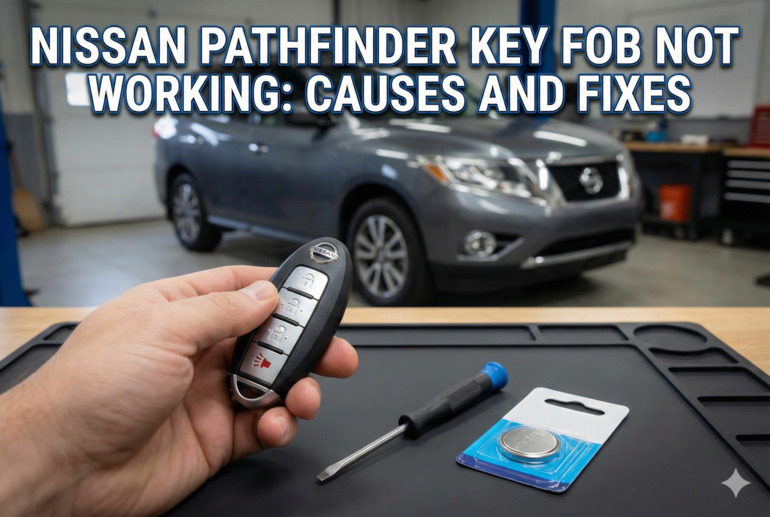
Start with the simplest fix: changing the battery. You’ll need a small flathead screwdriver and a new CR2032 battery (check your owner’s manual to confirm the exact type for your model year).
Look for a small slot on the edge of your key fob. Gently insert the screwdriver and twist to pop the fob apart. You’ll see the battery inside, held by a small clip. Note which side faces up (usually the side with writing). Remove the old battery and insert the new one in the same orientation.
Snap the fob back together and test all the buttons. If this fixes your problem, you’re done. Keep a spare battery in your glove box so you’re prepared next time. Most auto parts stores and pharmacies sell these batteries for just a few dollars.
2. Clean the Key Fob’s Internal Components
If a new battery doesn’t help, moisture or dirt might be interfering with the electronics. Open your key fob the same way you did for the battery replacement. Remove the battery and set it aside.
Examine the circuit board for any visible corrosion, which looks like white or green crusty deposits on the metal contacts. Use a cotton swab dipped in rubbing alcohol to gently clean these areas. Let everything dry completely before reassembling. Even a tiny amount of moisture left inside can cause problems.
Check the rubber button pads too. Sometimes dirt builds up underneath them. Wipe them clean with a slightly damp cloth and make sure they’re properly aligned when you put the fob back together. The buttons need to sit exactly over their corresponding contacts on the circuit board.
3. Reprogram or Resynchronize Your Key Fob
Your key fob might just need reprogramming. The exact steps vary by model year, but here’s a common method that works for many Pathfinders. Get inside your vehicle and close all doors.
Insert your key into the ignition and remove it six times within ten seconds. Your hazard lights should flash if you’ve entered programming mode. Now press any button on your key fob. The lights should flash again, confirming the fob is programmed.
Exit programming mode by turning the ignition to the ON position (without starting the engine) or by opening the driver’s door. Test your key fob to see if it now works. If this method doesn’t work for your specific model year, your owner’s manual should have the correct procedure. Some newer models require a different sequence.
4. Check and Replace Blown Fuses
A blown fuse can disable your Pathfinder’s keyless entry system entirely. Your vehicle has two fuse boxes: one under the hood near the battery, and another inside the cabin, usually under the dashboard on the driver’s side.
Consult your owner’s manual to find which fuse controls the keyless entry or body control module. Pull that fuse using the small plastic fuse puller usually stored in the fuse box. Hold it up to the light. If the metal strip inside is broken or melted, the fuse is blown.
Replace it with a new fuse of the exact same amperage (the number is printed on top of the fuse). Never use a higher amperage fuse as a substitute. That can damage your vehicle’s electrical system. After replacing the fuse, test your key fob again.
5. Inspect for Physical Damage
Take a close look at your key fob’s exterior. Cracks in the plastic case let moisture inside. Even hairline fractures can be problematic. If you spot damage, you can buy replacement cases online for most Pathfinder models.
Replacing the case involves transferring the circuit board and battery to the new housing. Be gentle during this process. The circuit board is fragile. Make sure all the rubber button pads align correctly with their holes in the new case.
If you see obvious damage to the circuit board itself, like cracked components or broken traces (the thin lines connecting different parts), you’ll probably need a new key fob. The circuit board is too delicate to repair without specialized equipment.
6. Test with a Spare Key Fob
If you have a second key fob for your Pathfinder, test it. This tells you immediately whether the problem is with the fob itself or with your vehicle’s receiver system. If the spare works perfectly, your original fob is definitely the issue.
When both fobs fail, the problem is almost certainly in your vehicle. That points to a blown fuse, bad receiver module, or wiring problem. You’ve now narrowed down where to focus your troubleshooting efforts.
Having a spare fob also gives you a working backup while you fix or replace the faulty one. You won’t be stuck manually unlocking your car in the meantime.
7. Contact a Qualified Automotive Locksmith or Nissan Dealership
If none of these fixes work, it’s time to call in a professional. A qualified automotive locksmith or your Nissan dealership has the diagnostic equipment to identify deeper problems. They can test your key fob’s signal strength, check your vehicle’s receiver module, and program new fobs if needed.
Dealerships charge more but guarantee that replacement parts are genuine Nissan components. Locksmiths often cost less and can come to your location. Either option beats being stranded with a non-working key fob. Get quotes from both before deciding.
Wrapping Up
A non-working key fob on your Nissan Pathfinder is frustrating, but it’s usually something you can fix yourself. Dead batteries account for most failures, and swapping in a new one takes just a few minutes. Cleaning corroded contacts or reprogramming the fob solves many other common problems.
When simple fixes don’t work, the issue might be in your vehicle’s electrical system rather than the fob itself. That’s when professional help makes sense. Either way, you now know exactly what to check and how to get your key fob working again.