
When your Hyundai Tucson’s air conditioner stops cooling, the vents may still blow strongly while the cabin stays hot. In other cases, airflow becomes weak, the fan stops altogether, or the system cools only while driving. These symptoms can point to very different faults, so replacing parts at random can waste money.
Start by separating an airflow problem from a cooling problem, then use the checks below to identify what you can safely inspect and when a technician is needed.
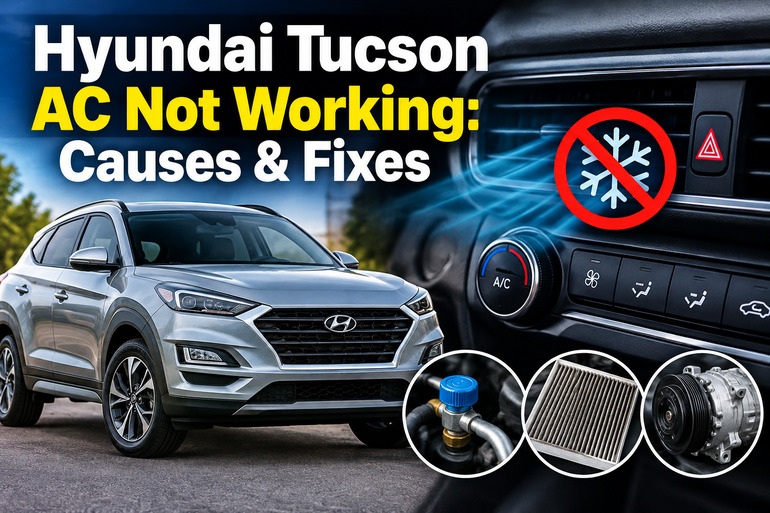
What It Means When Your Hyundai Tucson AC Stops Working
Your Hyundai Tucson’s air conditioning system removes heat from the cabin and releases it outside the vehicle. The compressor circulates refrigerant through the system, the condenser releases heat, and the evaporator absorbs heat from the air passing through the dashboard vents. The blower motor pushes that air into the cabin.
When any of these components fails, you may notice warm air, weak airflow, unusual noises, or a complete loss of cooling. A system that blows plenty of air at room temperature has a different likely fault from one that barely moves air through the vents.
The timing of the problem also matters. If the AC cools the cabin while driving but becomes warm when the Tucson is stationary, poor condenser airflow or a cooling fan problem may be involved. If cooling is inconsistent in both situations, refrigerant loss, compressor trouble, or an electrical fault deserves attention.
Some issues are easy to address, such as an incorrect climate control setting or a clogged cabin air filter. Others require specialized equipment to diagnose. Both insufficient and excessive refrigerant can reduce cooling performance, and the correct refrigerant specification must be used for your particular vehicle. You can find the relevant details on the refrigerant label under the hood and in your Tucson owner’s manual.
Hyundai Tucson AC Not Working: Likely Causes
Several faults can produce similar AC symptoms, but the clues often help narrow the possibilities. The five causes below cover the main systems to consider before spending money on repairs.
1. Low Refrigerant From a Leak
Low refrigerant is a common reason a Hyundai Tucson AC blows warm air. Refrigerant circulates through a closed system, absorbing heat inside the cabin and releasing it outside. When some escapes through a damaged hose, worn seal, leaking condenser, or another faulty connection, the system may struggle to remove enough heat.
You might notice that the AC takes longer than usual to cool the cabin, becomes less effective in hot weather, or stops producing cold air altogether. Sometimes the cooling works intermittently as the operating conditions change.
Refrigerant does not normally get consumed like engine oil or fuel. If the level is low, a leak or an earlier servicing problem may be responsible. Simply adding more refrigerant can restore cooling temporarily, but an unresolved leak allows the problem to return. Both undercharging and overcharging can affect performance.
2. A Faulty AC Compressor
The compressor circulates refrigerant through the air conditioning system. If it fails mechanically or cannot operate because of an electrical or control problem, the refrigerant may not circulate properly, leaving the vents blowing warm air.
Possible symptoms include cooling that never starts, intermittent cooling, unusual rattling or grinding noises, or a change in engine behavior when the AC is activated. However, these signs do not prove that the compressor itself has failed.
The exact design depends on the Tucson’s model year and powertrain. Some systems use a conventional compressor with an electromagnetic clutch, while other configurations use electronically controlled compressors. Hybrid models can have electrically driven compressors that require different diagnostic procedures.
A technician should establish whether the compressor is receiving the correct operating command and whether the refrigerant pressures indicate a mechanical problem. Replacing the compressor without checking its electrical supply, refrigerant charge, and associated components can lead to unnecessary expense.
3. A Blown Fuse or Electrical Control Fault
Your Tucson’s AC depends on electrical power and control signals. Depending on the model, these involve fuses, relays, pressure sensors, compressor controls, wiring, and the climate control module.
A blown fuse can prevent the compressor or blower motor from operating. A failed sensor or damaged wire may stop the compressor from engaging even when the dashboard AC indicator illuminates. Faults in the climate control panel can also prevent the system from responding properly to your settings.
The symptoms depend on which circuit is affected. If the blower works but the air remains warm, the compressor control circuit may be involved. If the vents produce no airflow at any fan speed, the blower’s power supply, motor, or associated controls deserve attention.
Hyundai provides different fuse configurations across its vehicles and model years. The fuse panel diagram identifies the relevant fuse names and ratings, but the layout may vary between vehicles. Always check the label fitted to your own Tucson before attempting a fuse replacement.
4. A Dirty Condenser or Faulty Cooling Fan
The condenser releases heat from the refrigerant as it passes through the front of the vehicle. It needs adequate airflow to perform this job effectively.
Leaves, dust, insects, and other debris can collect on the condenser fins and restrict airflow. A damaged or malfunctioning cooling fan can create a similar problem, particularly when the vehicle is stationary and receives little airflow from movement.
One recognizable clue is an AC that cools reasonably well on the highway but becomes noticeably warmer in slow traffic. The compressor may still be operating, yet the condenser cannot release heat efficiently enough to maintain good cooling.
A dirty condenser does not automatically mean it needs replacement. External debris, damaged fins, a faulty fan, and problems elsewhere in the refrigerant circuit require different solutions. A visual inspection can reveal obvious blockage, while fan operation and refrigerant pressures need a more careful assessment.
5. Restricted Airflow or a Temperature Control Fault
Sometimes your Tucson’s AC system may be producing cold air, but the cabin does not receive enough of it. A dirty cabin air filter can restrict airflow through the vents, particularly after extended use in dusty conditions.
A failing blower motor can produce weak airflow, work intermittently, or stop entirely. If the airflow becomes unusually weak across all vents, the filter and blower system are worth checking before assuming the compressor has failed.
A separate possibility is a faulty temperature blend door or its actuator. This mechanism controls how air passes through the heating and cooling sections of the HVAC system. If the door sticks or the actuator fails, warm air may enter the cabin even when the AC system is cooling properly.
You may notice that one side of a dual-zone Tucson stays warm while the other side cools, or that changing the temperature setting produces little or no difference. Such symptoms can point to an air-mixing problem rather than a refrigerant leak. A cabin air filter should also be checked when airflow falls, especially if the change is sudden.
Hyundai Tucson AC Not Working: How to Fix
Begin with the simple checks that do not involve opening the refrigerant circuit or dismantling dashboard components. These steps can resolve minor problems and help you give a technician more useful information if the fault persists.
1. Check the Climate Control Settings
Before inspecting components, confirm that the AC is switched on and the temperature is set low enough to request cooling.
Start the engine or put the vehicle in the operating mode specified for your model. Set the temperature to its lowest setting, select the AC function, and increase the fan speed to a moderate or high level. If your Tucson has a recirculation setting, activate it once the cabin has begun cooling.
Make sure you have selected the intended vents. On a dual-zone model, check both temperature settings, as the driver and passenger sides may be set differently. Compare the airflow and temperature from the vents after allowing the system a few minutes to operate.
If the air becomes cold after correcting the settings, you may not need a repair. However, if the controls respond normally but the vents continue blowing warm air, move on to the next checks. Do not assume that an illuminated AC indicator proves the compressor is operating.
2. Inspect or Replace the Cabin Air Filter
A clogged cabin air filter can reduce the amount of air entering the passenger compartment. Replacing it may restore normal airflow when the filter is the cause.
Consult your owner’s manual to find the filter and confirm the correct replacement part. Many Tucson versions have the filter behind the glove box, although its location can vary by model and design.
With the vehicle switched off, remove the filter according to the model-specific instructions. Check whether it is heavily coated in dust, packed with leaves, or otherwise obstructed. Replace it if it is dirty or damaged, ensuring that the airflow direction matches the markings on the new filter.
After installation, run the blower at several speeds. You should notice improved airflow if the old filter was restricting it. If air remains weak, or if the airflow suddenly dropped without an obvious filter problem, the blower motor, evaporator, or another part of the ventilation system may need professional inspection.
3. Check the Relevant AC Fuse
A blown fuse can interrupt power to part of the air conditioning system. Checking the fuse is a reasonable DIY step if you can safely access the fuse panel and follow your vehicle’s manual.
Park the Tucson, switch off the ignition, and identify the relevant fuse using the diagram on the fuse panel cover or in the owner’s manual. Do not rely on a fuse diagram for a different model year, market, or powertrain.
If the manual permits owner inspection, remove the identified fuse using an appropriate fuse puller and examine it for a broken internal element. Replace a damaged fuse only with one of the same specified amperage. Never install a higher-rated fuse, bridge the circuit, or bypass a fuse to force the AC to operate.
If the replacement fuse blows again, stop replacing it and arrange a professional inspection. A recurring failure suggests an electrical fault that needs diagnosis. Avoid touching exposed wiring or attempting electrical repairs around hybrid high-voltage equipment.
4. Inspect the Front of the Condenser for Blockages
Leaves, insects, and road debris can obstruct the condenser, reducing its ability to release heat. A basic visual inspection may identify an obvious problem without requiring you to remove vehicle components.
Park on a level surface, switch off the engine, and allow the vehicle to cool. Look through the front grille for significant debris covering the heat exchanger. Do not place your hands near cooling fans, since their operation can be automatic on some vehicles and they may start unexpectedly.
If loose debris is visible and accessible, remove it only where you can do so safely without bending the delicate fins or damaging surrounding parts. Avoid forceful pressure washing, sharp tools, or removing parts of the front assembly without the correct instructions.
If the condenser appears clean but the AC still works poorly in traffic, a cooling fan fault or refrigerant pressure problem may be responsible. Those checks require more than a visual inspection. A qualified technician can establish whether the condenser, fan, or another component is causing the loss of cooling.
5. Compare Airflow and Temperature Across the Vents
The pattern of the symptoms can help narrow the fault before you authorize a repair. Run the AC with the temperature set low, then compare the airflow and temperature at the different vents.
If airflow is strong but the air remains warm everywhere, the refrigerant circuit, compressor, condenser, or its controls may be involved. If airflow is weak at every vent, concentrate on the cabin filter, blower motor, and airflow path.
On a Tucson equipped with dual-zone climate control, compare the driver and passenger sides. A marked difference between the two sides can suggest a blend door actuator or related temperature control fault. You can also change the fan speed and vent selection to see whether the system responds.
These observations are useful diagnostic clues, not definitive tests. Do not remove dashboard trim or force the temperature control mechanism if it appears stuck. If the settings change but the vent temperature does not respond appropriately, arrange an HVAC inspection.
6. Contact a Qualified Automotive AC Technician
If the checks above do not restore cooling, professional diagnosis is the next step. The same symptom can result from a refrigerant leak, a compressor problem, a blocked condenser, an electrical fault, or a malfunctioning temperature control mechanism.
Ask the technician to test the system rather than immediately replacing the compressor or adding refrigerant. Appropriate checks may include measuring refrigerant pressures, testing for leaks, reading relevant diagnostic trouble codes, checking compressor commands and cooling fan operation, and assessing temperature control actuators.
Refrigerant handling requires suitable recovery and charging equipment. The correct refrigerant and specified quantity must be identified from your vehicle’s label and service information. Incorrect refrigerant quantity or compressor lubricant can reduce performance or cause damage.
If you hear grinding noises, notice smoke or a burning electrical smell, or observe overheating, switch off the AC and stop driving if the vehicle shows signs of an unsafe condition. Seek qualified help rather than continuing to operate the system.
Wrap-Up
When your Hyundai Tucson AC stops working, start by identifying whether the problem involves warm air, weak airflow, or a complete loss of operation. That distinction helps narrow the likely cause and prevents you from replacing parts unnecessarily. Simple checks involving climate control settings, the cabin air filter, and the correct fuse can sometimes resolve the issue.
If those checks fail, arrange a proper diagnosis before adding refrigerant or buying replacement components. Early attention to unusual symptoms can help prevent further damage and restore reliable cooling.