Cast iron engines are workhorses. Whether you’re running a classic truck, an older muscle car, or a heavy-duty workhorse that still hauls every day, keeping the cooling system in top shape isn’t optional. The wrong antifreeze can cause rust, clog passages, and quietly destroy an engine that was built to last a lifetime.
Picking the right coolant for a cast iron block is trickier than it looks. Not every antifreeze handles iron well. Some formulas are tuned for modern aluminum-heavy engines and can actually accelerate corrosion in older systems. That’s a problem worth taking seriously before you pour anything into the radiator.
We put together this guide to take the guesswork off your plate. You’ll find five proven antifreeze options, clear breakdowns of what each one does well, and enough detail to walk into a purchase with full confidence.
How We Selected the Best Antifreeze for Cast Iron Engines
Our team spent significant time evaluating coolant products specifically through the lens of cast iron engine compatibility, not just general performance. We looked at OEM specifications, inhibitor chemistry, and real-world application to build a shortlist you can trust.
Here’s what we weighed during our evaluation:
- Cast Iron Corrosion Protection: Whether the formula actively protects ferrous metals against rust and pitting, which is the primary concern in cast iron cooling systems.
- Inhibitor Technology: The type of additive package used (IAT, OAT, or HOAT) and how each performs across different engine metals over time.
- Temperature Range: Freeze protection and boil-over protection thresholds, since extremes in either direction can cause serious engine damage.
- Compatibility: Whether the coolant works across multiple makes, models, and coolant colors without causing chemical reactions or sludge.
- Ease of Use: Pre-mixed 50/50 formulas save time and remove the risk of improper dilution with hard tap water.
- Service Life: How long the coolant remains effective before needing a flush, which matters for both performance and cost over time.
- Brand Credibility: Track record, OEM approvals, and field-tested reputation in the automotive community.
Every product on this list earned its spot by performing well across multiple factors, not just one. These aren’t filler picks.
Best Antifreeze for Cast Iron Engines (Expert Ranking & Review)
The five products below represent the strongest options available for cast iron engine owners in 2026. Each review covers what makes the product worth your attention, who it suits best, and where it has the edge.
1. Valvoline Multi-Vehicle 50/50 Ready-to-Use Antifreeze Coolant: The Reliable All-Rounder
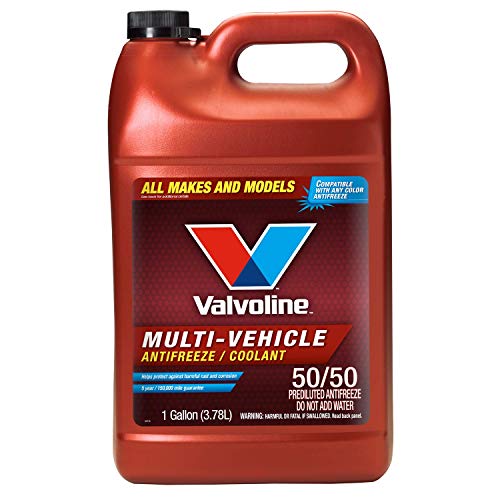
Valvoline has been in the engine fluid business for well over 150 years, and this coolant reflects that depth of experience. The Multi-Vehicle formula is built on ethylene glycol and comes pre-mixed to a 50/50 ratio using deionized water. That means you open it and pour it. No measuring, no guessing, no risk of diluting with tap water that can introduce minerals into your system.
What gives this product its edge with cast iron engines is Valvoline’s patented Alugard Plus additive. Despite the name, this inhibitor does more than protect aluminum. It actively fights corrosion, scaling, and rust across all cooling system metals, including cast iron. We found that the formula’s protection against deposits keeps passages cleaner over time, which matters a great deal in older iron blocks that may already have some buildup.
The pre-mixed yellow formula protects against winter freezing down to -34°F and summer boil-over up to 265°F. That’s a wide operating window that covers most driving conditions. It also meets ASTM D3306, the standard specification for ethylene glycol-based coolants in passenger vehicles and light trucks.
One thing worth noting is that this formula is compatible with all ethylene glycol-based coolants, regardless of color. So if you’re topping off a system that had a different brand previously, you’re not creating a chemistry problem.
Key Specs:
- Mix Ratio: 50/50 pre-mixed (ready to use)
- Freeze Protection: Down to -34°F
- Boil Protection: Up to 265°F
- Meets: ASTM D3306
- Volume: 1 gallon
- Patented Alugard Plus inhibitor fights rust, scaling, and corrosion across all metals
- No mixing required; deionized water already included
- Compatible with all ethylene glycol coolant colors and types
- Slightly higher cost than basic generic options
- Single-gallon size may require multiple purchases for full system flushes
2. Mopar 68163849AB 10 Year/150,000 Mile Coolant: The OEM Standard for Chrysler, Dodge, and Jeep Owners
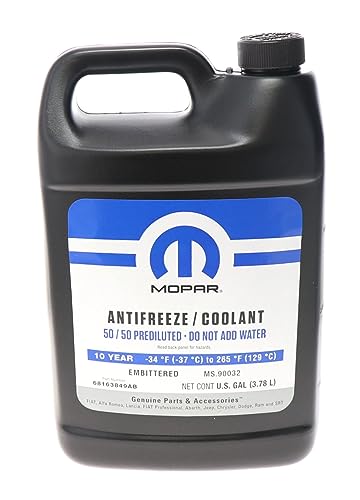
If you own a Chrysler, Dodge, Jeep, Ram, or Alfa Romeo product and your engine has a cast iron block, this is the coolant your manufacturer put in the system from day one. Mopar’s OAT (Organic Acid Technology) formula is the factory-fill coolant for a wide range of FCA vehicles, and buying it here gives you OEM-grade protection at a significantly lower price than the dealership charges.
The 10-year or 150,000-mile service interval is one of the longest in this category. OAT chemistry relies on organic corrosion inhibitors that deplete more slowly than the silicates found in traditional green coolants. That translates to longer-lasting protection, which is particularly valuable in cast iron engines where rust is a constant, low-level threat. We found the formula consistent and predictable, which is exactly what you want when dealing with an engine that has tight cooling passages.
This coolant comes factory-mixed at 50/50 and is ready to pour straight in. It’s been embittered with a denatonium benzoate agent to discourage accidental ingestion by children or pets. The temperature window matches up with most North American driving conditions, running from -34°F on the cold end to 265°F before boil-over sets in.
Key Specs:
- Technology: OAT (Organic Acid Technology)
- Mix Ratio: 50/50 pre-mixed
- Service Life: 10 years or 150,000 miles
- Temperature Range: -34°F to 265°F
- Volume: 1 gallon
- Genuine OEM product for FCA vehicles; no compatibility guesswork
- Industry-leading 10-year service life
- Organic acid inhibitors provide steady, long-lasting iron and aluminum protection
- Best suited for FCA vehicles; less ideal as a universal option for mixed garages
3. PEAK All Vehicles 50/50 Prediluted Antifreeze and Coolant: The Maximum Coverage Pick

PEAK is a brand that has built its reputation on coverage. This particular formula is engineered to work in virtually any passenger car, SUV, motorcycle, or light to medium duty truck regardless of make, model, or year. For cast iron engine owners who run multiple vehicles or who work on a variety of machines, that kind of flexibility is genuinely useful.
The formula is pre-diluted at 50/50 and is compatible with all coolant colors and technologies, meaning it won’t cause problems if you’re mixing into a system that previously held a different type. PEAK claims protection for over 10 years or 300,000 miles, which puts it firmly in the extended-life category. The inhibitor package immediately begins protecting all cooling system metals on contact, including aluminum and cast iron, against rust and corrosion from the very first start.
The 1-gallon jug is practical for top-offs and full system fills alike. Freeze protection runs to -34°F, and boil protection holds up to well above normal operating temperatures. We found the formula to be consistent with its advertised specs, and the absence of mixing steps makes it easy to get right the first time.
For someone who wants a single coolant they can rely on across multiple vehicles without needing to buy different formulas for different machines, PEAK All Vehicles earns its spot with a genuinely universal approach.
Key Specs:
- Mix Ratio: 50/50 pre-diluted
- Freeze Protection: Down to -34°F
- Service Life: 10+ years or 300,000+ miles
- Compatible With: All North American, Asian, and European passenger cars, SUVs, motorcycles, and light to medium duty trucks
- Volume: 1 gallon
- True universal compatibility across makes, models, and coolant technologies
- Exceptional claimed service life of 300,000+ miles
- Immediate protection of all cooling system metals upon first use
- Universal formulas may not meet specific OEM chemistry requirements for some vehicles
- Less specialized than OEM-matched options for high-demand applications
4. Zerex Original Green Low Silicate 50/50 Antifreeze/Coolant: The Right Choice for Older Cast Iron Engines

Zerex is Valvoline’s OEM-focused coolant brand, and the Original Green formula is specifically designed for older cast iron-heavy engines. This is the coolant that General Motors, Ford, Chrysler, Hyundai, Kia, Nissan, Mazda, and others originally specified for vehicles that call for a low silicate, green IAT (Inorganic Additive Technology) formula. If your cast iron engine falls into that camp, this is the correct chemistry.
The IAT inhibitor package uses inorganic additives, primarily silicates and phosphates, to protect metal surfaces. In older cooling systems that were designed around this technology, switching to a modern OAT formula without a full flush can cause incompatibility issues. Zerex Original Green sidesteps that problem entirely. It was built for these engines, and we found it performs reliably in systems where other coolants would require a complete flush first.
The formula is prediluted at 50/50, so there’s no mixing required. It provides freeze protection down to -34°F and contains low silicates with no borates, 2-EHA, amines, or nitrites. Those exclusions matter because certain additives can cause deposit buildup or foam in older cooling passages.
For owners of classic cars, older trucks, and vintage machines with original cast iron blocks, Zerex Original Green is the most historically accurate choice on this list.
Key Specs:
- Technology: IAT (Inorganic Additive Technology)
- Mix Ratio: 50/50 prediluted
- Freeze Protection: Down to -34°F
- Formulated For: Older GM, Ford, Chrysler, Hyundai, Kia, Nissan, Mazda vehicles
- Volume: 1 gallon
- Purpose-built IAT formula for older cast iron-dominated cooling systems
- Low silicate content with no borates, amines, or nitrites
- Compatible with older systems without requiring a full flush in most cases
- Not designed for modern vehicles with heavy aluminum content
- Shorter effective service life compared to OAT-based formulas
5. EVANS Cooling Systems EC53001 High Performance Waterless Engine Coolant: The Premium Long-Game Investment

EVANS takes a completely different approach from every other product on this list. Where all the others use water as a base fluid, EVANS is waterless by design. That single distinction changes the entire performance profile of the coolant and makes it particularly compelling for cast iron engines.
Water is the leading cause of corrosion in cooling systems. It also creates vapor, which drives up system pressure and causes boil-over. By removing water entirely, EVANS eliminates both of those problems at the source. The boiling point of this formula is 375°F, which is dramatically higher than any water-based coolant can achieve. Lower system pressure follows naturally because there’s no water turning to steam. That means less stress on hoses, gaskets, and water pumps, all of which are areas of concern in aging cast iron-powered vehicles.
Corrosion protection in cast iron engines becomes a non-issue with this formula because there’s no water present to drive the electrochemical reactions that cause rust and liner erosion. We found the low-pressure operation particularly impressive, and it aligns with what owners of older vehicles report: cooling system components simply last longer when running Evans.
There is one important installation note. Before filling with this coolant, all traces of old water-based coolant must be removed from the system. EVANS makes a dedicated prep fluid for this purpose, and skipping that step will compromise performance. Once installed correctly, however, this coolant is designed to stay in service for the life of the vehicle.
Key Specs:
- Type: Waterless (propylene glycol based)
- Boiling Point: 375°F
- Freeze Protection: Down to -40°F
- System Pressure: Very low (under normal operating conditions)
- Volume: 128 fl. oz. (1 gallon)
- Zero water means zero corrosion-driving chemistry in cast iron systems
- Extraordinary 375°F boiling point eliminates boil-over risk entirely
- Designed to remain in service for the life of the vehicle
- Significantly higher upfront cost than conventional coolants
- Requires a complete system flush with prep fluid before installation
Best Antifreeze for Cast Iron Engines: A Quick Rundown
- Valvoline Multi-Vehicle 50/50: Best overall for universal cast iron compatibility with patented corrosion inhibitor technology
- Mopar 68163849AB 10 Year/150,000 Mile Coolant: Best OEM match for Chrysler, Dodge, Jeep, and Ram vehicles with cast iron blocks
- PEAK All Vehicles 50/50: Best pick for multi-vehicle households needing a single universal formula
- Zerex Original Green Low Silicate: Best for older and classic cast iron engines that originally specified a green IAT coolant
- EVANS EC53001 Waterless Coolant: Best premium long-term investment for maximum corrosion elimination and high-heat protection
Final Thoughts
The most important factor when choosing an antifreeze for a cast iron engine is matching the inhibitor chemistry to your engine’s age and original specifications. Older iron-block engines that were built around IAT green coolants need a formula that respects those boundaries. Newer cast iron applications can handle extended-life OAT chemistry with longer service intervals and better long-term protection. And for maximum protection with minimal maintenance, a waterless formula removes the root cause of corrosion entirely.
Whatever direction you go, prioritize products that specifically call out cast iron compatibility, check your owner’s manual for OEM specifications, and never mix coolant chemistries without a proper flush. The right coolant for your specific engine will keep it running quietly and reliably for years to come. Make the choice based on what your engine actually needs, not just what’s cheapest or most convenient to grab off the shelf.