
There’s nothing quite like turning on your heater on a freezing morning, only to feel cold air blasting from the vents. If you own a Nissan Juke and your heater has stopped working, you know exactly what I’m talking about. Your morning commute suddenly becomes unbearable, and forget about defrosting your windshield properly.
The frustration doubles when you realize this isn’t just about comfort. A malfunctioning heater affects your visibility through foggy windows and can make driving genuinely unsafe. But here’s what you need to know: most heater problems in your Juke have straightforward causes that you can often fix yourself.
In this guide, you’ll learn exactly why your Nissan Juke’s heater might be failing, what warning signs to watch for, and practical steps to get warm air flowing again. We’ll cover everything from simple coolant checks to blower motor issues, giving you the knowledge to tackle this problem head-on.
What’s Actually Happening When Your Heater Fails
Your Nissan Juke’s heating system works by pulling heat from your engine’s coolant and blowing it into the cabin. When something breaks down in this chain, you’re left shivering. The system relies on several key components working together: the heater core, coolant, thermostat, blower motor, and various sensors.
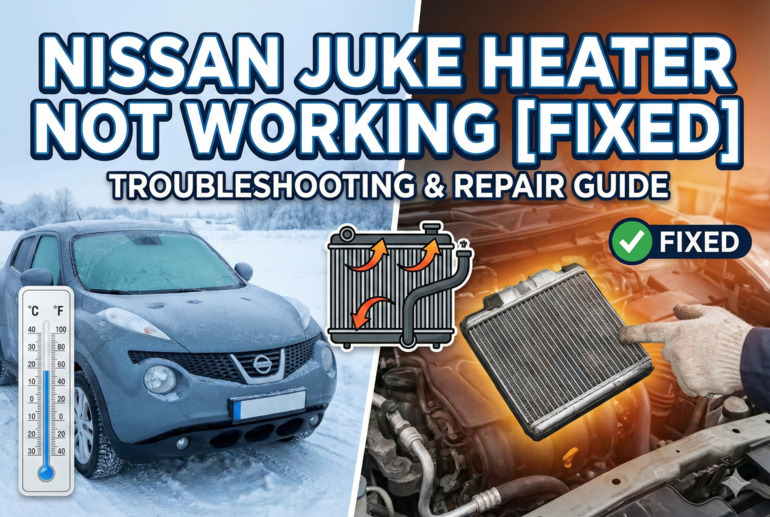
Think of your heater core like a miniature radiator tucked behind your dashboard. Hot coolant flows through this core, and the blower fan pushes air across it, warming up before entering your cabin. If any part of this process fails, you’ll notice it immediately. Sometimes you’ll get no air at all. Other times, the air flows fine but stays ice cold.
The scary part? A failing heater can signal bigger engine problems. Low coolant levels, for instance, might mean you have a leak somewhere. An overheating engine combined with no heat is a red flag that demands immediate attention. Your temperature gauge might climb while you freeze, which sounds contradictory but makes perfect sense when you understand the mechanics.
Ignoring heater problems can lead to more expensive repairs down the line. That small coolant leak can damage your engine if left unchecked. A clogged heater core might force your entire cooling system to work harder, potentially causing your engine to run hotter than it should. Plus, driving with foggy windows isn’t just uncomfortable, it’s dangerous for you and everyone else on the road.
Nissan Juke Heater Not Working: Common Causes
Your heater didn’t just decide to quit on you randomly. Something specific went wrong, and pinpointing the culprit is half the battle. Let me walk you through the usual suspects I’ve encountered over years of working on these vehicles.
1. Low or Contaminated Coolant
Your coolant does double duty: it keeps your engine from overheating and provides the heat for your cabin. When coolant levels drop too low, there’s simply not enough hot liquid reaching the heater core. You might still get some airflow, but it’ll be lukewarm at best.
Coolant doesn’t just disappear into thin air. If your levels are dropping, you’ve got a leak somewhere. Check under your car for puddles, especially sweet-smelling green, orange, or pink liquid. Even a small leak can cause big problems over time.
Contaminated coolant creates a different issue. Old coolant breaks down and develops gunk that can partially block passages in your heater core. This restricts flow and reduces heating efficiency. I’ve seen coolant that looked more like rusty water than the bright fluid it should be, and that’s a clear sign of trouble.
2. Faulty Thermostat
The thermostat in your Juke controls coolant flow based on engine temperature. When it gets stuck open, coolant flows constantly through the system, preventing your engine from reaching proper operating temperature. Your heater needs that hot coolant to work effectively.
A stuck-closed thermostat creates the opposite problem. Your engine overheats while no coolant reaches the heater core. You’ll notice your temperature gauge climbing into the red zone, which requires immediate attention to avoid engine damage.
3. Clogged Heater Core
Your heater core contains tiny passages that allow coolant to flow through. Over time, these passages can clog with sediment, rust, and mineral deposits. This blockage restricts hot coolant flow, drastically reducing heat output even when everything else works perfectly.
A clogged heater core often comes with other symptoms. You might notice a sweet smell inside your cabin, or your windows might fog up more than usual. Sometimes you’ll see actual moisture on the passenger-side floor, which happens when the core starts leaking.
The tricky part about heater core problems is their location. Tucked deep behind your dashboard, they’re labor-intensive to replace. That’s why catching clogs early through regular coolant maintenance matters so much.
4. Blower Motor Problems
Your blower motor does exactly what its name suggests: it blows air across the heater core and into your cabin. When this motor fails, you might have plenty of heat available but no way to move it into your vehicle. You’ll hear nothing when you turn on the fan.
Sometimes the motor itself still works, but the resistor controlling fan speeds burns out. This gives you strange symptoms like only one fan speed working (usually high), or no low speeds available. The motor runs, but you can’t control it properly.
5. Blend Door Actuator Failure
The blend door controls how much hot air mixes with cold air before entering your cabin. An actuator moves this door based on your temperature setting. When the actuator fails, the door might get stuck in the cold position, sending only unheated air into your cabin regardless of your settings.
This failure often announces itself with clicking or tapping noises from behind your dashboard. You’ll hear the actuator trying to move the door but failing. Some Juke owners report that their temperature controls seem to work backwards, with the coldest setting producing the warmest air.
Blend door problems can be intermittent at first. Your heat might work fine one day and fail the next, which makes diagnosis frustrating. But the clicking noise is usually a dead giveaway that points you straight to the actuator.
Nissan Juke Heater Not Working: DIY Fixes
Getting your heat back doesn’t always require a mechanic’s expertise or a hefty repair bill. Many heater issues have straightforward solutions you can handle in your driveway. Let’s go through the fixes from simplest to most involved.
1. Check and Top Up Your Coolant
Start with the easiest check first. Pop your hood and locate the coolant reservoir, a translucent plastic tank usually near the front of the engine bay. Check the level when the engine is completely cold. The coolant should be between the minimum and maximum marks on the side of the tank.
If it’s low, top it up with the correct coolant mixture for your Juke. Your owner’s manual specifies the right type, but most Nissans use a long-life green coolant. Mix it 50/50 with distilled water unless you’re buying pre-mixed coolant. Never open the radiator cap when the engine is hot, as pressurized coolant can cause serious burns.
After topping up, run your engine and turn the heat to maximum. Let it warm up to normal operating temperature and see if heat returns. If your coolant level drops again within a few days, you’ve confirmed a leak that needs further investigation.
2. Bleed Air from the Cooling System
Air pockets in your cooling system can prevent proper coolant circulation through the heater core. This often happens after coolant changes or repairs. Bleeding the system removes these air bubbles and restores flow.
Here’s how to do it:
- Park on level ground with the engine cold
- Remove the radiator cap and coolant reservoir cap
- Start the engine and turn the heat to maximum
- Let the engine run until the cooling fan cycles on
- Squeeze the upper radiator hose a few times to help air escape
- Add coolant as needed to maintain proper levels
- Replace the caps once no more bubbles appear
The process takes about 20 minutes, and you’ll know it worked when steady heat starts flowing from your vents. Keep an eye on your temperature gauge throughout this process to prevent overheating.
3. Replace the Thermostat
Swapping a faulty thermostat is more involved but still manageable for DIY mechanics. You’ll need a new thermostat (get an OEM Nissan part for reliability), fresh coolant, a drain pan, and basic hand tools. The thermostat housing sits at the engine end of the upper radiator hose.
First, drain your coolant by opening the radiator drain plug into your pan. Remove the bolts holding the thermostat housing, pull it away, and you’ll see the old thermostat. Note which way it sits before removing it. Clean the mating surfaces thoroughly, install the new thermostat with a fresh gasket, and bolt everything back together.
Refill the system with fresh coolant, bleed out any air as described above, and test your heat. A new thermostat typically costs between $20 and $40, while a shop might charge $150 to $250 for this repair. The job takes about an hour once you know what you’re doing.
4. Test and Replace the Blower Motor Resistor
When only your highest fan speed works, the blower motor resistor has likely failed. This component sits near the blower motor, usually accessible from under the passenger side of the dashboard. You might need to remove the glove box to reach it.
The resistor typically has two or three screws holding it in place and an electrical connector. Disconnect the battery first for safety. Remove the old resistor, compare it to your new part to confirm it matches, and install the replacement. Reconnect everything, and all your fan speeds should work again.
This repair costs about $30 to $60 for the part and saves you $100 to $200 in labor if you handle it yourself. The entire process takes maybe 30 minutes, even if you’re working slowly and carefully.
5. Flush the Heater Core
A clogged heater core sometimes responds well to flushing. You’ll need a garden hose, two hose clamps, and about an hour of your time. Locate the heater core hoses under the hood (they run from the engine to the firewall). Disconnect both hoses, being ready for coolant to spill out.
Connect your garden hose to one heater core inlet and let water flow through in reverse of normal coolant flow. This backward flush helps dislodge sediment. Run water through both directions for several minutes. The water should flow freely once the core is clean.
Reconnect the hoses, refill the cooling system with fresh coolant, and bleed out air. This often restores heat when sediment was blocking flow. If water barely trickles through during flushing, your core might be too far gone and need replacement.
6. Address the Blend Door Actuator
That clicking noise behind your dash points to a failing blend door actuator. These actuators are electric motors that move the temperature blend doors. Replacing one requires removing part of your dashboard, making this repair more challenging than the others.
You’ll need to locate which actuator is causing problems. Your Juke has multiple actuators controlling different doors. The temperature blend door actuator sits behind the center console area. Once you’ve removed enough dashboard components to access it, you’ll find a few screws holding it in place and an electrical connector.
Remove the old actuator, install the new one, and reassemble everything. Test your heat at various temperature settings to confirm proper operation. This repair can take two to three hours for your first attempt, and the part costs between $50 and $150 depending on whether you choose OEM or aftermarket.
7. When to Call a Professional
Sometimes heater problems go beyond DIY capabilities. If you’ve tried these fixes and still have no heat, or if you’ve discovered a severely damaged heater core that needs replacement, it’s time to contact a qualified mechanic. Heater core replacement requires removing most of your dashboard, a job that demands experience and patience.
A professional has the diagnostic tools to pinpoint electrical issues, scan for trouble codes, and test components you can’t easily access. They’ll also properly dispose of old coolant and ensure your repairs meet safety standards. Don’t hesitate to seek help when a repair exceeds your comfort level or available tools.
Wrapping Up
Your Nissan Juke’s heater might seem complicated, but most failures trace back to a handful of common issues. Starting with simple checks like coolant levels and working up to component replacements gives you the best chance of fixing the problem yourself. Each successful repair builds your confidence and saves money you’d otherwise spend at a shop.
The key is addressing heater problems as soon as they appear. That first day of weak heat is your warning to investigate before the issue worsens. Regular coolant maintenance, prompt leak repairs, and attention to unusual sounds keep your heating system running reliably for years. Stay warm out there, and don’t let a broken heater ruin your winter driving.